Who needs the death of Jesus? We have Facebook

social-media-jesus

The widespread use of twitter, tumblr, Facebook, etc, and the past success of the movie “Social Media” and the accolades it received across various Hollywood awards shows should have gained the attention of the church and thoughtful followers of Jesus. Yet, this is not the case. Normally, us self-professed Christian folk can dismiss the latest entertainment and internet phenomenon as a fad, but not this time. Indeed, this time, we are co-opting it for our “biblical” purposes and our sense of “evangelism”…too bad we are not thinking critically about co-opting these mediums and the theological statements being made in doing so. Moving right along, if the success of social media in the movies hasn’t gotten our attention, the explosion of social media as a way of relating and communicating most certainly should, yet when was the last sermon you heard on the relationship between the Gospel and Social media or the Gospel Facebook style? In a connected world, it seems that thoughtful Christian thinking is disconnected from the purposes and the impact social media is making on millions of people around the globe. What is occurring before our eyes is a new way of creating community and belonging. Hollywood and internet media has successfully tapped into the desire that people have to be a part of something greater than themselves…and if atonement is about anything, it is about connecting people something greater than themselves.

The church, however, is not failing to take advantage of social media or even having a Facebook or Twitter presence. In fact, more and more churches are connected to the abyss of social media. Yet, the reality is that few churches are asking the hard theological questions that Facebook and social media creates. For millions of people that use Facebook, and other social media, these mediums are their community. These mediums are the ways in which a generation of people are learning the skills of communication, and ironically losing their ability to communicate in truly human ways at the same time. The connections people are finding are taking the place of the real communal connections. In our attempt to be a part of an online community we are sacrificing real community; we seeking at-one-ment, yet the very means by which we are seeking is creating the very opposite desire that drives us to embrace artificial connectivity.

So are Christians really thinking about what makes Facebook work? What is it about Facebook that keeps users returning daily, coming back for more, again and again, only to find the same website exactly where they left it? In other words, what essential human need does Facebook fill that makes it “work” for thousands of people across cultural and international boundaries? What need is the church neglecting? What does a social media community have, promise and do that draws people unto itself? Might I suggest that Facebook works not because of what it is, but what it does. Let me repeat, Facebook works not because of what it is, BUT WHAT IT DOES. If any of my past posts on atonement have said anything thus far, I trust that the function of the idea of atonement, and our subsequent theology thereof, is pivotal to its importance, development and continual hermeneutical applications in the present context of human need.

What Facebook does is connect people. Facebook works for so many people because it taps into the primordial need all humans have to be in community with others. It fills a vacuum of emptiness and loneliness, making people feel part of something larger than their daily mundane existence. Facebook, and other forms of social media, has the power to orient lives and wrap them into a larger narrative with an agreed upon location, agreed upon communicational norms and agreed upon taboos that can get one kicked off a friends “friend list.”

For thousands of years human community has been created around sacred objects and the creation of boundaries to identify participation in a particular community. These agreed upon and understood objects and boundaries gave the participants a sense of belonging and a connection, in many cases, to a God from which the community had been gifted. In the past, meaning was often found as people learn to commune around the center known as God, the ultimate object of our attention, our “ultimate concern.” God was the supreme sacred object around which community was created…whether a specific commitment to the Christian idea of God was sustained is immaterial to this observation.

In our contemporary situation, we no longer need to connect to one another through sacred norms in the name of God or scripture. God and text, due to a multitude of factors, have been usurped as the most reliable means that teaches folks how to relate to themselves and that which transcends themselves. Blame it on liberalism, the scientific revolution, the failure of Christians to actually act like Jesus, or whatever, our generation no longer perceives at-one-ment as something solely experienced within a religious context…we now have social media to connect to others in mysterious ways, this satisfying our human need for belonging and hope amidst a community of others.

Now, its Facebook that makes these rules of community and takes the initiative of establishing how we connect with others, the world and ultimately fills a sense of void that generally only happened within the context of religious communities. When we need to connect, need to talk, or need to cry, we do so on cyberspace with our Facebook “friends,” all the while keeping real physical community at the distance of the keyboard. We no longer sink into contemplation, prayer or questions about the nature of what it means to be human. These questions are obsolete because of we have new communities that give us a sense of purpose (even if purpose is now defined as staying connected ALL THE TIME to everything that doesn’t matter…it’s the connection and perception of belonging through that information that now makes us –at-one with our disperate selves.) We are so serious about our Facebook connections that those on our “Friends List” that may not connect with us as often as we like could be excommunicated from our circle of friends.

If millions of people are now looking for community via Facebook, what is driving this phenomenon? Why do so many people find real connection here and not in real authentic community, such as the Church (please suspend all criticisms that the church is often not the church…just work with me that the church IS the beachhead of the Kingdom of God)? Why do so many people neglect family, and the coherence of Church family, for the facsimile relationship of Facebook? Could it be that the church and our families have ostracized many individuals through judgment or prejudice? Have we kept people away by our rules, laws and doctrines, building a hedge around our sacred communities rather than opening doors for those looking to belong somewhere? What happens when the primary means of connection is no longer God in Christ, but a Facebook icon on our smartphones?

Ultimately, is the success of Facebook partially due to the inability of the church, and many Christians, to be an open community who embraces the outcast rather than subdue them through doctrinal obligation, dry moral commitments or even extreme religious laws?

Just as Jesus accepted the marginal, the poor and the wayward of society, so too is there a place for these people at the table of Facebook. Facebook is the new community wherein anyone can belong, be loved and find friends. Mark Zuckerberg has offered a new narrative wherein our faces and books can be read by others. In the at-one-ment of Facebook, there is no judgment, there is no demonization and there is no prejudice. All are welcome to participate and be at-one…atoned of their separation and lostness through social media. Can we eerily hear Facebook echo John 8.10 to the outcasts, “where are your accusers?”

The connection that Facebook provides, however, is artificial. We do not interact with people on Facebook, we interact with images, pictures and statements. We learn how to relate to symbolic stimulus as a means of identifying with others, rather than learning the simple need we have to speak and hear one another. The result is a world that is “plugged in” and addicted to a form of hyper-connectivity, yet very disconnected.

How might Christianity speak to this reality? What central Christian event is the connecting event of history and the event that acts as the glue of Christians everywhere around the world? In what way does religion, specifically Christianity, connect us to one another? An answer may be found in the story of the Gospel and a renewed understanding of the atonement of Jesus and it offers a far deeper connection than facebook can imagine or re-narrate. Fortunately, the problem of connecting people is exactly what the Gospel of Jesus has always been about. The Gospel is about connecting others to Christ, to God, to one another and to the world.

A primary means of connection in Christianity is through the atonement action of the Christ. The atonement is generally wrapped into the gory details of the death of Jesus and how his death bestowed forgiveness into creation.

There is, however, another often neglected aspect.

While the atonement may be the vehicle of how God redeems humanity, it is primarily, at its basest function, a means of connecting people to God, each other, themselves and the world. The atonement, or at-one-ment of Jesus, does not happen in a vacuum. Disciples are gathered around the cross, the world beholds it, and community is created after this event. In other words, the atonement of Jesus is as much a vehicle of connection and the genesis of community as it is an event wherein we debate the love theory of Abelard or the substitutionary theory of Anselm.

Jesus Tweets Gospel of John Style

The Gospel of John beautifully demonstrates, through the words of Jesus, the events of the atonement through the “lifted up” sayings that occur in 3.14-16, 8:28 and 12.32. In 12.32 Jesus says, “And if I be lifted up from the earth, will draw all people unto myself.” As the Christ is lifted up before us, he draws all people to himself and connects that which was never together. He creates a community out of chaos and a sense of belonging out of despair. In the act of at-one-ment, Jesus makes us one, connecting us with himself, his God, one another, ourselves and the world. The result is a connected community we call the Church.

The second function of the atonement is forgiveness, but even this acts as a connecting, community making reality.

The first “lifted up” saying in John 3.14-16 indicates that forgiveness is primarily accomplished in the lifting up of Christ in the passion narrative. Jesus says, “even so the Son of Man must be lifted up, that whoever believes may in him have eternal life.” The atonement of Jesus is the act wherein we are made at-one with one another and God, but this is chiefly accomplished because we share the identity of forgiven people. Our forgiveness and acceptance by God in Christ connects us. Forgiveness is important due to the sense of belonging it fosters in the forgiven, creating a new family and new relationships.

Forgiveness creates identity in the community of Jesus. We share the bond of having encountered God incarnate in Jesus, demonstrating to us what forgiveness looks like and how to extend love and grace to others. The incarnation of God in Christ, and the atoning work of this Christ for humanity, is a physical means of connection that could not have been accomplished by an aloof God. Real connection happens when God is incarnated in Jesus for us and we are then the incarnate atoning Christ to one another and the world.

There is no grander connection than the one created wherein a true friend has laid down his life. After this event, we gather together as a group not sure of what happened, only to find the Christ come into our presence and breathe upon us the spirit that binds us. We are a community that was created by the Christ and, subsequently, are called to bring this community into the brokenness from which we came.

For generations, people have shared real life and found real meaning because this one was lifted up for us, creating a community that can never be torn asunder. Surely, the community wherein the Holy Spirit resides should be a community committed to sharing what real connection looks and feels like in the presence of a social media that narrates a very different form of community and connection. The Gospel event of atonement is the place wherein we can really see one another’s faces and wrap ourselves into a book full of stories that teaches us how to live in community and create a better creation as God takes it to the place that is Christ shaped…a place that begins as we stare one another in the eyes, kneeling at no other place, than the foot of the cross.

The Perverse Core of Atonement: Sacrifice or Relationship?

Redeemed Jesus Passover Lamb

For me, all doctrines and dogma are “fair game” and worth critical examinination.  A faith that is not able to withstand questions is an antique to be admired, not a faith that dares to walk and encounter the world with us.  The atonement, by virtue of its function in faith and theology, cannot be an antique!  It must be an idea that we carry with us…even when we are not sure what we are carrying or how it “works.”  So I wish to continue thinking atonement under a different rubric than my last post: the rubrics of sacrifice or relationship.

The old line on atonement theory/theology is that Jesus had to die to “atone” for our sins…and because of this act God is now able to be in relationship with the world, his anger being subdued by Jesus’ blood.   If you’ll revisit my previous post, I outline this in greater detail.

Most Christians would gladly agree with this simple statement of faith and the Catholic Church re-acts this very idea each time it performs mass and sanctifies the host.  But can relationship and sacrifice both be equal ends leading to the same goal of salvation or do they occupy different ends and different goals?  Is God primarily interested in being appeased or being in relationship?  Can both sacrifice and relationship be the goal of God killing Jesus  (this last phrase will make more sense a bit further down)  or does a blind embrace of a satisfaction theory of the atonement (and also its penal substitution relative) possibly contradict the at-one-ment that Christians testify in the very act of affirming Christ and him crucified?  Can God be both firstly loving yet also firstly burning in anger and does the vision of God cast by the life of Jesus lead us to believe that Jesus would have believed human sacrifice to be God’s answer for saving the world?

If we contend that God had to kill Jesus in order to save the world, then we are saying that relationship with the world is an accident of the substance of Jesus’ death.  In other words, Relationship was not God’s primary goal; It is the byproduct of this horrible event of propitiation. First and foremost, God’s honor had to saved and the only way to do this was to make someone else pay the price.  We are brought into relationship with God not because God first desires relationality with the world, but because God was first so offended that he had to kill Jesus to pacify his blood lust…and only consequently, as a result of this action, we are then brought into relationship with God…back into that edenic state into which we were first created.  So of primary importance is not that God desires to be in relationship with the world.  The primary object of importance is that God cannot be offended, and that such offense can only be pacified by blood.  If this is not the case, then please explain to me why animal sacrifice (and even human) was so central, not only in Judeo-Christian traditions, but in a myriad of other faiths.

Timothy Gorringe in his book, God’s Just Vengeance: Crime, violence and the rhetoric of salvation, talks about how blood propitiation emerged in Israel, and then by extension, would also be a useful paradigm through which the early Christians interpreted the violence done to Jesus.  He writes,

Propitiatory sacrifices sought to turn away God’s anger.  In seeking to understand the bulk of the texts which deal with this form of sacrifice we need to bear in mind that the emphasis on the rites of atonement characteristic of the Pentateuch derives from the period after Exile, which was the most traumatic event in Israel’s history.  God had made a covenant with the House of David, and was understood to have made an eternal commitment to Zion.  Now Jersualem was destroyed and the Davidic Kingship at an end.  What had gone wrong?  The answer was that Israel had sinned and was being punished for its sin.  In order to avoid another such catastrophe sin had to be avoided, but if it could not be avoided…, then the Priestly writers believed, sacrifice was available as a means of atonement” (p37)

(This is a dense paragraph and requires more attention than I can give it for this topic.  Paramount to my thoughts here is the origin of sacrifice and the “why” and “how” of its development.  I would strongly encourage you to peruse this book if you don’t have time to read its entirety)

This is the goal of killing Jesus.  The world has obviously not avoided sin, so Jesus, who is interpreted as God God’s self in later Christian councils and in the Gospel of John, kills God’s self.  This is important because the reason we don’t think about Jesus as a sacrifice of human proportions is because to many of us Jesus is not a human, he was God.  And it’s no big deal to us humans when God kills God’s self; its just what we’ve come to expect God to do.  It’s as if we give God a pass on human sacrifice because we have lost to history the reality that Jesus was a human.  YET, there is no evidence that Jesus was God, this is a category of faith, something that we believe in without any historical veracity… yet there is ample evidence that Jesus existed and he did so as a human being in ancient Palestine, yet the fact that he was human is lost in this debate because to bring up the humanity of Jesus is to raise some heinous questions of God, questions we’d rather not go near.

Jesus has been interpreted as HAVING to die to be a propitiation for the wrong humanity has collectively done against God via the first sin of Adam and Eve.  The relationship that creation has with God, as a consequence, is unambiguously perverse.  For surely if God were all loving to the degree that he desires relationship above violence, one would think that a God who is inscribed with all the “omni’s” (omnipotent, omnipresent, omniscient) could somehow in his mightiness be able to forgive by tapping into one of his omni-powers and bypass condoning  human sacrifice.  If God desired relationship with the world, one would think God could accomplish this however God would like, yet if the primary point is not right relationship, but restoring God’s honor, then Divine narcissism precedes Divine love…and the primary point is not a relationship, but punishment and incarnate hubris prior to any relationship.  But what if this is exactly what God was condemning on the cross??  What if they very thing we think the cross affirms is the very thing God is condemning in this event??  What if the cross means the exact opposite of what it is popularized to mean and THIS was the Gospel intention?? (I will write an entire blog making this argument in the future).

Oddly, this whole mechanical way of viewing salvation seems in stark contradiction to some of the very parables spoken by the very Jesus this very God verily needed to kill: the Beatitudes (see esp Matthew 5. 38-48, wherein Jesus teaches an inverted from of the Mosaic Lex taliones…yet God cannot follow the very teachings of God’ self when it comes to sin??  I’m just asking), the parables of vineyard workers (Matthew 20.1-16), and the prodigal son (Luke 15.11-32) to name a few.

This is precisely Slavoj Zizek’s critiques Christian belief and describes it as having a “perverse core”.  In his book, The Puppet and the Dwarf, Zizek describes the current façade of Christianity to be one of a perverse God that circumvents around a perverse core.  The perverse core is this: God’s plan of salvation is pointless because God has no one with which to contend but Gods-self.  In other words, all the mechanizations of Christian salvation that begin with Adam and Eve (following the usual Christian profession of God’s powers…God presumably “knew” what would happen with the garden debacle) are strange because God has no one to impress but God’s Self.  Why would God “have” to do this, or “have” to do that as a part of creation or salvation of a creation he created but then somehow lost?  What is it that forces God to “set up” the world in the fashion that God did in order to get himself to forgive the world that he knew would falter?  Why even start this game of cat and mouse in which millions of people will make the wrong “choice” or be born into the wrong culture…and thereby be damned?

Some might say that God would do this to be in relationship to some of us, yet, is it really worth creating because of a hedonistic need to have objects to worship yourself when you are quite capable of existing apart from the worship of those said objects, aka, creation?  And if it is about having “some”people respond in freedom, if one had never created for the sake of not having millions/billions of people damn themselves by not rightfully worshipping yourself, then those who do respond would have never had a conscious mind to know what they were missing out on precisely because they would have never had bodies within which their minds could function.  As a consequence, no harm would be done…And as Jacobus Arminius rightly notes, if God creates with the intention of damning creation, then the very act of creation is a great evil perpetrated by God…and since God is good, God cannot do such evil acts.

For Zizek, If God is God (as countless Christians profess, “God is God and I’m not”), then God can forgive without a blood sacrifice, a human sacrifice, because God is the maker of the rules, not one who must submit to the rules created elsewhere.   God can set the parameters… so why parameters of such infinite violence and suffering?   So what is the “end game” of atonement?  Relationship or blood sacrifice?

I can hear a quick rebuttal, “but God had to perform discipline on humanity for our offenses.  It would not be justice if God let ALL of creation off the hook.”  Ok, but why?  Because the Bible says so?  Could it be that our own inherent need for justice, and the relationship of justice and violence, shades the biblical text to such a degree that we have clouded the text with what justice means in anthropomorphic terms rather than in strictly transcendent terms, so that God looks an awful lot like our desires rather than desires that are totally other than ours?  * Ludwig Fuerbach has now left the building.*  What does God gain by having justice performed on a much inferior, lesser grouping of beings known as human?  How is it justice when the plaintiff is infinitely more resourceful than the defendant and indeed the outcome of the trial is immaterial to the plaintiff?  And this is Just??  Never mind conspiracy against creation that would surely arise if God has all the “omni’s” yet remains inculpable.  Does God possess justice ontologically or does God need justice performed for him, by himself, upon himself, in order to have a part of himself he would not otherwise have if not for the performance of the much needed justice?  So now we’re saying the perfect God lacks??

Let’s go further, maybe this is our response, “God had to punish Jesus because to just forgive creation out of mercy apart from violence would show God to be weak and not just.”  To whom would God look weak?  Who does God have to impress?  The Devil?  If embarrassment is a category of being, a necessary category that sits along side of dishonor and honor (key concepts in classical atonement theology), then amongst whom is God worried of being embarrassed by not having his honor restored through the punishment of a victim that symbolizes the offense that dishonored him?  If God’s primary goal is salvation (healing) and relationship with creation, why would God choose to do so through an endless amount of violence when God can have just as easily chosen to simply forgive the offense without the need for a sacrifice…you know, the same kind of forgiveness that Jesus teaches in the NT?

What I really want us to consider, at a much deeper level than normal, is what our theology of atonement says about our doctrine of God.  If we continue to reinforce a substitutionary or satisfaction type theory of atonement, what type of doctrine of God does this reinforce and why are we comfortable with conceiving of God so?  Is our doctrine of God, that flows through and from our theology of the atonement, consistent with the Word we see in Christ or do we see something different here…and, like my previous post argued, should we begin to re-articulate a theology of the atonement that seeks to bring people into relationship with God via their theological worldviews rather than cast a vision of the God of Jesus that makes this God a highly suspicious character with a severe personality disorder?

I am sure there are ample hesitations and rebuttals to my thoughts here.  This essay is not meant to be a thesis defending my argument at every turn from possible detractors…yet these are initial remarks as I continue to think the atonement during this Lenten season.  I am sure that someone out there is wanting to chime in and tell me about “free will” (to name just one objection).  I have anticipated some of these remarks and will post a response in my next blog.  But I also encourage you, the reader, to respond to where you think I may have gone astray or where you think I may have been frustratingly correct in offering some food for thought on atonement.  I will respond and might even write a post specific to your reaction or request…but if I have succeeded in at least making us think about God’s intention: relationship or sacrifice…I would have been pleased.  At the end, however, I have no greater desire than to think about God and Christ and to do so honestly as a fellow quester of truth…wherever it may be found.

Other-Wise Atonement: Thinking about the Human Sacrifice of Jesus

What-is-the-Atonement lamb pic

 In the past week I have had three conversations with fellow Brothers in Christ in regard to our ideas of atonement and its relationship to ministry and life.  Chief among these concerns has been the reality that more and more folks, especially folks under 30 (I am 31 FTR) are abandoning organized religion and churches.  It is my belief that such is not happening because the present generation is irreligious or lack faith.  To the contrary, they are very motivated by faith and mystery, it’s just that they seem to be embracing newer philosophies of faith found elsewhere because the way Christianity has been taught, preached, etc, has seemed to them quite bankrupt.  If I reflect on my own teenage years and youth group experience, many of the folks in my youth group are not interested in the faith and if they are, they are not very active.  Most have left the fold of the church.  Why?  Well, I think a large factor is because the church is not speaking to them anymore, and what it has said in the past has been shallow, totalitarian and just an extended version of Aristotle’s Ethics.  Their impression of the faith is kiddie pool theology, where everyone stays in the 3 Ft section because Christianity occupies no other section…and in this 3 ft section we swim continually, never venturing beyond the buoys that separate us from the scary “deep end.”  This, coupled with our horrible ways of reading the Bible as a flat story that simply contains maxims for life and ethical advice…wedded with our biblical literalism at every turn of scripture, has given the impression that our faith is shallow, overly experiential, and has little to offer after we say a prayer of forgiveness.  This is tragic and it saddens me.

As per my recent conversations, I have decided to post a practice in theology of thinking out loud (with you the reader as my company) on the subject of atonement.  I have recently argued amongst friends that the atonement should speak to the existential lack that is inherent in our context…that the atonement is still powerful but not in a uni-dimensional kind of way.  For us to speak to the generations of Christians that have left the church, and to those who will never come to our churches because of their impression of Christianity, we need to do as the church has historically practiced and ask how the atonement functions, what it does, and why that matters for people who don’t feel the weight of Luther’s guilt nor do they really desire God to wring the blood from Jesus beaten body over their head so they can be camouflaged when God peers their way.

So, I want to mention the most popular theories of atonement, or theories of how we understand what Jesus did by dying on Calvary, and how we might shift gears a bit to think the atonement differently.  This essay is not meant to be extensive, and much finer minds have done a better job of descandalizing the cross as some of you might interpret this blog to be doing, but it is my attempt to do theology in an honest way and wrestle with the Cartesian mind that we all possess, if we would only be so honest and not hide behind the fear of where our inquiry might take us.  To my brothers that have occassioned these words, I give thanks for your friendship and treasure your dialogue…and I pray others might find these musings more than useful.

 Let’s get started.  First, the substitutionary theory of the atonement has not been the king of the Christian block since the time of Christ.  There are several theories of atonement, or ideas about the “why” of the passion, that have had prominence in our faith: Ransom, Moral/Love, Satisfaction, and Penal.  Scripture testifies to ALL of these…and ALL of them are problematic, even scripturally, but most traditions accentuate one of these or combine them…but in the theology and faith of the church they were separate and did not emerge at once.

Ransom: Introduced by Origen 3rd century.  This is the idea that Satan, the prince of the world (so Origen was a dualist, sue him and sue most Christians alive today who are equally dualistic), had to have a payment from God for control of creation.  God decided to Kill Jesus as a ransom payment to Satan.  BUT, the trick was resurrection.  God let Satan receive payment and then took his payment back on Easter.  God tricked the devil.  This idea coalesces nicely with Christians who hold that creation is in a Struggle between God and Satan and that Satan is indeed the controller of earth…yet through this act God has no usurped Satan and defeated him again.  So I’m not sure what Pentecostals are still getting excited about with this spiritual warfare stuff; the battle is over, so to speak.  God paid the ransom in this theory because we did not have the “money” to make the transaction…and the rest is history.

Moral/Love: Abelard introduced this 12th century.  Abelard contended that Jesus died to show how much he loved the world and died as a perfect sacrifice expressing what it means to fully love creation…offering a model for how we should love one another even to our own deaths if need be.  The implication is also that as a supreme act of love God let Jesus suffer and die as an example of God’s ability to let evil happen to us so that we might be able to live into the resurrected reality of Jesus and be better people, hence the “moral” part.  He argued that Christ’s Life and death were examples of God’s supreme love to us so that all humans will be able to respond in return by loving God and finding salvation through the intercession of Christ.  Violence is allowed in the world because we are refined by fire and made holy in its furnaces, turning our hearts to God because of his example and being made holy as we live through the violence we all encounter.  There is more to this idea in Abelard’s work, but he wrote this AFTER the next theory by Anselm.

Satisfaction: This is the idea that Jesus was killed to satisfy the honor of God.  It really emerged from the way society was structured during the period of feudal Lords, etc, and was patterned after such societal norms of dishonor, honor and glorification.  God’s honor had been violated in the fall of Adam and Eve (ent), and as such, his honor had to be restored.  However, nothing is great enough to restore God’s honor but the sacrifice God’s self…ENTER Jesus the God-Man;  So God’s wrath was satisfied through the human sacrifice of Jesus.  This is also consistent with the practice of Jewish Temple in killing animals to satisfy God’s anger.

Penal Substitutionary:  This emerged most thoroughly in the Reformation and was crystallized by Calvin.  It is the idea that humans are utterly depraved and cannot be saved except that God would take a substitution for our sin; the old addage is “Jesus took my place” and many of us sing songs to this effect each Sunday in worship.  We are deserving of death; the only way we can experience life is for Jesus to die for us and then IMPUTE his righteousness upon us…so that after the death of Jesus when God looks at the world….he no longer sees our horrid sinfulness, but he sees the blood of Jesus covering our transgressions.

 These are the major theories, but there are others.  I encourage you to read the theologians mentioned above for the finer workings of their atonement theology.

The testimony to multiple understandings of atonement mean thinking the death of Jesus is not nearly as clean and neat as most Christians think…but the other thing that makes atonement a sticky issue is that we are heavily influenced by the Western Church.  Origen was part of the Alexandrian school, so too was Augustine (where one finds substitutionary ideas fit right at home)…Anselm was West also, so too was Thomas Aquinas (transubstantiation)…Abelard was Western but he was bucking the system during his time.  He was often criticized by other theologians, but he attracted many students and was a “go to” theologian for philosophers during the Enlightenment period.  However, in the East, substitution and penal theory did not reign the day…many of the Fathers from the Antiochene school placed a much heavier emphasis on incarnation and theosis because of resurrection, not because of a hyper penal idea of atonement.  So as for Christianity, the witness is actually split and there are theological, and biblical, problems with espousing any one idea/theory.  This is why I am inclined to be more existential in regard to the atonement and be open to multiple meanings that speak to our world, not dictate one method over another.

But the Gospels did just this; they interpreted the atonement within paradigms that made sense, and then translated that to their contexts from out of the story of Jesus they told.  The Gospels are telling the story of Christ and making sense of the crucifixion of Jesus…narratively attempting to make an appeal to how one might understand atonement.

Allow me a brief Gospel of John Excurses.

NO Gospel works/refines an idea of atonement in great detail, yet John goes to greater lengths here than any Evangelist, but it makes sense for him to do so.   John argues that Jesus IS the sacrificial lamb.   The importation of a fairly developed atonement theology in the Gospel of John makes perfect historical sense considering the historical context of the Johannine community that had been expelled from Temple post-70AD and were trying to make sense of being a Jewish Christian without a Temple…what better Christological affirmation than that we don’t need a Temple, we have the lamb sacrificed at the same TIME ON PASSOVER as it would have been happening in the Temple in the 30’s whichever specific year you prefer…but the Synoptics have Christ crucified BEFORE Passover…not during…clearly John is making a theological point.  So John is constructing an atonement theology, but it is within his context not outside of it.

Origen, Anselm, Abelard, the Reformers, they are all wrestling with how to understand how the work of Christ brings humanity into relationship with God; how does it restore brokenness to a sense of wholeness through the broken and bloody body of Jesus…and they did so in language and metaphor that was a.) biblical …but also b.) could speak to their listeners.  They did not speak past their listeners, but they proclaimed why the death of Jesus matters and why it should matter to their hearers and in their context.  The Spirit led them to do so.  From an existential perspective, I call for doing nothing but the same: speaking Christ to the world in such a way that they hear, listen and have an “aha” moment about how the at-one-ment of Jesus brings them to at-one-ment in God.  This doesn’t mean that classical understandings are mute.  They are still important and still carry currency for many, but to preach the lifting up of Christ to a world that feels separated from itself and others…is not to proclaim that you need to take a shower in the blood of Jesus, but to preach that through the act of his death he has put an end to sin and violence…he has swallowed death into his body and thereby all those things that seek to wreck our lives and create disharmony.  Yet the death, and massacre of Jesus, would not be complete without a resurrection to say that such violence and sin does not win; it is swallowed up in the grave thereby meaning so too has the sin (think hamartia here…missing the mark), death and utter lack that seeks to wreak havoc in our lives been laid to rest the with grave cloths of the paranormal Jesus who comes to all us Thomas’ who still think death is still an issue.

What I am arguing, albeit with an existential bent ( I am heavy on Kierkegaard and Heidegger here), is that while we may want to say that the work of Jesus is primarily this, or mostly that, and then tell people “no, this is your problem and here is your answer”…the better approach is to discover what it is that keeps folks up at night, what concerns them, where do they sense lack in their lives.  If Christ matters than it matters to them and the world in which they live; we do not need to tell them they live in a false world and then attempt to renarrate their lives with a story and concepts that are utterly foreign, and therefore, would be devoid of meaning.  We do this not to relativise the gospel but to be aware that people will seek for truth according to the questions that plague their being. And my argument is that the atonement of Jesus contains the answer, but the theological world that drives a person may be different from one individual to the next, and necessarily so too will be their questions, and so too must be the appropriation of the Christ event into their lives.

William P. Jones, in his book, Theological Worlds: Understanding the Rhythms of Alternative Christian Belief, talks about it as we all have different OBSESSIOS (problem, lack, brokenness in us) and therefore we all have different EPIPHANIA (an awakening to our angst and its solution) that show us our problem, what we need, and how to become whole through various answers that is offered by the Christ in his work.  The theological worlds in which most folks live, according to the work of Dr. Jones, are the following…and my experience also seems to validate this:

Separation…Reunion

Conflict…Vindication

Emptiness…Fulfillment

Condemnation…Forgiveness (this model gets a disproportinate amount of attention in our Churches)

Suffering…Endurance

By extending our understanding of atonement past a purely penal or substitutionary model (and thereby by extending our willingness to see why Jesus STILL matters to the world), we are actually able to see how Christ connects people to God through his death…and we do so beyond the realm of pagan blood ritual, though biblically we may still find meaning here.  It may be, in fact, that many folks are connected through the theological world of condemnation and forgiveness…but more and more people, in our context, are typified in the other 4 worlds.  The solution is not to tell those folks they’re wrong, and therein tell them their concerns and questions about faith are wrong, but to say, “well, the work of Christ can heal that part of your life and here is how.”  By appealing to the existential angst in an individual we are doing the same things as the Gospels, and the church Fathers: we are speaking into the lives of people and proclaiming why exactly the news of Jesus is good.  It’s good because whatever their malady, whatever their internal struggle, the atonement of Jesus is more than satisfying a primordial God who got his feelings hurt; the atonement of Jesus restores creation through violence as God’s statement that creation is no longer to use violence and sin as a means of negotiating the world.

This reality is affirmed, not because we are part of the Western Church and affirm all the theological baggage therewith, but precisely because we believe in the Resurrection.  The Resurrection makes these things true and it is what makes the Christ event relevant to folks in the now.

To conclude, I mention a brief Pauline excurses.  It is telling that even Paul, the one who paved the Roman Road, placed much greater emphasis on Resurrection than Passion.  He did address Passion elements, but did not hinge his entire theology thereon.  His famous chapter in First Corinthians 15 is not a perpetual statement on Passion and a Mel Gibson esqe love affair with violence in his movie titled “The Passion.”  (FTR, I really like the movie).  It does not read “If Christ be not slaughtered than our faith is in vain…If God be not appeased than our faith is nothing…”  (forgive me for too much liberty if you feel I have taken it there) but Paul over and over again says, “If Christ be not raised…”  The Resurrection is the difference maker…not a particular view of the atonement;  The atonement is utter meaninglessness if not for the peculiarly paranormal event of a Jesus not staying dead.  The resurrection is what places us in right relationship with God because in order to overtake death and sin…God does not need a human sacrifice, God just needs to overcome death through the only means possible: the loss of life in a physical body and the raising of that very body to end death’s residence in human history, in time.  Thus, if there is any doctrine or dogmatic stance one needs to take to be firmly Christian, it is the paranormality of resurrection, not a refined idea of atonement that has a diverse witness in text, tradition, reason and experience…a concept that while appearing to stand on the “solid rock of faith” is actually a bit more like nailing Jello to the wall.

“I See Dead People”: Zombie Apocalypse or Resurrection of Jesus?

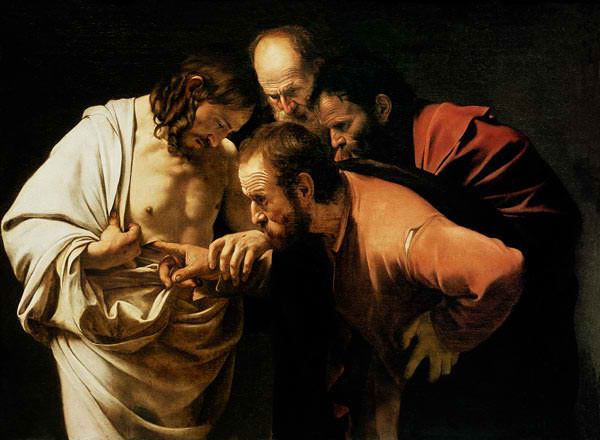
The Incredulity of St. Thomas by Caravaggio, 1601-1602

At the core of Christianity is a belief in the para-normal; there is nothing more para-normal than resurrection. Can we at least agree on this one point before you read the rest?

The recent craze over the “zombie apocalypse” has got nothing on dead people coming out of tombs.  Long before Woody Harrelson and “Zombieland,” is the Gospel of Matthew and its witness to the walking dead   These same dead people were not content to walk out of their tombs and look around, they actually walk into the city being passively revealed to mothers buying groceries, priests giving offerings and children playing in the streets without adult supervision. What a leery and smelly scene.   And believe it or not, if a person takes the resurrection seriously, as an event in time and, therefore an event in language, then the Entire New Testament is predicated on nothing more, and nothing less, than the paranormal. There you go, the Witch of Indor and a dead Samuel smack dab in middle of  your New Testament (figuratively speaking). You can thank me later.

The events that are witnessed to in Matthew 27 are not available to us. In this chapter, one is able to find the betrayal of Judas, Jesus before Pilate, his condemnation and mockery, the crucifixion, dead people walking (dead people who are not Jesus…Jesus rises in chapter 28) and his burial. We do not have the ability to ascertain its contents, its meaning, or its historical veracity.  Matthew, in true 2nd Temple resurrection theology fashion, tells of the holy ones rising from their graves and being revealed to many in the Holy City of Jerusalem. Matthew is the only Gospel that catalogues this very paranormal event.  If a person is looking to feed a peculiar paranormal fetish, quit watching TLC and read the Bible.

Yet Matthew gives us a unique picture of how disruptive the event of the death of Christ truly is…that in his very death surrounding graves in Jerusalem are opened and creation gives birth to a new space, a new time, a new set of rules, a new people who were once dead are very much not so dead. Resurrection is not a testimony of the norm; its a testimony that the para-norm has arrived and creation cannot be sewn back together along its perceived seems.

Resurrection is the very act of inscribing creation with the language of permanent aporia. It is a permanent strangeness that cannot be reduced to anything but anxiety and perplexity, a fond attraction of the strange that flavors our existence, both secular and sacred. Dialectical paradox has entered our ability to speak about the truth. What we thought was untrue has now happened, and what was untruth has become the truth. Creation has lost control of itself, its metaphysical rules and boundaries have been infringed upon through the very testimony of the impossible…making the impossible the new norm for a world of supposed possibilities that lie to us about their true boundaries and dictatorial control. To say that we believe in the resurrection of Jesus is to say that we believe in a new creation, where reality is re-construed, judgments are not so neatly Kantian, Hume is not so doggedly correct and scientific empiricism must bow at the feet of the irreproachably impossible possibility of “real” writing and existence. The Resurrection is not a belief in a historical “fact” as much as it is the Gospel statement that creation is not what it seems…there is an Other who is raised among us. For Christians, this other is Jesus…none other than the Word itself.

The Christ event, in its inception at the resurrection and in its concurrent reflection in the Gospels because of the kerygma of resurrection, is para-normal both in the sense that it is a reality alongside the normal…dependent upon the normal for a sort of analogy to make sense of its non-analogous testimony; and it is also paranormal in the sense that Jesus initiates some serious paranormal activity in his subsequent “appearances” in all the Gospels (except Mark where there are no post-resurrection appearances…but in John Jesus makes a Casper like appearance and even makes breakfast through the aporia that is his body) not the least of which is Matthew’s telling of dead people coming out of their graves. These stories are weird. We should not be used to them, but unfortunately they have lost their para-normal flavor because truly brilliant people are those who dismiss this paranormality with pretentious disdain rather than wrestle with what Resurrection is and how paranormal our lives really are.

What these events testify to is that resurrection is an event of ambiguous paranormality that sets the stage for a paranormal world in which our lives are predicated upon actions we did not chose, spoken to us by words we did not create and testified to us through stories we never told. This must be why modern people are so averse to reading these stories, since us liberal American and European types are so convinced of the ontology we possess through our mere choosing.

To believe in resurrection is not only to believe in the story of Jesus at a historical level, but it is to believe that embedded in a universal story of humanity is something that is beyond our grasping or comprehending, yet this something is equally normative of what makes us who we are, something that allows us to transcend our mere mortality. In other words, there’s more to us than what we see and there is certainly more to Christ than what one can know. The resurrection is the kergymatic utterance that we don’t control our words or our world…and the Ascension is the theological statement that such will forever be the case…the closer we get to understanding in the post-resurrection scenes of our lives, the further our attempts at harnessing creation float away.

If the Resurrection is able to make anything clear…it makes abundantly clear that our apprehension of reality and our relationship to what is “real” is vastly different than most folks imagine. The relationship between space and time, matter and the ethereal, sight and perception, experience and experience, are all blurred as the Gospel witnesses to a resurrection that not only must contain the physical body of the Christ, but in carrying the load of the Christ, it also carries our words about the Christ into uncharted territories. The Word that was made Flesh in John Chapter 1 has now been resurrected to a space that is not allowed to constrict our language or the description of the world that exists through our speaking. The Resurrection has to be more than a statement of raw “fact” about Jesus coming back to life. If that’s all it is, then that is pretty boring…thank you Apollonius and Honi the Circle drawer (google them). Instead, what the resurrection does is make a declarative statement about para-normal reality/activity and usher in an age in which anastasis is the sign of God’s present Kingdom, not a precursor to a stroll down the streets of gold. Anastasis happens IN creation, not outside of it.

Precariously enough, the resurrection is that singularly ambiguous and para-normal event upon which the New Testament rests, and subsequently, most Christian dogma produced thereafter has a flavor of para-normal reality. Visions of a victorious Christ, a blood laden final battle at Armageddon, a community meal that is the very essence of an absence of Jesus’ body and bodily fluids, and a testimony that darkness and light compete on opposing levels in a struggle for creation…these are all paranormal. They are not the content of life as “seen” or “verified” or even…”ex”-perienced on a daily basis, but they are generated out of a belief that the paranormal is an intimate part of creation that connects humanity to its ground in God…that there is something on the other side of the symbols that occupy our lives that continue to beckon us as we desire to connect to that which connects us to the world, yet it still unavailable to us. That science even claims to do this just means that many folks have bought the lie that they control the language. Resurrection, on the other hand, allows the paranormal to set the stage for mystery, ambiguity, and true anastasis…a reality above the static existence of perception and apprehension…and alongside of the “real” world reminding us that what is real is more than we know; its more than we see; and its more than we can control regardless of the specificity of our language or the logic of our ideas/ideology.

To believe in the resurrection of Jesus is to say that which we keep in the tombs of our worlds, thinking them dead and non-substantive, are the very things that are trying to free us from a life of such horrible certainty and the burden of believing you know everything. Even more so, it is to believe that the “nothing” that can’t happen and the “impossible” that is not available is the new “something” with which we must contend. As Lacan was apt to note, “We think where we are not, therefore we are where we do not think.” We are not what we are; we are not who we’re going to be; yet we move further from ourselves as we get impossibly closer to the place from which Resurrection comes/happens. This is why I believe in the resurrection, the paranormal movement of the New Testament, and a Christ that is nothing more, nor nothing less, than the paranormal Other who calls us into the Kingdom Of the “real” God.

Did the First Christians Worship Jesus?

Front Cover of Book
Front Cover of Book

On occassion I will also post reviews to ParanormalChrist…Here is the first of many installments.  This is a book review I wrote  and was published in Review and Expositor: A Baptist Consortium Theological Journal over James Dunn’s little monograph, “Did the First Christians Worship Jesus?”   This an edited and amended version so as to make my points, and the text, more clear.  I hope you enjoy this debate about First Century Christianity and New Testament.  But even more, I hope it deepens your faith and creates a passion for critical inquiry into the paranormal reality of the Christ.*

Here is a question that very few Christians ever get around to asking, “Did the first Christians worship Jesus?”  This may seem like a strange question upon many eyes and ears, yet it is one that has a diverse witness across the New Testament.  Jesus did not worship himself nor did he ever promote himself as an object of worship.  So at what point did the Christian church quit proclaiming the proclamation of Jesus, i.e., the “Kingdom of God” and start proclaiming, “Jesus is God so let’s worship him”? At what point did worship shift from being directed to the God of Jesus (as even Jesus taught), to worshipping Jesus as God?  What was the historical transition?  What was the role of Jesus in early Christian worship and how was devotion to Jesus understood in the very fluid context of the first century?  To these questions, James D. G. Dunn, attempts to provide some clarity using a text that is most near and dear to many practicing Christians: the New Testament.

In so doing, Dunn, who is a Pauline scholar by trade, resumes his recent scholarly forays into the tradition of Jesus in this fascinating discussion of early Jesus devotion.  Dunn has written extensively on the theology of Paul and early Christianity, proving himself to be well qualified for the delicate task of handling the content of Christian dogma.  As an addendum to his larger works, Jesus Remembered and Beginning from Jerusalem, Dunn is here focusing his attention directly to the topic of the worship of Jesus within the context of early Christian monotheistic convictions; the issues are many, and the questions difficult, but the result is a brief text with great implications for those who are not deterred by the very provocative title.

On the surface it would appear that the tradition of Jesus as God, and as an object of worship, would be the presumption of the New Testament authors, yet such is not necessarily the case.  Dunn asks at the outset, “Would Jesus himself have welcomed his being confessed as equal with God?”  In other words, did Jesus want to be worshiped?  He continues, “The way to an answer may be more difficult or challenging than at first appeared, and the answer to the question may be less straightforward than we like.”  Indeed, as Dunn will point out, an objective look at the New Testament is not uniform on this question and pluralistic approaches to Jesus devotion is the only singularity in this sacred text on Jesus.

In searching for an answer to the problem of Jesus devotion, Dunn structures his text around the topic of worship within the context of monotheistic belief.  If one is to understand whether or not Jesus was worshiped  one should first understand the various rubrics of worship within the first century.  So Dunn explores the idea of Jesus being worshiped by studying the means, and objects, through which early Christians worshipped.  Thus, the four chapters of the book are formed by Dunn’s understanding of what constitutes essential worship, and theistic persuasions, within the canonical witness of both Old and New Testaments.

First, he defines what worship is and secondly moves on to discuss the practices and sacred places of worship.  Thirdly, he explores the question of to whom worship was given or directed.  The final chapter examines the role of Jesus within these three areas of worship and explores in brief detail the New Testament witness on the matter. He concludes with a summary of the entire text and his findings.

A strength of Dunn’s investigation is his attempt to not only engage the New Testament text and its diverse witness on this subject, but it’s attempt to engage the text while maintaining constant dialogue with two of his theological contemporaries and New Testament authorities Larry Hurtado and Richard Bauckham.  Both of these scholars have also recently published monumental works on early Christianity and the tradition of Jesus.  The personal interaction between these three scholars proves as the larger academic conversation from which Dunn is working.  Through constant conversation with the New Testament, and his colleagues, Dunn notes areas of weakness and strengths across their various positions, offering an alternative approach to their conclusions when necessary.  At every turn, however, Dunn is gracious, even in disagreement

An unexpected strength of the text is Dunn’s erudite handling of orthodoxy and the history of early Church dogma.  He is comfortable using the Greek metaphysical language of the councils and offers insight into how these ancient formulations may cause more confusion than clarity.   He is aware that his results will have implications for how we understand historical doctrines such as the Trinity, and also how we understand various heresies, such as modalism.  With brief warning, Dunn points out that if we misidentify Jesus and his relationship to the Father, we could again fall into the trap of Modalism, a belief that the God of the Old Testament and Jesus is the same being.  This leads us to “Jesus-olatry,” turning the icon into an idol and fails to be consistent with the witness given to us in the New Testament.

For Dunn, the New Testament offers a range of meaning and images that the authors felt necessary to talk about Jesus and their devotion to him.  He ultimately concludes his book asking for reserve on the question of whether Jesus was worshipped and points his readers to embrace the New Testament concept of Jesus as a means through which worship is directed to God, rather than the object at which our worship stops.  For Dunn, this is the New Testament evidence summarized.

While many would read the title of this text and assume this is a scholar with an agenda, Dunn is really attempting to let the New Testament speak for itself on the matter of Jesus as an object of worship.  Dunn is not promoting any specific Protestant perspective, nor is he attempting to deconstruct Catholic orthodoxy.  The book is about seriously engaging the plurality of the New Testament witness on an area that is pivotal to contemporary Christian witness, faith and practice.  Thus, this is an excellent, concise and clearly written text for anyone who takes the bible critically and seriously…and wants to deepen their faith by more than emotional appeal.  And for all Christians who affirm the tradition of the priesthood of all believers, this book is important as we daily do ministry in the world and attempt to understand the role Jesus played in ancient worship and the role he must play for each of us as we offer praise to the Father, through the Son, in the Spirit.

Dialectical Thinking is Paranormal

Hegel-dialectic

When it comes to thinking, dialectical thinking IS definitely paranormal.  There is no other philosophical method that has the ability to show us that what we consider normal is actually not normal at all…that alongside the normal trapped in its web is something more true, more normal yet also allusive.  Dialectic is the constant reminder that what we think we see in our world is actually not what we’re seeing…it truly is thinking about the world in such a way that another reality begins to emerge from the stable reality we have created and assumed for ourselves.  What makes it most paranormal is that we have seen it and lived amongst it even while we have never noticed it.  In short, dialectical thinking contradicts our ideas from within our ideas…no liberal science necessary.

Dialectic is one of those great philosophical words/concepts that is often thrown around but very little understood. Perhaps this is because most folks just don’t see the world dialectically…paranormally.  Dialectic doesn’t have any practical import in our daily lives in order for it to be a concept that makes sense; at least this is the perception. For many, the world is not something that requires dialectic to understand it rightly. The world is plain and flat; it’s black and white. The world is what we see and what we see is what the world is. All the while, this view of reality is very much dependent upon seeing the world from “somewhere,” from “someplace,” a “where” and a “place” that we did not create ourselves…a where and a place from which we cannot so easily move. To use the language of Martin Heidegger, we have been “thrown” here against our will and we have been silly enough to think it was our “choice”. We’re such good Americans.

The basic premise that what one sees is what is…and that our sight is the full production of ourselves is itself one of the greatest lies of modernity. It certainly doesn’t consider the place from which our desire to know and understand comes (i.e. The Real)…the place that cannot be assimilated into the symbolic order of our language. It doesn’t take into consideration that no one has chosen the language in which they participate and how that language is organized, which in turn leads to being able to see and interpret what one sees …and it certainly doesn’t take into account that the very premises we all hold dear are also susceptible to corrosion within the ideas themselves.

Phenomenology and Dialectical thinking brings all this to awareness.

As Sean Homer writes in his book on Lacan, “the paradox of dialectic is that the positive always turns into a negative.” But naturally, most people do not want their positive ideas of things or opinions being turned into a negative or shown to not be true. We like to be right and we don’t want to find out that our “right” is really wrong. If this is the case for you, stop reading now.  What dialectic does, at its basest most functional level, is couch the ideas of the world that we have (think religion, politics, economics, society, etc) within a paradigm of logic that dares to take logic to its ultimate ends.  Dialectic shows that ideas are never the whole story, that under the idea is a another more true idea or form yet to be seen because it lies just beneath the surface, encouched in what we can call dialectical tension.  This is a tension that, ironically, once it is discovered, forces us to realize it has really been on the surface all along…thus, revealing the world we apprehend and see to be totally other than what we apprehend and see.  At bottom, dialectic is a way of seeing the world as it really is, not a way of seeing the world as we think it to be.

To take this step just a bit further, dialectic is the process whereby all of reality: its concepts, ideas, structures, etc, are displaced in the very ideas that make them what they are.  In other words, the very thesis of an idea or an object also contains the counter-idea that shows the initial thesis to be nothing and empty. This may seem like the foundation of nihilistic philosophy, and to a degree it is, yet nihilism actually stretches at least as far back as medieval Christian theologians such as Miester Eckhart.  Nihilism, or the nothing that dialectics generally discloses about the structure of the world, is not a philosophy of crude, critical scholars who want to have their cake and eat it too; it is a philosophy that sees nothing in every idea because every idea is inherently unstable in its logic. Ideas (and the worlds built around them as all worlds are) are not impregnable or absolute.

Dialectics is a natural philosophical fit with phenomenology because phenomenology posits that nothing exists functionally apart from the idea of the thing. Idea and object go hand in hand. Phenomenology is the premise that objects do not exist independently from the perception of those things in human consciousness. This was the basic premise of the entire work of Edmund Husserl; it is the attempt to simplify the material world by saying the phenomena we encounter matters.

A classic example of this is Hegel’s “Master/Slave dialectic.” The idea of Master and Slave are lost in reciprocal relationship. In order for the Master to be as such, he must be recognized by the Slave for this signification and vice versa. The Master is then free to live life as Master because he is recognized by the Slave as Master. But dialectics disrupts this “universal truth.” For since the Master needs the slave’s recognition for his identity he can never be a free Master, whereas the slave doesn’t need the recognition of the Master to be a slave because the slave’s status is affirmed through something else: his work/labor as a slave. Thus, if the slave’s identity is independent the recognition of the master for his identity it is not the slave who is enslaved to the Master but the Master to the slave. Subsequently, it is not the Master who is free; rather it is the slave who is free. So the Slave is really the Master; the truth is really a lie.

With dialectics, one does not need to deconstruct an idea to show that it is nothing; its own deconstruction is inherent in its very existence and definition. I hope you can see how this proposal and idea of dialectics can offer a whole other world of theological inquiry than the one that is “mastered” to us via orthodoxy. I’m not so sure what this means about the very famous words in the Gospel of John, 8.32, “And you shall know the truth and the truth shall set you free,” but it probably means these words don’t mean what they seem.

I wish to utilize Hegelian dialectical philosophy as theological method because of the seriousness with which it approaches the material world. Many theologians and biblical scholars avoid dialectics but such has not always been the case.

Dialectic has traditionally been employed within theological circles in very benign, though helpful ways. Indeed, it was the dialectical theology of the mid 20th century that paved the way for neo-liberalism and post-liberalism, two very necessary movements that have shaped theology into the present. A school of dialectical theology was reinforced by larger than life theologians such as Karl Barth, Emil Bruner, Dietrich Bonheoffer, Rudolph Bultmann and to a degree even Paul Tillich. But this mode of dialectics, with the exception of Paul Tillich’s latter Systematic Theology, was content to not push dialectic far enough. Barth, for example, was content with a very simplified definition of dialectic that was employed as a symbol of tension between the world as received and the world as is, the already and the not yet. Barth’s famous, and also very helpful, idea of the Word of God and Word of Man for understanding scripture is dialectical thinking…that in the Bible we have both the words of Man and God…The words of man not being the same as the word of God, yet the word of God being expressed in the words of man. This is dialectic, but it doesn’t go far enough because it doesn’t take Hegel’s method seriously. It attempts to see the world as it is currently understood within our liberal and conservative biases; it doesn’t seek to see that the world we engage might not be the real world after all.

For a full Hegelian method to be appropriated, one must learn anew that the negative, or nothing, is not something to fear but constitutive of reality. Conservative scholars often say that this theology or philosophy of nothing as championed by folks like Sarte, Derrida, Lacan or Zizek is nothing more than tearing away at reality and faith as we know it. It is argued that all they wish to show is that there is no meaning anywhere so that everything is permissible behavior for a humanist society. But the problem is these characterizations are not true.  Most of these critiques are made by those who have never read, or understood, any of the respective thinkers they wish to criticize.

If anything, dialectic is NOT reductionistic. It does not seek to say there is no meaning to life; in fact, it argues for a proliferation of meaning and truth in many places and especially those places where we least expect to see it! Dialectics affirms that life and our worldviews are products of a very complex relationship between object and thought…and that as all objects are somehow the precarious existence of their substance and our thought about them their truthfulness is then necessarily contingent upon our language and consciousness. No “Truth” is able to rise above this logically. The world of ideas presents to us the world in which we live; the only way to change the world we live is to see how very unstable our ideas about the world in fact are. This is the task of dialectic: thesis, antithesis, synthesis.

All dialectic does is analyze via phenomenological awareness that life is comprised of a constant tension within the very life we think we live without tension. It’s not an attempt to “throw away the faith” or “deconstruct Jesus,” but it does very much show that our world is not as tidy, neat and complete as we think it to be. And the benefit of seeing this opposite/negative in the supposed positives of life is that we can then evaluate ourselves, our faith, our world more carefully and begin to live in more authentic ways.

God of the ParanormalChrist: A Definition of Real

Graph of Lacan’s 3 primary registers: Real, Symbolic, Imaginary

I will frequently be using illusively symbolic language on this blog.  While many folks have an aversion to philosophical language, sometimes words like “being” “real” “truth” “virtue” simply can’t be defined in any plain, simple, way.  To do so is to tame them, domesticate them, and to trade in a thoughtful life for one that makes us comfortable, or what Plato would have called, “the unreflective life.”  Meaning, however, is lost in definition…just as paranormalchrist is here taking on a totally different meaning than popular parlance might suggest, so too some redefintion of terms is necessary at the origins of this blog.

One of the interesting terms I will employ is the term Real.  One should not misunderstand my usage of Real with what is ordinarily “real”.  In fact, what is ordinarily “real” is precisely not the Real that is guiding the ParanormalChrist.  It is not the real of ordinary usage of which religion and faith speak.  When one says “God is Real” this is not to confuse God with what we know of the “real” world; rather we are describing another paranormal form of reality…a REAL alongside what we live as real.  Religion and faith testify to “otherness” that profoundly shapes who we are.  We attempt to be in relation to such “otherness” via ritual expressions of faith…but we NEVER see the Real that initiates our liturgy; God is Real, but the Real God is never “found” or “harnessed”…so the rituals continue, the worship is endless, our bodies find brief connection with the Real through these things…but not really getting any closer to the reality that instigates the act or belief.  The Real is what stands behind the symbols, on the other side of the imaginary world built through symbols, but cannot be confused with those symbols.  So it is this Real, this primal Cause of our being, our speaking, our praying, that I wish to define.   I will define Real via the neo-Freudian reading of Lacan.

My usage is predominately taken from the psychoanalytic theory of Jacques Lacan (please see the menu link for contemporary Lacanian theory).  I make no claims to originality here.  But I find Lacan’s theory of how reality is structured via the psyche as the most probable way to speak about languages, and their byproducts: human relationality and the subsequent construct we call culture/soceity/religion, etc.  I will also give brief explanation as to how the idea of Real is also related to the concept of God.

The real is that which is unattainable.  It is the part of life that is no longer near due to ones introduction to the symbolic order via the imaginary.  However, the Real is always that which shapes one’s behavior and drive.  It is, to use an ancient philosophical symbol, the primal Mover of being, yet without being bound to the category of being.  It is an is that is not.  Thus, it is always located beyond being, yet near enough to being to impact it.  It is that which intrudes into our existence, almost without notice, yet non-localizable. It is the only part of existence that is unadulterated by the symbolic order.  Precariously, however, it is the Real that gives rise to the symbolic order.  It is that which needs to be signified, but that which always escapes signification in the process of discourse.  Its naming is its loss.

Lacan, in an interesting theoretical turn, equates that which needs to be signified as the subject’s lack (which is expressed in the subject’s desire to “fill-in” the gap of lack that is an inherent byproduct of using a universal medium language) to express a repressed desire that can never fully be attained because it is not fully present-able.  Hence, its presence is the incarnated forms of dreams, intonations, and slips.  In this respect, Lacan can talk about the Real in a fashion that is similar to the unconscious.

The unconscious is not Real; what is beneath it and resides therein IS.  The real, then, is that which is beyond and may exist and function on several planes.  It will be necessary to focus on the real as that which commences the drive, pursuing one in one’s quest to fill the gap of lack represented by the symbolic order; In other words, the Real commences the drive and quest for belief and faith.   The Real may be likened to an Nietzschen eternal return of repetition, wherein the drive continues to reel in the subject but the real of the drive is never found.  To use Mark Taylor’s language, one could say we are always after what’s Real, After God.  The drive perpetually returns to its secondary position creating substitutive objects (objet petit a) rather than catching the reel/real thing. It will be argued that this real is that which is not only beyond, but the place from which ultimate otherness arrives.  The place from which this comes is the unconscious.  The real, then, is the repressed unconscious reality that seeps outside the bounds of the psychic self and makes its invisible self visible…shaping our world.  The concept of Real gives representation to that which cannot be re-presented or presented.

In Christian grammar, this is not called real, but God.  God is the symbol that is used to represent what is beyond, but creatively brings one into the symbolic discourse of the subject.  It is the symbol that controls the grammar of lack as humanity searches for the bridge that never was.  The supreme example of a substitutive object that sits in the place for the real, that represents the lack,  pacifying our religious symptom is the Eucharist; the body we break without ever accessing the body…Sorry Aquinas.  For Lacan, however, God is unconscious, residing as the master of the “horrible house of truth” wherein signification is the true and only form of sovereignty.  And as such, only God is Real…and the real is God.  This sounds awefully familiar to a famous Bible verse in the Gospel of John, “In the Beginning was the Word, and the Word was God, and what God was, the Word was” [my translation]  The Word is God, God is the Word…and the Real is because we speak, we speak because God is Real.

What is Paranormal Christ?

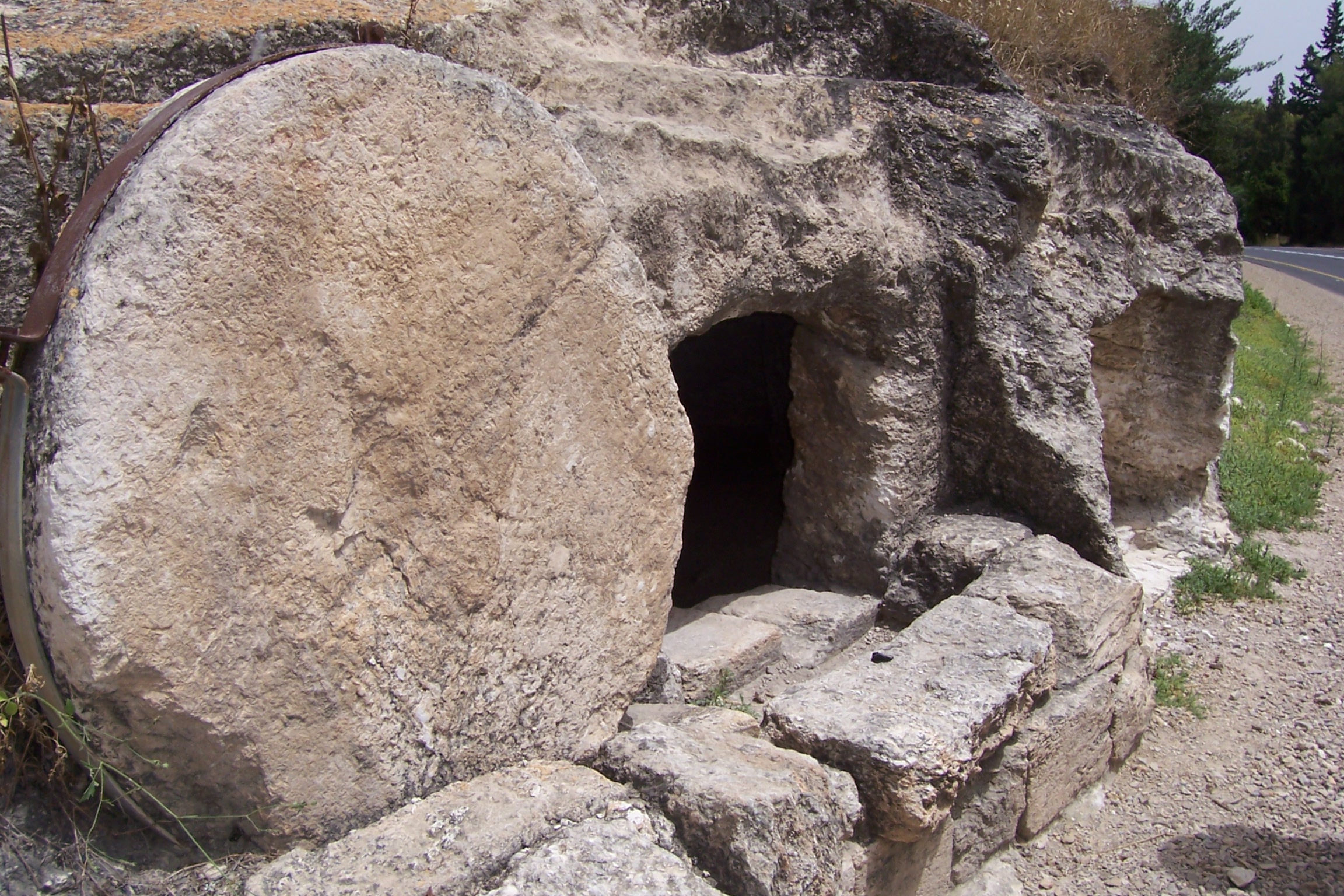
Stown hewn tomb at the base of Mt. Carmel, 1st Century

Google “paranormal Christianity” or simply “paranormal” and see what happens…the perverse core of christian fascination with a reality more than the physical world will immediately become apparent. Our culture is fascinated with what happens “when we die” and where “we” will go when our bodies are no longer full of life. In general, this fascination takes the inquisitive mind in one of 3 major directions: atheism, theism in the form of a structured religious expression or an agnostic embrace of an alternative reality known as “paranormal activity.” Most people fit in one of these three categories, while the most zealous among us argue their “belief” with impassioned rhetoric if little else.
The common denominator of the above is one’s attempt to teleologically define the world; they are not simply offering a view of the world, and especially its aftermath, that is objective. Objectivity is not part of the equation when it comes to thinking our non-existence into a form of paranormal existence. The goal is to tell ourselves a story about ourselves that allows us to engage our current story with structure, security and hope. This is true even for an atheistic persuasion. If the hope one has is an atheistic embrace of nothingness…I would dare say that the atheist is more comfortable thinking the world absent God and God’s relation to the paranormal (irregardless of the plethora of “scientific” reasons for engaging such reflection), than she is including God in the equation for such configurations…at least the atheist hopes this to be the case.
The most striking aspect of this phenomenon is the utter lack of definition being found in these discussions and the apparent either/or, false binary distinction, that gets imputed onto the issue of paranormality. Either one believes in souls or one believes in ghosts. Either one is Christian and believes in some ethereal bliss for all believers like heaven or one is atheistic believing our bodies to be natural compost at the end of their course. A third option is that one may believe in all of it, expressing complete agnosticism toward the issue of the paranormal activity, but being perfectly happy to say “yes” to just about any theory of what the paranormal may be by virtue of the host of probabilities.
Symptomatic of this explosion of paranormality is the universalizing conceptually of what cannot be universalized. One is given “concrete” description of what comprises the paranormal and what the paranormal MUST exclude. The paranormal has come to include a rigid set of shallow criteria rather than truly be a concept of reality that functions at its most basic level: Para-Normal…that which is alongside of, beside, the normal (never mind the host of linguistic and psychological problems that confront a concept of the “normal.”) In other words, we have taken our scientific form of epistemology and subjected the “science” of paranormal studies to the rigid dogmatism of certainty and patterns that typifies science as a discipline and our subsequent ways of apprehending the world as modern and post-modern people. But the problem is…paranormal activity, by its very description, cannot be fully described, totalized or fully understood. It refers to a reality that is outside the norm but somehow also intermingling with it. The paranormal cannot be anything more, or anything less, than the awareness of a unique reality that exists alongside the normal, with the normal, in dependence on the normal, not something that rises above it or is a higher form of existence.  The paranormal cannot be so easily defined, some groups so easily excluded. We need a new operative understanding of the paranormal, especially in relation to faith, belief, religion, and philosophy; one not so restrictive, shallow or lost in cultural fluff.
In fact, as I will argue in this blog and through the multiple kinds of reflection and inquiry that will take place here, the paranormal IS the only description of reality we have…even the reality that we think to be the most empirically concrete form of realness available to our precious little Kantian senses. Notice I did not just say that the “paranormal” and its popular conceptions is our bearing of reality. Nothing could be further from the truth. What I did say, however, is that life is best described in that in-between place of where we know, with where we don’t…what we think, with where ones thoughts originate, what we say, with the genesis of our words, what we experience as “normal” …with that normal alongside all of us that alludes apprehension.

It is this conception of paranormal that I wish to explore and engage at a theological, philosophical, biblical, cultural, psychoanalytic, linguistic, etc, level on the pages of this Blog.

Along the way I will employ the services of books you know, like the Bible, with books you may not know, like Slavoj Zizek’s “Enjoy Your Symptom” or Marion’s  “God without Being.” I will explore orthodoxy in heterodoxical form at points and subject sacrosanct doctrines to linguistic and socially constructive analysis.  This is where paranormal takes on a new life, and our obsession with taming this word is relieved of itself and able to de-center our certainties.

Misty Overgrown Cemetary

I invite you, the reader, on this journey. Rest assured, this blog will not be passe musings on “paranormal activity” and ghosts and goblins nor will it be fanciful evangelically Gnostic christian reflections on the pearly gates or the streets of gold.  If you search for such bastardazied mystogogy you need to search elsewhere. If, however, you are interested in questing for truth, for virtue, for what is real, and especially engaging these maxims around the centrality of the meaning of the Christ (and all the linguistic luggage associated therewith) then you have come to the right place.  The domain is of philosophical and theological inquiry is not relegated to strictly religious areas because the religious and the secular are always intermingling and informing the other.  Thus, what is at work here is a Renaissance of sorts wherein the world is eclectically engaged via the unlimited nature of its own content.  I’m not totally sure where the journey will lead, but I, like you, hope for the epiphany that can only come through catching a glimpse, and encountering, the most singularly neglected paranormal event to inhabit creation and redefine being as we know it: the resurrected real of the paranormal Christ.

From The Pew

A Layman's Look At The Gospel

Flora Fiction

Creative Space + Literary Magazine

The Bibliofile

Book Reviews, Books, Bestsellers, Literary Fiction

bookconscious

"Books are humanity in print." Barbara Tuchman

existentialmoonwalking

A few impossible things before breakfast are always on the menu.

Beautiful Life with Cancer

Discovering the Gift

Victoria Elizabeth Ann

Leader. Writer. Employee Development Specialist.

COOL MEDIUM

Media, Space, Technology

Lynette Noni

Embrace The Wonder

Malcolm Guite

Blog for poet and singer-songwriter Malcolm Guite

WHEN THE WHORLS FUSE

REALITY IS MARVELOUS

The Charnel-House

From Bauhaus to Beinhaus

Damyanti Biswas

For lovers of reading, crime writing, crime fiction

Christianity in the 21st Century

The Search for Truth and Meaning as a 21st century Christian

Yard Sale of the Mind

The Price is Right

The Paschal Imagination

Where the Aporia of Faith Meets Phenomena

Where the Aporia of Faith Meets Phenomena