Thinking Tombstones & the Grave

photo

Graveyards, Tombstones…the speck of infinity wherein time has stopped.

Here one is able to notice an era of foregone lives and remembrance that is now only marked by stones that are too large to move and to irrelevant to demand attention.  Some stones have been pushed over, some broken in half; others have crumbled from the weight of patience and are slowly deteriorating one speck of dust at a time.

To use a reference from Catcher and the Rye, many even have red crayons on them…tribute of the one who chose to vandalize rather than respect the place where history was completed.

Whatever the cause, plight or age, these weathered stones and sunken grounds populate the landscapes of historic cemeteries and ancient church yards. They reside on hillsides long forgotten or beside sanctuary’s that no longer include them in worship.

There are very few well worn walkways.  Few hillsides with the ghost of Christmas present perceptibly known.  Gothic rod iron fences that envelope family plots now with missing gates…visible signs that not only can no one be kept out, but no one wants in.  The only sign of history is this stone; an anchor in time that refuses to let the yore swallow us whole without some scar on the earth.

Some stones are traditional, rectangular monuments that set upon the ground over top the breath now stolen from distant lungs.  They have rounded tops that slant down like a bell curve with a simple name, dates and perhaps a mention of their prodigy.  Usually one finds a monument with two names, one for each spouse, lives bound by time and not prevented to rest beside one another for eternity…the only thing connecting them…the shingling of their dates.

Other stones are more alluring and rousing, stones that are large obelisks that protrude from out of the ground.  These stones have triangular tops that point to the heavens, as if to direct the souls beneath them the direction of their flight.  They are perfectly square all around with large bases that are able to withstand the very best of Mother Nature, though upon seeing some of them worn it is clear who will eventually win this contest.

Others tombstones, from an age in which honor was bestowed upon the dead recognizing that they are the ones that shaped our present, are tall rounded projectiles wherein cloaks and tassels are carved out of the stone and draped over the marker.  It a sense of humanity wrapped in granite, importance signified by the perpetual wave of nothingness that is their life in the present memory of those who stand before them.

There is a distinctly eerie feeling associated with these stones, these inelastic monoliths that take on a lifelike portraiture of cloaking the one who no longer needs this cloak or these tassels…or the warmth of these cool reminders in time.

Who cares so much about their dead that they give such minute attention to the very stone that will serve no purpose but to rebuke time and demand this life be remembered?

And still others, have pictures of the deceased, old photographs that capture our senses and haunt our memory as we peer into a glimpse of one that is no longer with us; the Aryan blue eyes and blonde hair of an extinguished light that now imperceptibly stares at us through the stone.

We are our images…the stones simply remind us that beneath them is a picture we will never see…and it lies beneath the dates that are now etched into dense constitution of a stone that will one day be a testament to our world once our world and its people are gone.

On one I read, “Baby,” with statue of a stone lamb lying atop the memorial.  A reminder of a life dreams never had and families whose dreams have ended.

On another I read, “Rector,” and I think about the sermons this man preached, the souls with whom he prayed.  Now, he lies lonely…several yards away from the closest tomb and far from the prayers he most likely deserves on All Souls Day.

Surprisingly, I notice another, “Blessed are they that die young…” and at once I am saddened by this child erased from the timeline of history, but relieved of the hurt and pain of living in the world.

And then there are the stones, the markers, usually groups of them together in the oldest part of the cemetery that are nothing more than obscene fragments jutting from the ground.  They are raw deposits of raw jagged rock, raw markers of raw lives, whose very marking in raw and unsanctified stone is representative of lives buried beneath.  They remember those that lived for those that were actually living.  Their tombs are sealed by the rock that says nothing and looks as if it was torn from the side of the cliff and then driven into the ground.

I’ve walked up along these stones, ran my hand over their rough surface and asked the old man beside me, “who are these people?” and “When were they buried?”  On occasion its neighboring stone has become so dilapidated and ruined…that I’ve picked up the pieces still intact and placed those back where they belong.  There are many cemeteries filled with nothing but stones like this…testimonies of people who have been forgotten.

resaca

In Resaca, I walked in the penumbra of that Civil War battle where many are laid to rest.  I walked hallowed ground as I stare at names of soldiers now sunken in the earth.  I read the story of women who donated the land, buried the dead, and prayed for their families…I feel the heavy hearts that picked up shovels, opened the earth, and poured the bodies of dead young men into the ground as if watering the soil.

Bright eyed optimism met fear and reserve on ground not far from here…racing pulses and sweaty brows climbed the hills that rise above this cemetery…an indentation of the world where the deposit of aspirations now lie in respite.

The common denominator of these stones, their dwellings, is the telling of the stories that lay beneath them, over this ground, as this part of history closed its chapter and all its hopes, dreams, failure and accomplishments are buried beneath the unforgiving weight of the earth.

We stand before these deposits of human being and we peer through the mist that must have clouded the eyes of loved ones, of strangers saying “farewell.”

These monuments are touching, emblematic of a connection in time to one that shaped the world in which we live, the very landscape that now holds them taking shape by feet they placed upon it.  A lived experience that communities shared of dying young, growing old, and finding purpose…all as we live toward the direction of an earthen house that will mute our voices unless we are able to let a few of our dreams percolate to the surface.

These stones, these grounds, are testimonies of stories that stopped being told.

They are screaming reminders to not forget…to rehearse and retell of these people.  The great irony is that these people are not much unlike us.  We just find ourselves on a different part of the arch of history…and one day, our stones will scream too.

Let’s tell our stories so our stones aren’t left with such a heavy burden all alone.


A Poetic Essay: Writing Love & Poetry with Cixous

cixous

Helene Cixous, the philosopher, writer, thinker, novelist, poet…one with the uncanny ability to grasp the impossible and poetically narrate newer possibilities.

As Derrida describes of her, “A poet-thinker, very much a poet and very much a thinker.”

She writes the kind of poetry that describes the conversant and then leaves one asking, “what just happened?”

Cixous writes,

“It is the places that make love.  Places and all their features.  For them to make love (and so that they might do so), the features must combine their forms, their different energies, and their properties in a whole whose total makes god.”

Poetry is poietic.  The mundane becomes the exotic.  Form and content blend in ways that seek an apocalyptically pristine constitution.

Something to deliver us from ourselves.

The more I see of the world the more I become convinced that the world will not be saved by those who can write prose and disseminate its smooth flat reality.  Such only leads to the nothing of no possibility.

What the world needs is the poet.  As poets perish, the stench of the corpse of our imagination begins to intrude into the spaces that are disguised as lively.

And we hear the gasps of death left in the vacuum of the dead poet.

Poetry lives among us and sees beyond us…it sees and feels the rhythmic beat of relationship and gives rolling hills and texture to Tom Friedman’s “Flat World.”

Poetry, as theory and praxis, is difficult.  Difficult because we no longer think poetically; we think matter-of-factly.

We no longer use words in which we may become lost.  In writing our words…we have lost them.

We no longer feel emotions that cannot be harnessed.  We commoditize our emotions through manipulation and consumption.

We see the world in the script of black and white (letters and reality).  When in actuality, reality may be best situated beneath the writing and beneath its margins…imagined in the places we cannot see because we cannot speak them.

Poetry is not merely the art of speaking and rhyme…

it is the very act of taking the actual path that has become grown over through time as we faintly see the footprints of daring poets whose footprints have left vague impressions in the dirt…

Hear Cixous:

“One can’t escape the hidden designs of God.  She has written everything down and we do not read.  We are read”

Cixous, writes and speaks…and she does so poetically.  It is a poetry not bereft of science or prose…but one that writes poetically in response to this world of cold hard surfaces.

She has met Lacan and yet she is still a poet.

She captivates the reader with simplicity in a world filled with complexity…making what is so familiar to us all, the language of love, distantly close.

I ran across one of her texts recently, a text that is as deep as it shallow and as profound as it is complex.

As a lover of the gospel, and its imaginative possibilities to love more deeply and thrive more fully, I embarked on her work “Love Itself: in the Letterbox.”  What I happened upon was the delicate and inter-relationality of continental theory, psychoanalysis, language and deep expressions of love for which I was little prepared.

This is a dangerous text.  It is shockingly simple.  It is infinitely iridescent.

If you want to think and feel the subjunctive character of what is so familiar, then read her.  She writes of the already and the not yet always already.

She makes the simple act of writing love letters, letters in the letterbox, an act of deep reflection and intuition.

She talks of love, its behavior, its appearance and its presence.  She speaks our language, with our language and is yet speaking of the act of writing love past our language.

She is the poet.

Here is the world.

The world does not drown our words…and therefore our interminable possibilities.  The words of the poet open up creation…giving us a new gospel of sorts.

Going to the letterbox, Cixous speaks with us, to us, for us and also past us…about that which is most salient in our lives, either in lack or in excess…the incarnation of this four letter word: L-O-V-E.

The problem with writing love is that it is the problem of writing us.

Our problems are beautiful.

Our humanity can be tragic, but that is what makes it lovely.

Just as Gospel attempts to reforge creation via love located in the depths of what we call God, it being the hearkening from out of our graves into a poetically imaginative and lively world, so poetry speaks words of creativity and new impossibilities into the dirt that attempts to bury our dreams and hide our morbid smell.

This conflict of life and death, of the as is, with the as it should/could be, is the task of poetry.

Poetry is the horribly beautiful description of that which we most long for…but for many of us remains remote.

She writes “love itself.”

She doesn’t create a new world as much as she sees the real world, where routine trips through our lives are given sharper focus and memories become conversation partners with our future.

Wherein our emotions become sensations, we feel with our sight, smell with our hands, and think with our heart.

Thus, in the Spirit of Cixous, I not only form this essay in her simple prose, but I write this short poem pursuant to her vision and to descry the absent presence of love…longing not for a world of continued non-rapport, but for a world were love itself and being itself can finally become one.

Love is Poetry, Poetry is Love

Cixous writes, “I was afraid you would always be there. I didn’t want to tell you that earlier.”

Have I not heard footsteps behind me?  Have I not imagined them as they approached?

I have seen you before.

Your Smile is familiar.  I knew it was there but I did not see it.

I was afraid of this day.  Hopeful it would come.  I have read this story before, even though it has not been written.

The speech that is spoken, I see your lips move, but I am unable to hear.

I see your breath in the foggy, misty morning, but I do not feel it upon my neck.

“I was afraid you would always be there. I didn’t want to tell you that earlier.”

Earlier has arrived later.  I delivered the letter.

The mailbox was empty.  The letterbox was not emptied but my letter did not remain.

I wonder if it was delivered.

What an undone world.  Tears roll down my cheeks.  They collect behind my ears.

The world is lonely.  I am surrounded by everyone.  But I am not surrounded by one.

“I was afraid you would always be there.”

Perfect love?  Gospel?

Love is a nomad that returns to my tongue and restores my despair.

I didn’t want to tell you.  But love casts out fear.

I keep writing love, love writing me.  The letterbox is cold.  It warms my hands.

I leave the letterbox solemnly.  Back through the fog, leaves crunching behind the smile I feel staring at me.

I look through the world.

I say to myself, “I was afraid you would always be there. I didn’t want to tell you that earlier.”

Too Scared to Love: an Essay on Fear, Love & the Gaze

Emerson Fear

FEAR & GOSPEL

“Perfect Love Casts out all Fear,” so the writer of the Epistle of 1 John tells us.

In a world of so much fear, and so little love, one is left to wonder if there is indeed a perfect love that can handle the level of fear that seems to be inundating our worlds, our communities and our lives.

Fear of being nothing motivates us. Fear of losing everything makes us work harder. Fear of being ignorant makes us study. Fear of never being loved makes us pursue those filled with fear and unable to love in return with even more abandon.

Fear negotiates the world. It even negotiates our relationship to one whom we call The Christ. Were it not for fear, the fear of God, one wonders if fear could have become such a common currency.

It is used by so many, understood by so few. Fear is the Lord of the world.

Perfect love casts out fear? Really? Into what context does this even make sense…?

The Gospel’s knew something about fear.

They knew whoever controlled the mechanism of fear controlled the masses and their behavior. Yet, the Gospel attempts at multiple levels to dispel fear in some uniquely concrete ways that are lost on us when we read it as a story of details, rather than a narrative of provocation.

At multiples places in the Gospel the very thing that causes fear (principally the unknown) is resolved through a state of overcoming that which is feared.

In other words, fear is defeated by fear that is directed toward the redemption of fear.

The remainder of this redemption is no longer a love gone awry…a love that is misdirected because it is directed by fear, and therefore unloving, but a love that is so perfect that it can cast our fear.

Fear has been redeemed to become otherwise than itself through a dreadful event.

There is nothing more fearful than a dead person emerging from a borrowed tomb…yet there is nothing more redemptive than the ultimate fear of death lying lifelessly dead beside one whom the earth could not contain…The Christ simply giving it a passing glance as he slowly walks by.

This is paranormalChrist at his finest. An Example of the perfect love of God casting out the fear that threatens all of us constantly.

But the resurrection is not the only fearfully fearless redemptive act that redirects a love gone awry.

Others places in the Gospel remind us that Jesus came into the fearful situation of calming storms. These situations are unique because it speaks volumes about the Gospels mission to step directly into situations wherein fear is the arbiter of reality and denounce it as a misdirected affection. It is no coincidence that the stories do not primarily serve a purely Christological function, as much as they serve to renarrate the world we receive.

No doubt, the incarnation of God in one whom we call The Christ is a renarration par excellence, but such renarration does not occur because we have been able to precisely determine the ontological significance of the Historical Jesus. The stories don’t serve as perichoretic marking points.

The stories serve as confrontations with rulers, with archetypes, with paradigms of seeing the world that are now made new because the Christ has been his paranormal self and defied the natural order of things via God’s perfect love for the world…a love that castes out fear in every situation because what we fear most, our deaths, is now no longer something that should be feared.

Remember, Death is still lying outside the tomb lifelessly dead, its vibrancy and sting negated via the Christ and his stubborn refusal to remain subject to Hades.

This doesn’t only mean that now fear has been dealt a death blow via the death of death, though it certainly may mean at least as much. It also means that the supernatural perception of the Christ, the powers that allow him to calm fear, to suspend deaths final grasping, is not bound to his X-Men capabilities as much as it is bound to the simple things we miss about The Christ.

Fear cannot be defeated with greater fear.

Christ does not defeat fear in the world via the death of death with a greater coercive strength to make death die.

It is not with force that Christ resurrects himself nor is it with force and great chaos that Christ speaks stillness into the brooding clouds and churning seas of life that would love nothing more but to overtake our beings, who we are, and sink our dreams and potentials into the watery abyss below.

Fear is not defeated with a greater fear…that simply makes it stronger and more resistant.

What fear and death cannot resist, and what can thereby redeem love gone awry, is perfect love.

Perfect love that is characterized via The Christ as: perfect words, perfect presence, perfect patience, prefect space…a space that receives perfect love in simplicity and is filled with so much love that fear itself no longer has habitable room.

There is very literally no room at the inn where perfect love resides.

Moment of fear: The Crucifixion

Moment of love: Today you shall be with me in paradise…words spoken into immeasurable violence and death wishes thrown all around us.

Moment of fear: The perfect Storm

Moment of love: Peace be still…words of peace spoken into hearts filled with dread.

Moment of fear: My life is moving toward death

Moment of love: Death is not the final word…God actively raising Jesus and giving Jesus the gift of resurrection.

*And for a contemporary application…

Moment of fear: People all around us so filled with fear that their fear has produced a love gone awry

Moment of love: embracing the paranormalChrist and being a presence of spoken love that gives fear no safe harbor.

The Gospel is filled with saying no to fear, yet it is by fears we have been living and through fear our love has gone awry…and we have mistaken our fears for the things that we love even as the things that we love seek to be destroyed because fear does not allow us to fully love what we have been given to love.

We do not know how to love and surrender power through love.

We do not know how to receive love that is not seeking to gain something from us.

We do not know of a love that seeks the benefit and wholeness of the Other because we love through our fear of self satisfaction.

We do not know that love is not about control; it’s not about infinite demand.

We do not know that perfect love is self-kenotic…a self-kenosis that incarnates a love that is more than ourselves and creates a world so utterly foreign that it lends its audience to ask, “Can this be the Christ?”

Surely salvation/healing doesn’t look like this!

We are so fearful of losing everything or not being fulfilled or getting our way that our fears have characterized our affections and disguised themselves as pure motives when all they really do is keep us from loving and precipitate the destruction of our worlds…one nation, one community, one home, one person at a time.

Fear does not give life…it steals it…which is precisely why The Christ had to steal the greatest fear of them all.

Fear does not have the final word; It doesn’t get to write the end of the story.

Love and the Gaze

Our world is one with fear and trembling before the very numinous presence of a multitude selves unaware and it has become the catalyst for our narcissism and the infinite demands such places on those around us.

We know that fear is persistent and structurating because our world is in disrepair. A world guided by perfect love does not fall apart; its seams remain tight and colorful, keeping reality sewn neatly together…but fear unravels the seams and slowly pulls reality apart…because fear cannot understand what it cannot see…that it doesn’t really exist.

There is nothing to fear because fear is no-thing.

The nothing of fear has held love hostage…and love has gone awry…its very presence being questioned and its idea being lost.

And this takes multiple forms.

The chiefest form that is encountered by the many of us is the fear that holds us hostage to the gaze of the other…or perhaps we are the other that holds the world hostage in our own gaze.

The gaze is the view into reality wherein the subject, the person, is the all knowing, seeing, desiring eye, by which all of life is held to account.

There is nothing outside the gaze…no greater perspective than the gaze. It is penetratingly stubborn and inhospitable because it desires to see all things without adjusting its view…without discovering that it’s a gaze that is founded upon the fear of really not seeing what is there to be seen.

So long as the gaze can hold the world in its view, it sees what it wants as such desires are generated out of the fear to really see the world for more than it is. To see the world for more is to see its own self negation, to be on the road to seeing a world marked by beautiful subjectivity rather than fearful controlling of the subjects/objects that comprise the world.

So long as the all seeing eye of the gaze is lost in its specter of fear…love will remain distant because love is the impossibility of real relationality that the gaze has lost in its own sight.

The gaze becomes its own worst enemy because the very thing it is attempting to achieve, i.e., peace and happiness, is alluded its sight because it has failed to grasp that peace is not the product of seeing and demanding…holding the world in debt to its vision.

As Gerard Wajcman notes in describing a central thesis on the gaze:

“the central thesis that rules the hypermodern world- that all of the Real is visible- is itself animated by an implicit correlative thesis: If all of the real is visible, then all that is not visible is not Real.” (Lacanian Ink 38, “The Universal Eye and the Limitless World”).

It is little wonder that a world lost in the gaze of a love gone awry, one fueled by fear and disenchanted by what could be real by what is “real,” is incapable of seeing past its own fear and into a world of new creation that doesn’t just expand the gaze but negates it in its totality.

Real love, real relationality, is absent, not because fear has the final word, and thereby also death its closest partner, but because death and fear are what is visible and real…while the real moments of love that could be spoken into existence are seen as not real because they are not…they are not in the gaze.

And thus the vicious cycle recurs.

Those who want love the most…are also those whose love has gone awry because it is founded on fear and not in the simplicity of a spoken presence that reshapes the world one syllable, one touch, at a time.

Such perfect love simply does not exist in the gaze.

Peace is the result of loving past the fear, past the sense of happiness founded upon the fear of not controlling or having, past the sense that everyone around us is held hostage to the debt of the perception of the gaze.

“Perfect love Casts our fear…” the writer of the Johannine Epistle tells us.

As long as we continue to love from fear we are never really loving; we are only fearing to love.

…and as long as we fear to love because we have confused love with the needs of the gaze, we as a culture and society will continue to become dismembered, continue to spiral into despair and continue to be our own worst enemies in our quest for what all human beings want…

Love, peace and happiness as can only come from one who emerges from the tomb, stops, directs his gaze at us and confidently says, “Fear Not.”


Jesus and Islam: The Perfect Scapegoats

jesus-islam

 “Christ is not divinized as a scapegoat.  Those who take him to be God – Christians – are the ones who do not make him their scapegoat,” writes Renee Girard in his text Quand Ces Choses Commenceront.

Girard’s work attempts to reveal the role that violence and victimization play in the organization of human society and his research, particularly in his Violence and the Sacred, contends that humanity needs violence and uses violence to create peace and harmony within communities.  Without violence as an organizing principle,, and therefore without a subject upon whom violence may be directed…a victim, people groups cannot maintain peace or establish tranquility.

Not only does violence organize secular communities, it also unites and organizes religious communities.  Arguably, violence is never absent religious overtones.

Violence acts as the glue of communities because it allows the majority in the group to direct their animosity and hatred toward a “sacred” object upon which they can uniformly direct their aggression.  This object or person is what we call the scapegoat.

The scapegoat is also a person that is believed to have violated the taboos of community, so aggression toward this person is justified.

Yet, the scapegoat is not sacred in and of itself; it is “sacred” precisely because it brings reconciliation.

When the community identifies a scapegoat to fill its need for harmony she becomes the target of a unifying animosity.  The only way to keep peace in the community is to destroy the “presumed” problem, the scapegoat, as a response to the conflict.  The community unites around this cause and directs its aggression upon the violator, sacrificing it for the good of the community. The people who were once threatened by disharmony are now united in cause and purpose through violence.

As Mark Heim notes in atonemental work, Saved from Sacrifice, “In the train of the murder the community finds that this sudden war of all against one delivers it from the war of each against all.”

This process of uniting around violence, finding peace in the death and annihilation of another, is not limited in its scope.  It also lies at the center of the Christian story: the Crucifixion of Jesus.

I do not presume to be able to descandalize the Cross or Passion event of Jesus the Christ with such brevity.  Such, in my opinion, has already been handily accomplished by Mark Heim, Renee Girard and others in their seminal works.  But it is not too far a stretch to say that however Jesus is understood, mimetic violence is a part of his narrative…and it’s a narrative that does not cease upon the nails entering the hands of Christ.  We continue to employ its mechanizations into the present.

Jesus is not to be the scapegoat of Christians; this, however, is precisely what we often make of Jesus.

The crucifixion is the event in which Jesus is killed by the people for the benefit of the people.  The story of the Gospels shows us characters that kill Jesus in order to establish peace.  Christians, rather than confronting Pilate’s medium of peace as sinful, condone this violence against Jesus and write songs and hymns reveling in the gory details of a victim known as Jesus.   Mark Heim reminisces, “I attended worship services all my life…and sang about the blood shed for me…If I was comfortable with the abstract idea, why did I shrink from the reality?”

Christians deplore the technology of sacrifice, except in the case of Jesus, wherein his sacrifice was necessary to forgive our sins.  Our sin problem becomes the problem of Jesus and we gladly accept him on the cross in order to give us the peace and harmony we need in the Church community.  His death unites us and hides us from our own selves in the process.

Jesus becomes the scapegoat whereby we can not only pacify our ethical guilt, but in so doing alleviate ourselves from the threat of an angry God.  It’s a “win win”: peace with ourselves and peace with the Holy Other.

And if it works with Jesus, why not continue to unconsciously pursue this mimetic verbal and physical violence into the present to make us feel more American, more Christian?  After all, if God destroys Jesus to bring peace, surely we can destroy lesser humans to accomplish the same.

Along with Jesus, we American Christians are now doing the same thing with a major world religion: Islam.

Our present, and decade old phobia of Islam, is the continuation of an unfolding drama that for most Americans began on 9/11/01 in lower Manhattan.  The country had experienced a rupture to their worldview that morning.  The instantaneous refrain that was heard throughout the nation was revenge: to paraphrase President Bush, “I hear you, the world hears you, and soon the people responsible for this event will hear us all.”

At that point in history, polls demonstrated the nation was united in purpose and violent pursuit of the criminals.  This was scapegoating in action: directing hate and violence toward an agreed upon enemy in order to restore order, unity and peace.  We sought salvation in violence.

We sought to kill those who were not guilty to rebuild the worldview that was taken away from us from the actual guilty parties.  Only through violence could we seek peace.  It was the dialectical impossibility of American politics to somehow be the bearers of peace with one hand, while holding an anvil in the other.

The scapegoating that began almost a decade ago has now spread to the religion in general.  Most Americans have very poor ideas about Islam and many have no problem condemning it as religion of hate and death.  The hatred that is brewing against Muslims in our nation is astounding, even while many Americans spewing Islamophobic rhetoric have never read the Koran or spoken with a peace loving Muslim.

Islam has become an easy scapegoat.  Americans have figured out a way to make Islam their sacrificial victim and kill it for the good of the many.

It works, it unifies and it gives us a common enemy to hate.  Rather than engender Deuteronmistic hospitality as Moses and Jesus taught, American Christians are ready to put Islam on a cross.  Can we not see what we are doing?  Do we not see that we are using the same sinful violence that killed Jesus to give us excuse to kill an entire religion and culture (physically and verbally)?  Did Jesus not suggest that if we hate someone in our heart, we have already committed murder against them?

A question in the spirit of Girard would be apt to ask, “Does Jesus die in order to affirm the peaceable kingdom that is brought through violence, or does Jesus die as a testimony against violence in order to establish the peaceable Kingdom?”

Is Jesus’ death an affirmation of violence as a unitary principle or is his death the swallowing and ending of violence as a currency whereby we should attempt to establish harmony?>

Some of my fellow brothers and sisters will, and have objected, saying, “Do you see Muslims showing your type of tolerance?  Do you see Muslims wanting to understand your faith and love you?”

My reply is, “Yes”. I have experienced hospitality and love from Muslim strangers.  I have been with them in Syria and walked the streets of Damascus, sipped Turkish coffee with them in Jordan and put my arms around Bedouin wanderers.  I have felt the hospitality of peace loving Muslims that have saved money for years in order to take their family on Hajj to Mecca.  I have seen their smiles and heard their children laugh.  I have been at home in their presence and have eaten dinner at a common table, even talking about things like Jesus and Mohammed in a place called Sinai.

So “yes,” I have been with Muslims who have “tolerated” my Christianity and attempted to “understand” my faith.

But even if I hadn’t, I still serve a Christ that teaches, “You have heard it said You Shall Love Your Neighbor and hate your enemy.  But I say to you, love your enemies, and pray for those that persecute you in order that you may be sons and daughters of your Father who is in heaven.”

We’ve already made Jesus a scapegoat…must we make an entire religion and ethnic group one also?

Christ of Chaos- a sermon in Luke

Is this really what Jesus was talking about?

*A sermon on Jesus, judgment and some difficult words of The Christ in the recent Lectionary reading of Luke 12.49-53*

“When life has become old and the spirit faint, it is in the beginnings that we again find the living springs from which the vital energies flow” Jurgen Moltmann, “Hope and Reality: Contradiction and Correspondence,” in God Will be All in All

Life has become old, and the spirit of Luke’s readers has become faint, as the words of Jesus echo through the corridors of the churches and continue reverberating to our own. As Jesus speaks these shocking words into a ministry that is taking now itself toward Jerusalem, the roads along the hills and valleys of The Galilee that lead to the Holy City are filled with visible reminders of the imminent end, the end that Jesus feels pushing himself toward the ultimate hill upon a hill. Christ is moving toward the Pinnacle event in his life, an event that will end on a pinnacle for those of us who know where Luke is taking Jesus in his narrative. Why is Luke taking us to this place? Because it is from this place that the end of creation will occur and a new beginning be resurrected. And along the way, we get a view of the teaching of Jesus that seemed to frame his entire work within the paradigm of the pending end of time, the much feared last days. Jesus is not heading toward Jerusalem, leaving the comfort and serenity of The Galilee, in order to anticipate the coming vindication of the righteous through a final fiery judgment. Jesus is marching toward Jerusalem because the end is already here.

This is why along the way, in Luke, we get these familiar teachings we call parables merged so frequently within sayings that have to do with readiness, ending, approaching, consummation, and judgment. These are the primary means of Jesus’ teaching and also the primary content. Jesus is challenging us to embody a parabolic way of life because this is the way the world will look when the work of Christ is completed. He is not preparing us for the coming end; he is opening our eyes that the end is now. And with Luke’s hearers, we, like them, are able to recognize this because life has become old, our spirits have become faint. From this ending, we recognize that a new beginning is on the horizon…and as we peer into the land of the text, Luke’s narrative, that end is seen in the silhouette of the Christ that is walking toward Jerusalem…yet leaving behind some very troubling things, troubling words. With our brothers and sisters in Luke’s Gospel we see Jesus approaching but what is he bringing with him as his shadow moves closer to the middle of the earth, the hill to which Luke is taking us where the end will be a new beginning?

In a sudden breach of Jesus’ typical demeanor, Jesus uses some of his most difficult rhetoric to express his frustrations with Jerusalem, the known world. Jesus becomes negative, going a step further than rehashing his most beloved stories such as separating sheep’s from goats, bridesmaids and bridegrooms, thieves and masters. Here, Jesus gets as graphic as anywhere in the Gospels. His emerging from The Galilee has produced a fiery prophet with great intent and fire in his eyes…determined to counteract the expectations of the disciples, his own disciples, perceptions of what he desires for the world and what he has truly come to do to.

Jesus, in the middle of a long diatribe, quickly turns to his disciples specifically for this teaching. As he stands amidst the crowds, he finishes his final thought then swiftly turns to his disciples, to us, and says… as if with contempt In his voice…”you think I have come to bring peace, to make your life easy, you think I have come to give you purpose, to caste off your oppression without event…wrong”

“I have come to cast Fire upon the earth and how I wish it were already kindled! But I have a baptism to undergo and how distressed I am until this is accomplished! Do you suppose that I came to grant peace on earth? I tell you, NO, but rather division. For from now on five members in one household will be divided, three against two and two against three. They will be divided, father against son, son against father, mother against daughter and daughter against mother, mother in law against daughter in law and daughter in law against mother in law.”

The theme of Jesus and conflict starts early in Luke’s Gospel. While we may seem affronted with Jesus’ rhetoric in chapter 12, this is a theme that has been building throughout the Gospel of Luke and will very literally bleed into the second half of Luke’s Gospel, Acts.

The very beginning of Jesus starts with a prediction of conflict in Luke…The adult Jesus is simply fulfilling the plot line that has already been laid out by Luke. In Luke chapter 2 Jesus is presented to the temple, and an old man named Simeon, who was already filled with the Holy Spirit (which btw won’t happen in the narrative for many years to come in The Acts), is able to ascertain through the power of the Spirit that in this baby Jesus is the consolation of Israel. Simeon tells Mary, what must have been a very chilling prediction, “this child is appointed for the rise and fall of many in Israel…a sword will even pierce your own soul.” At the time, we as readers are not sure how this will unfold but conflict quickly pursues Jesus in his first act of Public ministry in Luke 4 where Jesus fills the entire synagogue with rage because of his teachings. They tried to kill him before his ministry had even started…Jesus had already begun to wield his sword, but the sword will get more mighty and polarizing as Luke’s story continues.

And time would fail us to rehearse the polarity of the narrative of the Baptist, the public acts of choosing to call tax collectors over the proper house of Israel, breaking the Sabbath observances, and the much infamous Sermon on the Plain wherein Jesus corrects Moses on multiple occasions…and these to just name a few. By the time we get to chapter 12, Jesus has begun his ascent from the Galilee toward Jerusalem, his heart and head are weary, his spirit must be growing faint with lack of faith he finds…so at this point in the narrative Jesus states explicitly what has been unraveling throughout the narrative to this point. He is fed up with these people who are not understanding his message and continually perpetuating non-parabolic forms of life that revolve around their customs, power, positions, economics, …and if it would just begin happening right now, if fire would already be set ablaze then the purging of creation and a new beginning could occur.

So it’s not only the message of Jesus that is rote with conflict; it is his very presence. The presence of Jesus the Gospels call Christ is the entrance of conflict into the story of the world because he is the entrance of the end. His presence is the weighing of the scales of judgment. He is our beginning that has entered our end so that we can have a future beginning. And this is what is so disconcerting to these characters that oppose him in the story, to those families that are divided because of his teaching. Jesus has entered a narrative that begins with “loud Hosannas” and “glory to God on the highest”…his entrance is hailed by those that have no business recognizing the Baby Jesus whose notoriety is seen in the public announcements we see at Christmas time “Joy to the world, Peace on earth, Goodwill toward humanity”…remnants of a Gospel story that says Jesus came to bring peace rather than a sword. The unassuming announcement that is brought by none other than Gabriel in Luke 1 reminds us of Daniel wherein Gabriel seems to be a bearer of messages concerning the last things…the announcement of Jesus is the eschatological sign that the words Jesus echos in Luke 12 are also connected to his very life. Jesus is the end and he is speaking judgment and conflict not only to Luke’s hearers but also to us. The birth of the Christ, in ironic fashion, was the judgment of God into the world…and only thereby might peace be found on the other side of the life that Jesus must live…is living in our text.

If we grant the tension that the Gospel gives us a Christ that declares division while also proclaiming peace, yet his ministry somehow embodies both, causes both, what are we to presume this cryptic saying of Jesus is to mean? How do we make sense of this eschatological prophet whose story lead many of Luke’s hearers, and us, to proclaim that we are not only dealing with a unique prophet grounded in history but one that we must also confess as son of God, Christ, Messiah…and of what is he Christ, for what purpose is this derisive character known of Messiah entering the world of Luke’s Gospel, and our lives, with some words that subtly challenge the comfort of our seats and the peace with which we idealize our ideas of the world and creation?

The most striking thing about this passage is that it occurs prior to Jesus once again returning his gaze to the crowds. Jesus is still speaking in the absent presence of Peters words, “Lord, are you addressing this parable to us or to everyone else as well?” The tone of the texts indicates Jesus is speaking these words to the disciples…for after he tells them of this conflict and sword that he brings, then the text says, “he was also speaking to the crowds…saying.”

Jesus is addressing this difficult saying to Luke’s churches, to those who were then currently living the tensions of families broken up because of the gospel, to families that had lost their inheritances because of their allegiance to Christ, to families that we on different ideological sides of the role of the temple that had by the time of Luke’s Gospel been destroyed. Jesus is speaking this to disciples; people in the conflict…and the reminder that he comes to bring conflict is a reminder that Jesus has prepared them for this difficult time.

While the Gospel did seem to have a euphoric sense to it, a sense of ultimacy that if Jesus was followed then new creation would emerge in a way consistent with all of their prior conceptions, the stark words of Jesus here is that his ministry will divide the very homes his ministry will also unite…and if he could expedite the process even the Son of God wishes that fire would consume creation and hold the powers that be accountable for their evil and oppression. Luke is using this discourse of Christ to remind them that the division they are now experiencing is not unexpected…even Christ knew such would happen…and the message of Acts tells us what a life proclaiming the Gospel looks like for those bound to this very divisiveness…how do they survive such division? The power of the Holy Spirit.

But what makes Jesus direct this very strong verbiage to his disciples?? Why doesn’t he point out the superstructures of society that are suppressing his people and keeping Israel in occupied bondage? Why doesn’t he come right out and say to whom this judgment and division is going to be directed? Why not a call to social-action like the prophets of old here? Why not attack the overtly political actions that are necessitating the presence of a judgment and a coming Christ? Why not address this warning to people that are not followers of Jesus? What is Jesus doing here?

He wants his disciples to see and feel the role reversal that takes place in the pending judgment of God visa vi his death, resurrection and giving of the Holy Spirit that will later unfold in Luke/Acts. The Kingdom of God, the coming God of whom Jesus is the living presence, has come, and is coming, into history to judge those very folks who think they are not subject to judgment…rather they think they provide and do the judging. The judgment of Christ comes about under the indictment of resurrection and victory and is purged by the fires of cleansing…fires that Jesus presumably believed would be quite literal.

Conflict and division is central to the Gospel of Jesus and the hell that Jesus wishes here upon the characters of the text, perhaps even us in the present, (remember he is responding to Peter) is a judgment upon our very ideas of judgment and role in preserving the status quo of the current system that is not enlivened by the parabolic vision of the Christ and the pending kingdom. Our judgment, even as disciples, establishes a foreign kingdom, one not beholden to God or divine purpose. In a world where Luke’s Gospel is very political, Jesus is seeing through the ideological powers that bring judgment and peace (ideologies we often support even as disciples)…yet these will in fact be proclaimed as garbage under the microscope of the Gospel…fit to be burned and destroyed as a part of God’s weighing of creation. Jesus is fed up with this complicity. He sees all this and he wishes it would go ahead and start raining sulfur…yet he knows that just as his ministry started with a baptism by John so too his purpose must end in another baptism into the earth. The effect of this baptism and the belief it has produced in Jesus will be a division amongst people that were already being lived by Luke’s churches…and has been lived historically throughout Christianity.

You see disciples often forget a very central point of Jesus’ messages. While the disciples of Jesus then, like us today, like to take the words of scripture and use it to indict those that are not faithful…if we keep with this text we find that Jesus is directing these words to his disciples because they are often confused about their own complicity in guilt, and therein, judgment. We like to direct this discourse to some ominous event in which “god is going to get them” and we are on the winning team…only problem is, Jesus is not using this as warning outside the community of faith. He is using it to warn his disciples…that they should understand the risky business of following the Christ. Following Jesus is difficult. It’s divisive. It may not lead us to the Purpose Driven life that looks like the American dream. It may not lead us to powerful positions within secularity…it may lead us up a hill we are not prepared to walk.

…Chances are…it will lead us into division with others, our family and even ourselves because it lays bare our thirst for the dominant configurations of power and narcissism that plague our lives…and what will judge those misplaced configurations of power? In Luke’s Gospel, the resurrection and ascension of Jesus has already done this. The presence of Jesus and his words is the arrival of judgment of the last days…We already stand under these words because God, who is the end of the world, has come into our presence. But Jesus has prepared us for this with these very words.

So while multitudes read Luke 12 and rehash fantastic scenarios in which this will happen at some grand event when all of time and eternity collide into the presence of an end times that is only given vision through the writers of facetious fiction…Luke’s is showing us his hand. It’s not about when. It’s about now…and the judgment of Christ is already finished. Despite our hardships or that divisiveness of the person of Jesus…the cost of following him, which in America is precious little, despite this…the jokes on us. Christ does bring a sword, but he swallows his own sword up when the garden spits him out of his earthy cage. While we await this judgment and its victory…Luke will later remind us…we are already judged on Calvary…and we’ve already had victory. Jesus is telling us about what will happen cast within Luke’s narrative of what has happened.

It’s a little thing we call Easter.

Exchanging the Resurrection for the Soul

The-Resurrection-of-the-Dead_620

“I am concerned with Christ as He appears in the Gospels, taking the Gospel narrative as it stands, and there one does find some things that do not seem to be very wise. For one thing, he certainly thought that His second coming would occur in clouds of glory before the death of all the people who were living at that time. There are a great many texts that prove that. He says, for instance, “Ye shall not have gone over the cities of Israel till the Son of Man be come.” Then he says, “There are some standing here which shall not taste death till the Son of Man comes into His kingdom”; and there are a lot of places where it is quite clear that He believed that His second coming would happen during the lifetime of many then living. That was the belief of His earlier followers, and it was the basis of a good deal of His moral teaching. When He said, “Take no thought for the morrow,” and things of that sort, it was very largely because He thought that the second coming was going to be very soon, and that all ordinary mundane affairs did not count. I have, as a matter of fact, known some Christians who did believe that the second coming was imminent. I knew a parson who frightened his congregation terribly by telling them that the second coming was very imminent indeed, but they were much consoled when they found that he was planting trees in his garden. The early Christians did really believe it, and they did abstain from such things as planting trees in their gardens, because they did accept from Christ the belief that the second coming was imminent. In that respect, clearly He was not so wise as some other people have been, and He was certainly not superlatively wise.” Bertrand Russel, from essay Why I Am Not A Christian


We don’t need Betrand Russel to tell us Jesus was wrong about Eschatology.  Most Christians think the same.  Rather than become atheist like Russel, Christians just embrace the idea of everlasting soul and we never mention that early Christian kerygma contained the grizzly image of resurrection.

The Delay of the Parousia of Jesus has created an unspoken level of cognitive dissonance within the community of disciples that follow the wonder worker from Nazareth.   Jesus was never bashful about proclaiming the imminence of the coming Kingdom of God.  The Synoptics are full of Jesus’ more immediate eschatological leanings.

Examples abound but here are a few from the Synoptics.  I do not include the Gospel of John because Johannine theology is far more reflective and a different theological animal than we find in the more rudimentary synoptic tradition.

Luke 12.35 & 40 “Be dressed in readiness and keep your lamps lit…you, too, be ready, for the Son of Man is coming at an hour that you do not expect.”

The verb “to be” here in v35 is a present, active imperative.  In v40, the verb “coming” is also a present imperative; it may be translated middle or passive.  It is clear that Jesus is speaking of a present expectation, one he strongly believes (or at least was strongly believed in by the author of Luke) by the usage of an imperative.

Matthew 24.32-34 “Now learn the parable from the fig tree: when its branch has already become tender and puts forth its leaves, you know that the summer is near; so, you too, when you see all these things recognize that He is near, right at the door.  Truly I say to you this generation will not pass away until all these things take place.

Notice the imminent tone of Jesus’ speech.  Jesus is speaking future here, but doing so in an exact temporal sense that locates this future within the present of THIS generation.  The word for “pass away” is in the subjunctive mood, giving it a sense of future openness, but that is negated by the “not” that precedes it.  It is not a sense of indefinite passing away being referred to here.  It’s a very specific location of place into which this passing will NOT go: the future.  It’s presently pending.  Also note the nominative “this” referring to generation.   Keep in mind this verse starts where Jesus isolates his listeners as “you” in v4.  This “you see” refers to a present active stance Jesus is asking of his readers/hearers.

Jesus is not lost when he thinks these events are going to transpire.  He believes they will happen to the very ones with whom he is speaking.

Mark 14.61-62 “The high priest was questioning him and saying to him, “are you the Christ, the Son of the Blessed one?” And Jesus said, “I Am; and you shall see the Son of Man sitting at the right hand of the power and coming with the clouds in heaven.”

In this passage, Jesus makes a narratival confession of his status as Christ and links that status with the imminent coming of the end.  Jesus tells the High Priest that “you” will see this.  The “you” is part of the second person plural future of “see” and positions Jesus’ response to the plural scene in which he finds himself.  His “you” is a reference to the characters with the narrative, not outside of it. Jesus, here, seems convinced that this gross injustice that is about to be carried out upon him will be vindicated in a very physical manifestation very shortly.

These few verses, along with the scope and content of Jesus eschatological ministry, seems to also fall in line with the major consensus’ amongst the latest NT scholarship.  At bottom, Jesus was an eschatological prophet who saw his ministry as the pending coming of the Kingdom of God.  He fully expected, and anticipated, its fulfillment in and through his ministry.  This sense of urgency did not wane with the death of Jesus.  It was alive and well within the early Christian tradition.

The Apostle Paul was also convinced of the imminence of the return of The Christ, the fulfillment of what the angels told the disciples as they saw Jesus ascend into heaven in Acts 1, “why do you stand here staring up into the sky?  Don’t you know that the same Jesus that you have seen depart will return in a similar fashion?”

The Church of Acts is acting in the shadow of an imminent return and we are reminded of this at the very front of the Acts narrative.  The early church took these teachings and narratives seriously.

Paul’s imminent eschatological predilections are on full display in 1 Thessalonians where he calms the fear of fellow believers who are now facing the death of those very ones to whom Jesus might have said, “this generation will not pass away.”  Problem was…this generation was starting to pass away.  Paul writes to assuage their fears and in the process reinforces the imminent eschatological teachings that began in Jesus’ sayings.  Thessalonians is a great letter to isolate early Christian sentiment regarding the imminent return of God/the Christ because it is our earliest Christian letter (possibly as early as 38-39CE) and the church has not had the reflection of decades to fine tune its thinking.

In Paul, we do begin to see some eschatological development.

In 1 Corinthians 15, Paul merges the concept of resurrection to the final idea of Kingdom of God.  Here he conflates the notion of resurrection into final parousia, a commencement that will involve the physical resurrection of the dead, and living, into an imperishable existence that can live in this coming Kingdom of God.  In Paul we see the merging of the gospel traditions of Jesus teaching, with more Pharisaical leanings that taught resurrection.  If one subscribes to the theory that Paul also wrote 2 Thessalonians this clearly shows a move in Paul away from imminence and toward delay…as there are some “conditions” that must be met that are wholly other than the conditions Jesus mentions in the Gospels.

The further we move from the very historical event of the Christ the more developed we get in regard to eschatology, or the coming of the God in Christ.  The latter pastoral epistles then become concerned with how to “do” church and “be” church and very little attention is given to the coming of Jesus.  The quicker the church can move past this unseemly historical absence, the better.

So the church stands in the wake of a grave that has been opened and a return that has not taken place.  The imminence of Jesus and Paul has not been fructified, and in the process, one major element of their eschatology has been left out of the equation in regard to “last things”: resurrection.  Jesus and Paul both taught that a resurrection would occur, a physical resurrection, restoration of creation as a part of God’s final victory over evil.  It appears Jesus had taught Mary this on at least one occasion (John 11).

We, as the present day church, have forgotten this…and we give strange looks to people like me who want to once again move this hope front and center.  You don’t believe resurrection produces weird looks and confusion?  Next time you’re at church, tell someone you believe your dead corpse will once again see life and see what they say.  Tell them that bodies matter to God and that the New Testament hope is fleshly resurrection, not a soulish flight to Jesus, and I promise they will look at you like you’re a Communist.

And because we forgotten resurrection we have fallen in love with an idea of Last Things that are absent the New Testaments core eschatological tenet: resurrection.

Why?  How do I make this connection?

Because the church had to figure out a way of getting everyone to heaven without the event that Paul and Jesus firmly believed was necessary for any idea of God’s coming Kingdom: resurrection.

They both taught it would be imminent and was pending.  Such imminence, as history continues to illustrate, was misplaced.  Yet, hope in Jesus the Christ could not be misplaced due to his resurrection and despite our own.  Thus, the church internalized the hope of Christians to be one of internal release, soulish ascent to heaven, that really doesn’t need a resurrection to be manifest.

Take a poll: Many Christians are content with knowing that when they die they will go to heaven.  Ask if they care about being resurrected, they might not even know why you ask the question.  Little wonder.  Many preachers today are peddlers of soul language and confessions.  Their entire object of ministry is the proverbial “never dying soul.”  They are not interested in the restoration of creation as the vehicle whereby the world is restored into right relationship with God via the resurrection of Ezekiel’s dry bones.

The result has become an infatuation with spirits and souls.  But how could we do otherwise?  Jesus hasn’t returned and the resurrection has not happened.  We have to believe in something.

No one, at least people of faith, like to think that their relatives have died and have remained rotting in their graves.  We do not want to believe that our hope is somehow connected to the material body that the creator gave us before we entered the world.  We want to be released from the pain and tribulation we face within our bodies.  We want to believe we can escape them…not wait to be resurrected with them.

This need to escape and find a fulfillment to the “sinner’s prayer” has produced an entire generation of people that are no longer interested in being resurrected because their soul “will fly away oh glory.” If Jesus is not going to return to take our bodies, as he promised in John 14, then we need another device whereby God can fulfill his promises of salvation and get to our “mansions”.  Thus, we negate all of Paul’s talk about resurrection and embrace his only verse that says “to be absent in the body is to be present with the Lord.”

The cognitive dissonance of an absent Jesus, and the absent event of resurrection, has created a vacuum of meaning that has been filled with the concepts of spirits and souls.  The Greeks would be mightily proud.  We no longer need resurrection to get to “heaven.”  It’s not a viable element of our eschatological categories.  We just need to believe on Jesus to ensure our soul flies to the right place.

Countless Maccabees died in vain.  They should have known better than to think God would resurrect their corpses atop Masada.

Since Christians have traded in the currency of resurrection for the currency of the soul we are more prone to embrace ideas that are anti-Christian eschatology and pro-secular spirituality.  Souls, spirits and apparitions have such a strong appeal because we have come to conclude that this vision of human eschatology (what happens after we die) is credible and it is credible because the imminent vision of Jesus and Paul has tarried too long.

One could even argue that the evacuation of resurrection space, of holy mystical space, has been left behind for that form of metaphysics we can grasp and make happen, apply.

Indeed, the absence of the coming of Jesus and the misguided imminence of Paul has created quite a problem for the church.  We have turned to many idols to forget this unseemly absence.  We have embraced ideas that allow us to get around resurrection and still have our Christian cake.

Not only have we embraced reason as the means by which we may know all things, but we have also opted for choices that require ourselves (our volition) to make it to heaven…rather than depend on a divine act whereby whatever is the “coming Kingdom of God” can only be given to us as a gift, a gift of resurrection that is absent our ability to believe ourselves to it.

And this is where we must make our eschatological stand.  Our end, the future of the world that is God, is never something we inherently carry in our bodies or that we secure via our belief.  God, the world’s future, is only given to us as a gift we could never give ourselves.

Resurrection is the ultimate gift because it is the ultimate end we can never give ourselves.

Christ Goes to the Movies: The Conjuring and Resurrection

CONJURING_ONESHEET_MAIN_FINAL_INTL

Our culture is a walking contradiction.  Drives me crazy.  We are on board with Stephen Hawking, Richard Dawkins, or any “professional” atheist writing today…then these same people buying the books of these methodologically inept charlatans of logic, flock to theaters to see a movie about nothing more, or less, than our fascination with the paranormal and the hunch we all have that grandma is floating around us, just over our left shoulder to be exact.

If you want to throw off mythos, just embrace Reformation theology…you don’t need to be an agnostic kool-aid drinker.  There are plenty of rationalists to choose from.

As a culture we lap up, in giant proportions, anything that can effectively deconstruct the mysterious and ambivalent, the numinous and the holy, only to find ourselves making small budget films such as The Conjuring and Paranormal Activity weekend box office smashes.

We can’t believe in the hope of a valley of dry bones, but those orbs in our pictures, you know, the ones floating around our kids in all those family photos, those are the real deal…certainly more real than any sort of kerygmatic utterance that has given birth to a faith that refuses occupation from the culture around it…even if the evangelical right has failed to grasp the memo.

We hurriedly rush to be “intellectual” and “scientific” and deny the dogmatic claims of faith…fools rush in where even angels fear to trod.  It has become in-vogue to trash faith, downplay theology, point out the idiocy of structures of belief (and I admit, much of what claims Christianity today is downright stupid).  Even complete idiots think they are smart just because they can utter the senseless words, “I don’t believe in God,”  quote Bart Ehrman, or even follow Betrand Russell down his path of Christic critique when he notes that Jesus miserably failed to have his pulse on eschatology.

Anything and everything that might tear down the metaphysical/that alongside the physical/paranormal…is embraced as if it’s the new intellectualism…yet these same people that want to evacuate faith for nothing more than a misplaced sense of coolness (or a idolatrous sense of empiricism) embrace the very platonic worlds of embodiment they wish to bankrupt when they deny the most paranormal event of them all: the resurrection of the Christ.

In other words…for a culture that is obsessed with being “historical” and “scientific” we sure are quick ditch Jesus and embrace Casper.  The resurrection is nonsense, but living forever in a soulish existence is perfectly logical.  Jesus is garbage, resurrection is nonsense and ahistorical dreaming, but I know my grandpa gave me this vision from beyond the grave!

But this is problematic because the answers of science and history (besides the fact they are both biased and limited) are not able to give us an answer to the ultimate question of thinking our own non-thinking dead self.  We are beings toward Death…Heidegger was correct.  We cannot avoid this…and being a Humean (a follower of David Hume’s thought) doesn’t change the fact that we all reckon with death even if we think it to be nothing more than an uncertain void.  Our lives are marked in relation to our deaths because only in relation to our deaths can our lives have meant anything.  The beginning is such only in relation to its ending.  Our lives are not the infinity of totality until the total has been subsumed into the infinite.

In The Conjuring, the scary movie that has recently taken the country by storm, it became apparent that the very thing that we fear as a culture is the very thing we cannot let go of: death.

We are not interested in conjuring any ideas of the Christ, faith, or resurrection, those are all nonsense but we are very interested in conjuring the paranormal outside the parameters by which the paranormal has been thought for millennia: faith, hope, God and a holy respect for mystery.   We fill our own sense of existential wrath (that our bodies will eventually die) with answers that we can live with, rather than answers that wish to unsettle that with which we live.  The resurrection, or hope in that which we cannot control, we evacuate for the more believable and apprehendable view of a soul that will outlive our bodies and exist in some sense of temporality wherein we can communicate with our loved ones or even make ourselves into family photos as perfectly round cylinders…or better yet, perhaps we’ll be able to speak to our loved ones via the Long Island Medium one day.

We spend our entire lives trying to run from death, thinking our living apart from our dying, yet the dying fascinates us more than the living…we are infatuated with what happens after we die and with the latent presence of death that surrounds us in the very idea of the disembodied spirits of others…even to the point that Christians have conjured a view that dying is in fact better than living!

What?

Tell that to the person that died.

We look at death as if it’s a celebration rather than what it really is…the cold hard fact that the Rider on the Ashen Horse…the rider named Hades and Death (and for anyone that has experienced his swiftness experiencing a death is hell…See Revelation 6.7-8) is still very much at work and has not yet been fully defeated by the One on the White Horse.  The First Fruits of a Resurrected Christ have not yet produced subsequent harvests as Jesus, Paul and the Apostles all presumed were imminently pending.

Death Sucks…

and romanticizing it in some weird form of Christian Gnosticism or discounting Christian ideas such as the paranormal reality of resurrection only to embrace ghosts and goblins (as does The Conjuring) instead is utterly ridiculous.   Makes no sense.

Christians are so scared of dying they make up heaven and their favorite biblical chapter is the aliteral Revelation 21…and the anti-Christians are so scared of dying they embrace “spirituality” or spiritual things such as The Conjuring and in the process continue to live forever thanks to the Greeks…oh the stories we will tell ourselves about ourselves to make our aimless lives less pathetic.

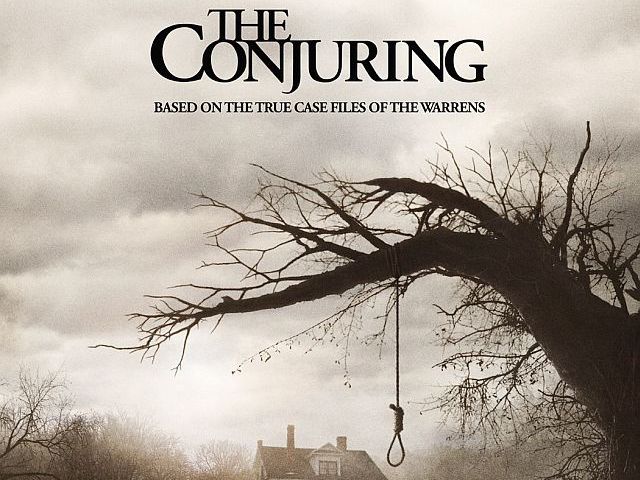
In The Conjuring, death is everywhere and it becomes incarnated via some very stark images. r-THE-CONJURING-large570

Death resides as a dark presence behind the family that occupies the haunted house.  The family is oblivious to its presence but the seer can see it.  Death is hanging by the neck right above the head of an unbeknownst character…its feet dangling overheard as we feel the breeze of its toes brush past our neck.  Death lives behind the door in that dark place we cannot see…climbing its ways onto our beds…tugging at us, pulling us, pressing upon us…and its stench reminds us that this idea we have of death is not as surreal as we first imagined.  Death is guiding our families up stair wells and stair cases…causing us to beat our proverbial heads into those spaces where we think can save ourselves from its evil nothingness.

Death is present.  It is absent.  It is unruly.  It is random.  It is filthy.  It is unkept.  It is chaotic.  And for now, it is final.

Death is the residue of creation that demands some reckoning with its absent presence.  This is why scary movies work.  It’s not the scenes on the screen that bother us…it’s that the scenes on the screen will not stay on the screen and will make their creepy way into our lives, jeopardizing our living.  That’s why we jump when things go bump in the night after watching great possession movies like The Conjuring.  The Conjuring doesn’t bother us…it’s that we too might be conjured and thereby be dead.

Yet, reckoning with death’s residue is exactly what binds Christians and those who think Christ is ridiculous…

And that followers of Jesus have evacuated resurrection and embraced The Conjuring of our Souls via The Conjuring Christ…the ultimate seer…is equally ridiculous and maybe even borderline heretical.

Let me explain.

Most people in America believe in the concept of a soul.  Most people believe that this soul leaves the body and goes somewhere after death.  Christians somehow embrace the Pauline idea that “to be absent in the body is to be present with the Lord”…and also is to be present with me in my house when I feel that sudden waft of cold air that is obviously my dead god-fearing grandmother.

Many people believe there are spirits, evil and good, warring against us, and each other, on a daily basis.  Christians and anti-Christ’s both use the language that the deceased person is in a better place.  Many Christians believe in a literal devil that literally got himself and a 1/3 of all the angels kicked out of heaven (for you KJV readers who think this, you’ll need an Apocrypha to find this story)…and that on their way to hell they have been given free pass to exit and enter hell as they enter and exit weak people whom they might possess.  These evil spirits are what possess us and the historically innocent victims of the movie.  When Christians see The Conjuring…they absolutely think this entire episode could be likely, at least on a minor scale.  And many more conservative Christians would never even watch this movie for fear that they might have exposure to those said evil spirits and bring them to their homes.

Many non-Christians, like the ones on those TLC shows that hunt ghosts, for some weird reason invoke Christian rites when dealing with evil spirits.  People who claim no faith, even the protoganist demonologists in the movie, The Conjuring, don’t show a particular commitment to Christianity, though they use Christian symbols and rites in their anti-conjuring efforts.   The very faith that many people think improbable is at least probably effective on the more probable reality of spirits in our midst…yet those rites are given their efficacy on the very event they deny as improbable: the resurrection of Jesus whom we call the Christ.  Can someone explain this to me?

In other words, there are some very generally accepted ideas about death, what it is, what it means, who survives it, where they go, what they do, and how all this relates to infinitely evil and good spirits that many believe are part of the primordial beginnings of creation.  All this typically surrounds conversation of our “spirit” or “soul” and very little can be delineated by way of difference on these ideas whether one is speaking to a Christian layperson or an anti-Christian post-modern American.

So the non-faithful are embracing the rites of faith, efficacious only on the ridiculous ideas of Jesus and his resurrection, which they don’t believe in…AND the idea of death shared by pro and anti-Christ people is virtually synonymous at a cultural level.

We are seriously confused.

If Christian ideas of beginning and middle are so very different from the narrative of secularity and culture…then why do we as Christians share so closely the view of endings we find to be common currency by those who could care less about Christ?  If beginnings and endings matter…and the beginning of Hawking, et al, is so very dissimilar to the beginnings we found on the Holy, then why are our ideas of ending virtually similar in how we construct them?

If our theology and faith matter, and it matters because of the answers and practices it imposes upon us that choose to follow The Way, then our theology should lead us to a different pronouncement than that shared by The Conjuring…and a culture that seems to have little trouble embracing the pagan idea of a soul but can easily laugh at the idea of resurrection.

There’s a reason that the paranormal is romanticized and fantasized in the form of spirits/souls…and why Zombies are killed.

Dead people don’t come back in the flesh…this is unacceptable and would constitute an Apocalypse (I think biblical authors could agree here).  There is nothing Christian about believing with everyone else that manifestations of The Conjuring and its subsequent manifestations of soulish flights to heaven (or hell) are “what happens” or “could happen” after we die.  Even the Greeks believe this.  What is Christian is not providing ontic purchase to those things that call themselves real while denying reality to the event by which all reality must stand in measure: the resurrection of one they call the Christ.

jesus-resurrection

Thinking our death is one of the most difficult things to honestly do…thinking our non-existence.

Death is not just a residue, or remainder, of all those who have been born and died so that we too might also be born and die, but from a Christian theological perspective death is a theological residue of the resurrection.  Jesus, as the resurrected one, leaves behind a millennia of tombs that are still coated with the presence of death.  The tombs have not given up their dead…the residue simply thickens as history progresses.

Existentially, this bothers us…death bothers us.  It is such a bother that even those that want to completely throw off the paranormality of metaphysics are left embracing some bizarre form of metaphysics in order to feel good about what happens when they are done living their hedonistic lives…and Christians do the same, only in obverse.  Christians embrace a bizarre metaphysics of existence as a reward for physical deprecation.  In the end, they both hope in the same thing…the same status and form of existence…and the Christian just makes themselves feel better because at least their soul makes its way beside Lazarus.  As my former professor of Church history would never tire of telling us, form and content people, form and content…two sides of the same coin.

But maybe there is a third way.

We do not need a Conjuring Christ to call forth our platonic souls from their evil material cages when we die.  We do not need a Christ to Conjure us with his magic and all of a sudden make known what is only now perceived via our ability to reason and the fountain of our vision.

No!  To believe that Christ is a conjurer of dead people is to believe he is nothing more than some sort of spiritual witch, an extension of God’s self that does things that he tells others in the biblical narrative to flee…like pursuing seers and diviners.  Jesus is not a conjurer and God is not the collective holder of Plotinus’ basket of souls that are at home in the being of God waiting to be dropped into this miserable thing we call “flesh” (shout out to my Southern Baptists if you will).

What we need is to divest ourselves from these fallacies and have a theology and faith that is consistent from beginning to end.  We need to affirm an ending that is marked by its beginning and vice versa.  We need to be unique in our idea of hope, not only in regard to things such as soteriology, Christology, etc., but also extend that uniquely Christian flavor to our ideas of eschatology, the consummation of history…extend our uniqueness to our idea of death.

D. Stephen Long, in his book The Goodness of God, notes that a good life is marked by an equally good death and that we as a culture, specifically as a church, have forgotten how to die good deaths.

I have pondered this idea for many years now and what it might mean.  Perhaps, part of dying a good death is not placing our hope in something we have always been taught and presume it to be biblical…but maybe a good death begins when we are aware that our beginning and ending all end up in the same place: in the empty tomb of Christ that marks our birth and resurrection into the infinity of divine mystery.

The Conjuring Christ is not the one that sits by our death beds and gives us the options to haunt our relatives, or take flight to heavenly bliss…a good death is not marked by the certainty of the soul conjurer we call Jesus.

A good death is relegating our very existence into the grace that we cannot understand and into that mystery we call God…and our hope is that in that space is one/One who is/was Resurrected.


It’s called The Book of Revelation, not “Revelations”

Revelations End

The most popular and feared book of the Bible, the Book of Revelation, suffers a thousand deaths every time someone gets this wrong. You can hear it at any coffee shop (at least in my town), church parking lot, or casual argument at work when a co-worker is trying to convince you of all the things they have learned from Hal Lindsey or John Hagee. Heck, you’ll probably even hear it around the Thanksgiving dinner table or around the Christmas Tree of Baby Jesus. As with many arguments, this phrase is often used to win, to be right. The Bible is the ultimate trump card to win all arguments; and let’s face it, it’s not really being used for much else nowadays. The Bible functions apologetically as the proverbial ace up one’s sleeve…and as the ace begins to get slammed on the table in defense of a particular end time scenario this quaint phrase rears its ugly head and becomes the second incarnation of Jesus the Christ as someone says, “Well, the Book of Revelations says…”

Stop. The. Presses.

There is no Book of Revelations. Sometimes this reference to the scariest book in the Bible is just shorthanded. People get lazy, so instead of calling it “The Letter of Revelation,” “The Apocalypse of John,” or even “The Book of Revelation,” we have given it the shorthand name “revelations.”

Perhaps you’ve heard it said like this. As you try to defend the idea that maybe the secular State of Israel is not the same as the ancient historical reality of Israel and then build on that nuance for a deeper appreciation of the complex geopolitical situation of the Middle East, your conversation partner may halt you mid-stream and say, “Well, in Revelations is says…”

Again, there is no “revelations” in the Bible. This may seem like a minor point of contention, something that those of us obsessed with semantics would find amusing while the rest of the world is concerned with praxis and scriptural applicability to our lives.

Not so fast. You see, the language we use builds the worlds in which we live. We construct worlds with our language…our language is not just constructed by our worlds. The same is true for our biblical understandings. The bible doesn’t just shape our language; our language about the Bible also shapes how we understand it. And in this case, confusing “The Apocalypse of Jesus Christ,” or “The Book of Revelation” with “revelations” plural creates a gross methodological starting point wherein we have already begun to read this book incorrectly by our very naming of it wrongly.

Let me quote the first verse of the Book of Revelation, which is also a historical letter to 7 historical Churches. The following is my own translation.

John writes, “The revelation of Jesus Christ that God gave to his servants concerning what must quickly come into being, signifying the sending of its message through his messenger and servant John.”

John does not call the following Letter a series of “revelations” about Jesus nor does he title his message as one of multiple meanings or purposes. His point is clear. He is writing A (singular) Apocalypse about Jesus.

Now, unlike popular parlance would have us believe, the word apocalypse does not mean end of the world, mass destruction, fiery balls of molten rock falling from the sky, visions of John Cusack and the Movie 2012…Apocalypse means none of this. The language of apocalypse has taken on a ton of baggage because of the Book of Revelation for sure, but such has happened not because Revelation warrants it, but because we are reading it as a book full of disasters rather than reading it as The (singular) message of the resurrected Christ we call Jesus and the work God has begun in his ministry.

Apocalypse is the Greek word that means to “reveal,” “to disclose,” or “to make known.” The word does not mean to hide, to puzzle or to cause massive destruction. What John is telling us at the very first sentence of this letter filled with apocalyptic imagery, revelatory imagery of ONE revealing, is that he is about to tell his readers who the Christ is. He is about to define him. He is about to disclose him to the world, not hide him away in some Bible code that only experts with massive book sales can unlock for the rest of us. Revelation is about disclosing the story of God in Christ working to redeem the world and bring about its new creation. It is not about giving John a secret message that his Churches would not understand…a message that would be locked away until 2000 years later when the world is on the verge of economic collapse, Russia and Iran are in cahoots and Israel is now in jeopardy of losing the veracity of its longest standing peace treaty with its very historical neighbor: Egypt.

NO! John is not interested in any of this. He is interested in giving us a vision of Jesus that is grounded in the imagery of the Hebrew Bible in such a way that the story of Jesus is simply the contiguous reality of what God had begun in those ancient stories of Abraham, Isaac and Jacob. He is interested in Revealing Jesus to us! He is not trying to hide the Christ or his workings! And he is busy doing this in a literary type and genre that was used by oppressed peoples who felt as if the only way their worlds could be redeemed was for God to physically break into their present and alter their future.

Apocalypticist’s, such as John, are negative people and they have historical warrant for their lack of prophetic optimism one might find in older prophets such as Isaiah or Jeremiah. Apocalypticist’s use dark imagery, but only because they understand the nature of humanity and they witness to a strong historical track record in which humanity does not come around as it should, it does not follow the message of Christ and it is in love with power and the trappings of the worlds empires.

The people that write letters such as Revelation, Enoch or Esdras are feeling the sledge hammer of evil and they are sharing in the oppression and persecution of their brothers and sisters in Christ. They are writing with inspiration from an oppressed minority that has suffered immeasurably. They are labeled as atheists that wish to subvert the State and are accused of eating their children and drinking their blood in a ceremonial meal we now call Eucharist…for these kinds of people, who have seen their own brothers and sisters used by Nero as human torches to light the Roman skies at night…for these kinds of people, and for a person named John that is in Exile on a remote Island known as Patmos BECAUSE of his faith…for them the only language that will suffice is that of the literary type we now call apocalyptic because there is no other form and positioning of words that is able to not only capture their angst and despair but also provide them hope in a world full of beasts that are getting drunk on the blood of the saints!

But Just because it is a negative literary type that is employed by people of faith from around the years 200BCE to 200CE doesn’t mean that the letters or books that contain these images are trying to hide anything. Indeed the opposite is the case…what they are arguing is that the only way to see reality and the world is through this apocalyptic lens. It is the REAL world, the real picture of what is going on…not the picture of what will happen 2000 years after the writing of the document. John is speaking a word to the present. He is revealing Jesus in the present. He is not hiding Jesus under the Bushel of history awaiting his full disclosure to the enlightened ones amongst us in the year 2013 who have the ability to change all of their interpretations to fit history and to correct all of their previously bad interpretations’.

John is writing to reveal. He is not writing to hide and he titles his letter this in the very FIRST sentence if we will simply stop to read it. Let’s not read this Letter with all the expectations of the people who can’t read Greek…or they do read Greek and just skip the first sentence. You’d think they would have learned something in Elementary School English about context clues and following directions. John is giving us directions before we start reading…and he is telling us he is writing A (singular) revelation (disclosure) of who Jesus the resurrected Christ is as he opposes and destroys evil. He is not trying to hide anything.

Quit trying to play connect the dots…there are no dots to connect. Save your $ and quite buying all those “Left Behind” books and their historical revisionist counterparts that are now making their way on the scene.

So John is writing about A revealing of Jesus that is not convoluted but thoroughly dependent upon the story of God that is told throughout the Hebrew Bible and he is telling it in a singular kind of way.

In other words, it’s called Revelation, not Revelations.

People often confuse all the many images and plot lines that are developing within this mysterious letter with mini-revelations, mini-visions that constitute a larger whole. To a degree, this is correct. John, however, is not writing to give us snippets of historical details that can be understood apart from the resurrection of Jesus…apart from the Lamb of God who rides on his White Horse. There are many images and visions in the letter because the story of God in Christ is long and tedious. It is not easily flattened or easily summarized…it has been building as a metanarrative for at least 2500 years. History such as this that is melded together with a cosmic Christ event cannot be reduced to a mere retelling. It must be poetically and beautifully written so as to captivate its hearers and bring those of us as readers into its world, which is ironically our very own. These images are part of a coherent whole meant to disclose the meaning of Christ and the direction of the world…they are not meant to be read as mini-revelations that all have theological meaning apart from Christ.

All of these visions, chapters, characters, numbers, seals, bowls, prostitutes, angels, witnesses, etc., all of these work harmoniously together to tell the story of God in Christ. To tell the world that Christ is Lord, not Rome. To tell the world that Christ has defeated death, it has not defeated him. To tell the world that Rome is not the new creation, but God is busy about building a New Jerusalem. To tell the world that Jesus we call Christ is the Alpha and the Omega, the beginning and the end…the I AM. This is the SINGULAR revelation (revealing) of the Apocalypse of John.

The way we talk about this letter profoundly affects the way we read it…and sadly, many people read it as if it is a 22 chapter encasement of multiple revelations rather than a part of the Gospel of Jesus the Christ that is attempting to show a singular revelation of this One whom the world crucified but whom God saw fit to resurrect.

Revelation is not meant to be confusing and it’s not meant to scare the you know what out of your you know where. It is meant to cast a vision toward the incarnation of God in Christ and tell ONE story of revealing to a world that is sadly mistaking the Pax Romana, or the Pax Americana, with the Pax Christi. Christ is king, Christ is Lord and he is such because of the work he has done…and John wants us to know of this work. This is why John writes his letter. He wants his churches to know the risen Christ in relation to their world…and as a part of our canon of Christian scripture the Church has said we confess we continue to need it to do so.

So next time you are tempted to skip the first sentence of Revelation, or you get in that discussion at church or with your neighbors about the bible and the last days and they tell you what it says in the “book of revelations,” just remind them that the work of Christ is singular and it is powerful. Confusion is not of God, it’s of the other guy.

And the Apocalypse of Jesus is not so much about destroying the world as it is redeeming lives. You might be surprised that in the face of such Good News, aka Gospel, you may just render them speechless.


God is Nothing: Lacan Wrestles with Thing 1 & Thing 2

thing one and two

“In the symbolic order, the empty spaces are as signifying as the full ones; in reading Freud today, it certainly seems that the first step of the whole of his dialectical movement is constituted by the gap of an emptiness”

-Jacques Lacan in his “Response to Jean Hyppolite’s Commentary on Freud’s ‘Verneinung.’”

Everyone wants something.  They strive for something…some-thing.  We as a society are fixated on the things, the little ‘beings’ or objects to which our attention is directed and for which our work is given.  When we look at the world we see it through the lens of things, of a bunch of somethings, and we turn all of our ideas, hopes, aspirations and longings into various things that we can pursue, participate in or master.  The world is full of things, and as Hannah Arendt is apt to tell us, we have given the world around us the thing nature that it is; the world and its things are “thing-ified” (if I can so gently make that word up) because we have taken the world from what it is and we have conceived of the contents of the world within the limits of what constitutes thingness…what constitutes possession for only a thing can be possessed.

We work for homes, for cars, for piles of things.  We work to secure our lives through the things of our investments…we secure our relationships by the things we invest in them and we derive all meaning from the fact that we are able to take our ideas, generate an imaginary world and then divest ourselves of what is real in search of the always illusive thing.  This quest keeps us questing, keeps us defining, keeps us pursuing the thing/things.

We have made the world so dependent upon the idea of thingness that we cannot even conceive of anything that is not a thing.

I am here reminded of Dr. Seuss’s story The Cat in the Hat.

In this quaint little tale, all of everything (the state of affairs within the children’s home if you will) are fine.  Everything (which is really nothing if you remember…more on this in a few more paragraphs) is fine.  UNTIL someone comes into the life of the children and begins to give the room a “thing” nature.  The Cat in the Hat releases “things” into the house, which ironically disrupts everything (which was really nothing as the Mother left the children alone).  The Cat brings in the thing nature…even brings in real characters known as Thing 1 and Thing 2…and they do things, they play with things, they value the fun they are having with “every-thing” and it is this chaos of thingness that is valued…that even the children valued.

For a short while the “things” happening were a new creation, a new way of being, a new diversion from the nothing they were really experiencing.  They valued this new “thing” and they did not listen to the goldfish swimming in his bowl that was full of nothing and going nowhere, yet somehow the fish in the nothing place that goes nowhere was able to see what happens when “things” get out of control and usurp the space of nothing.  These things were valued, that is, until after several attempts by the goldfish sternly reminded the children that these “things” need to stop and “everything” needs to be cleaned up and ordered aright once again.  In other words, we need to get back to the real that is nothing.

The releasing of everything and its chaos into the nothingness of the empty home wreaked havoc even as it also preoccupied the children for a short time with new “things” to watch, see and do.  Into a room of nothing, everything was created…and everything that was created was shown to be nothing more than a diversion from the Real of life that happens apart from “thingness”…the  mundane space which conditions who we are…the space that is more determined by nothing than by the false ontology of thingness.  The children thought the “things” were fun and properly teleological in orientation, yet by the end of the story they discover it is a teleology that goes nowhere and does nothing more than distract us from what really conditions the spaces inhabited by our lives.

We have not given the world a thing nature for purely entertaining reasons as these children were so apt to do (though we have done this), but this thing nature has occurred because of our misdirected sense that what is and what will be is constituted more by the presence of a/the thing, than by nothing.  We have filled our worlds with things to rid ourselves of the nothing…yet the joke is on us.  We cannot rid ourselves of nothing even with the thing as Lacan so aptly notes above.

We have done this, not only in regard to the physical things we enjoy, but also into those metaphysical realities to which we give allegiance and service.  Of course, in our late capitalist culture, the world has taken on the very nature of the thing.  That is why we live.  But why has the thing nature also dictated how we think our faith, our God and the meaning of our lives?

Because we have so thoroughly conceived of the nature of reality as the nature of the thing, it seems that God, Jesus, faith, the ecclesiastical community, our salvation, etc., have all become nothing more than a long list of things; a long list of possessions that give us identity.  They are things that are, things that matter, things that will be…God is nothing more than the thing to which I pray or the thing I fear.  The church is the thing I do on Sunday to ensure I am in proper relationship with the Thing I call God so that this God will bless me with another thing.  My faith is the thing that makes me who I am and conditions how I engage the world…and my salvation is the thing I have because so long as I have it this thing is mine…and because I have all these things, I AM SOMETHING.  To be without these ultimate metaphysical things, things that are grossly conceived as all other things in our language and habits, is to mean that I am nothing, no one, not a something.  These things make me who I am.

I can “see” them.

I can “feel” them.

I can experience them.

I can “touch” them.

I can think them.

These things have become concretized into our thing schematization because we can think the world only in relation to the thing.

But this is where we are wrong.

The thing does not make us who we are or create our worlds.  The thing has no ontological purchase of its own; its only purchasing power comes from us who invest the currency of the thing with value.   The thing is not an end and it is not a beginning.  Thingness is not realness and it is not absoluteness.   We think our lives, worlds and faith(s) are all about being properly directed toward the right thing, but what Lacan discloses to us is that it is not the thing that shapes who we are or where we are going; it is the nothing that does all this.  We want to think there is something, yet our lives are all really the result of the reality of the nothing…the nothing that is disguised as some-thing via the thing that is really nothing apart from the nothing that makes it a thing.

All that may sound a bit circular, confusing even.  I promise I am not writing to confuse.  So let me break this down and then argue the point a bit further:

There is not anything other than nothing.  Nothing is…there is no such thing as a thing apart from the nothing which gives rise to the world in our vision, though this is a world that rests its things on nothing; it’s not a world that ends nothing with a world of things.

We have so conceived of the world via a thing nature, or a particular type of ontic character, that we have left behind the role that nothing plays in making us everything we are…even as this idea of absence and nothing is still nowhere to be found.

Nothing conditions how we speak, what we value, what we pursue, those “things” we are fearful to pursue.  Nothing is what places us where we are and it is only relation to that nothing that meaning can be created or generated.  This is one of the main thrusts of nihilistic philosophy.  It is not a philosophy that argues for some sort of black hole abysmal reality where there is no meaning; on the contrary, it is only because nothing is that everything can have meaning for a thing only has meaning in relation to nothing.  Apart from this frame of reference, a thing is lost in itself without any analogous referent from which it may make sense.  Apart from nothing a thing is not even a thing…and therefore, apart from nothing we too are nothing.  Thus, nothing is.  So while we strive to forget nothing by thinking everything, we lost in the process an important part of ourselves and what makes us who we are.

Lacan goes well beneath Heidegger’s own idea of Geworfenheit here…

Lacan notes, “But the subject has a no less convincing sense if he encounters the symbol that he originally excised from his Bejahung.  For this symbol does not enter the imaginary, for all that.  It constitutes, as Freud tells us, that which truly does not exist; as such, it ek-sists, for nothing exists except against a supposed background of absence.  Nothing exists except insofar as it does not exist.”

He goes on to the quote at the beginning of this essay, “it certainly seems that the first step of the whole of the dialectical movement is constituted by the gap of an emptiness.”

What Lacan is observing in his response to the famous psychoanalyst Jean Hyppolite is that our lives are negotiated more from the gaps of nothing than by the imaginary worlds we have built for ourselves.  Nothing is the condition of meaning because the symbolic order rests on this negation of things in order for meaning to be construed.  It is only  because there is an absence that a presence appears.

The bejahung that Lacan mentions is Freud’s term for our original primordial inception into the symbolic order.  It is the original affirmation that we did not affirm.  Our place in this order, an order which does not exist but exists apart from itself, is really nothing…it’s a place we cannot place anywhere, it is nowhere, yet its constitution as nowhere means that it is the nothing that is somewhere.  The bejahung is our inception into that order (language, symbols, sounds, meaning, body language, ideas,etc.), an original inception that is no longer available to us but surfaces in us at moments of repressed desires, visions, déjà vu, dreams, etc.  It is the place into which we are plunged and emerge with the symbolic, with language, yet we cannot recount the making of the symbolic or its highs or lows.  We are people of symbols yet the genesis of the symbols have long been lost in ek-sistence of the bejahung that’s nothingness allows for the existence of other symbolic things, which really do not exist.  Or as Lacan notes, “Nothing exists except insofar as it does not exist.”

Thus, our worlds and the things we fill them with are really nothing and they reside nowhere but the places we have granted them to reside.  The emptiness of our minds, the places where we do not think but where we really are, is more indicative of our condition then are all the things we create and all the imaginary’s we fabricate.

So if our worlds are really conditioned by nothing and the foreclosure of our language into a specific symbolic order, what does this mean for those things that mean most to us…those things that we can place our in our hands, our heart and our minds?

It means that we are not driven from or toward the places we can grasp, but we are perpetually the creation of what has grasped us even as it has nothing to grasp us with.  The gap between there and here, where and there, is the gap and nothing that makes us as much who we are as all the fabricated things we have created to hide from the gap that is nothing, yet has made us everything.

These spaces that are nothing are really the spaces that fill our lives…it is the nothing of the lives we wish we could have that surface in our consciousness and produce the world we think we see.  Only because the fabrications of our worlds do not really exist, because they are nothing, do they present themselves into the symbolic order as an imaginary thing.  The fact that things appear to us in the present and we aim for them in the future, only do so because they are nothing and do not exist anywhere, thus our very “thing” nature of the world is really driven by the world we do not see toward the place we do not know with “things” that aren’t really there…meaning they are the things that are not really us or the real that remains allusive.

If the thing nature of the world we have created is merely that which has taken us away from the place of nothing, and nothing…or that which is no longer available to us, is that which constitutes our moving, thinking and being, than what does that say for our faith and its objects if we continue to call them things?  Perhaps, to begin this conversation aright…we should begin not by saying all those things that are things and then seek about defining them in our possession…but perhaps with Lacan, we should take a more apophatic approach.

For if as a people of faith we claim that God is where we come from, where we are and where we are going…perhaps we are not discussing a thing known as God…

Perhaps what we are saying is that God is nothing

From The Pew

A Layman's Look At The Gospel

Flora Fiction

Creative Space + Literary Magazine

The Bibliofile

Book Reviews, Books, Bestsellers, Literary Fiction

bookconscious

"Books are humanity in print." Barbara Tuchman

existentialmoonwalking

A few impossible things before breakfast are always on the menu.

Beautiful Life with Cancer

Discovering the Gift

Victoria Elizabeth Ann

Leader. Writer. Employee Development Specialist.

COOL MEDIUM

Media, Space, Technology

Lynette Noni

Embrace The Wonder

Malcolm Guite

Blog for poet and singer-songwriter Malcolm Guite

WHEN THE WHORLS FUSE

REALITY IS MARVELOUS

The Charnel-House

From Bauhaus to Beinhaus

Damyanti Biswas

For lovers of reading, crime writing, crime fiction

Christianity in the 21st Century

The Search for Truth and Meaning as a 21st century Christian

Yard Sale of the Mind

The Price is Right

The Paschal Imagination

Where the Aporia of Faith Meets Phenomena

Where the Aporia of Faith Meets Phenomena