Speaking of Noah


Noah

There is nothing that intersects Church and Culture as much as a Hollywood portrayal of a beloved Bible story. The reactions to the recently released Paramount Pictures film Noah has continued to prove this true.

Upon hearing of the proposed production of the film many Christians preemptively began to be suspicious, simultaneously anticipating its release but perilously curious to see how Hollywood might butcher their Vacation Bible School themes of old. A tight lid was kept on the film and there was little information about the film online until its release. Since then, the cultural noise coming from Christian critics and defenders alike has come to deafening levels.

Yet despite a haze of persuasive Christian personalities pleading with their constituents to avoid the picture, the film has had a strong showing at the box office; it’s as if the critics are having the opposite effect of their intent and theaters continued to be packed for the film even after pleas of abstention.

In its first weekend Noah grossed $44 million dollars in the US and had an International gross of $51 million. In Russia, the film grossed $17 million becoming the best release ever for a non-sequel film. For a film that cost $130 million to make, it was well on its way.

By its second weekend at the box office Noah has eclipsed the $100 million dollar mark and set box opening box office records in several countries such as Brazil, Germany and Peru. Italy, France and Japanese markets open to the film this coming weekend.

This strong showing has not assuaged the dismissals of many Christians. Before people have even seen the film they are relying on their trusted cultural voices to guide their viewing decisions. In a land where people prize liberty, freedom and personal choice, many Christians are glad to let their trusted prophets decide for them.

But many of the criticisms have nothing to do with the quality of the story or the imagination of the directors. Even picking on the CGI seems like a stretch to me, especially if these viewers enjoyed Star Wars or Lord of the Rings.  The criticisms seem to universally focus on its portrayal of the “actual” flood narrative and the misconstrual of characters such as Noah, especially since the Bible is crystal clear about the personality traits of Noah (tongue in cheek*).

To add further insult to injury, many people and beloved bible teachers can’t help but illustrate their extreme biblical and Judeo-Christian tradition illiteracy by attacking characters such as the “Watchers” and the story-line of animosity between Noah and the leader of the cities of Cain.  These characters are not wholesale creations but are an intimate part of apocalyptic Jewish tradition.

For example, the Watchers are embedded in Jewish tradition and extra-canonical texts such as The Book of Watchers via the tradition of Enoch, The book of Jubilees and even the Book of the Giants. They do indeed function as precarious figures who not only teach humanity metallurgy and the like, but also tempt them to sin and evil. But their role in the tradition is firm and poignant.
As for the animosity between the Line of Seth (Noah) and the lineage of Cain, this has long been an interpretation within Jewish Midrashic and Christian attempts to make sense of language that occurs in Genesis referring to “sons of God” and “daughters of man.” While many contemporary Christians make fools of themselves thinking this refers to literal angelic beings, our forbearers knew something else must be done here. This language was interpreted as referring to the two lineages that oppose one another in the film: Seth’s line being the sons of god and Cain’s line being the daughters of men.

What this all points to is not a freelance corruption of the biblical story but an imaginative portrayal utilizing biblical and Jewish traditions to continue telling the story of Noah in uniquely compelling ways. Christians have issue with this imagination, but even within our own Christian tradition Noah was rarely interpreted as a literal event that must be adhered to and retold with narratival integrity. Early Christian interpreters did not see the story of Noah as a literal tale of God’s righteous anger and sadistic justice but as a foreshadowing of Christ.

Following a Christian allegorical representation, the story of Noah foreshadows that righteousness is expected by Christ. Noah is the Christ figure that represents life. The flood is not about literal destruction, but about salvation from death via Christ. The ark is understood as the Church, outside of which there is no salvation. The over indulgence of Noah after the flood which leads to his drunken stupor is read as an allusion to the Eucharist, or thanksgiving, that Christians commemorate when we give thanks and break bread rehearsing one history’s more fateful evenings.

Yet the movies critics persistently bloviate over theological content rather than cinematic presentation. The argument, if there is one, is to be had over the latter, not the former.

The film is being levied as “pagan” with “cultic” keynotes.  Some Christian viewers say that it is an entirely fabricated narrative with little resemblance to how the flood really happened. Other criticisms make fun of the character of the Watchers as unbiblical and more akin to Lord of the Rings than the Bible. Shades of the following are also surfacing: the movie has little character development, God is not the central character, Noah is portrayed as a madman, evolution is being promoted, the movie deviates from the biblical narrative, and the producer is an atheist Jew.

These criticisms are being broadcast on every imaginable form of media and countless people have already found Noah guilty of biblical heresy. For them, this movie is nothing more than something else to stand against, a cultural perversion of God’s Word, even while folks all around are engaging this film and perhaps turning to the pages of Genesis for the first time.

Christians pray for occasions to share their faith and talk about scripture with others, but on this account many are passing up that opportunity…an opportunity to not only dialogue with others but to also dig into their tradition and learn.

It is true that the film takes great liberty to develop and create an entertaining narrative, but who can blame the producers?
The Genesis account of the flood is very sparse and there is little to no character development of Noah, his family or even God for that matter. Read the chapters. You will be surprised how many holes in the story Christians have filled with their imaginations instead of staying strictly to what the bible says. If we want to blame the movie for being sparse on biblical details, blame the exilic editors of the material for not giving us any.

What would a movie being “true” to a verse by verse account of this story even look like? Not even Mel Gibson’s Passion of the Christ followed a verse by verse literal account of the Passion of Jesus and Christians loved that film.

One obvious example is that in the Bible Noah only speaks one time, once! Not exactly what we need from a main protagonist. Yet we act as if we’ve had conversations with him and know him personally. And that one time is when he curses Ham for coming upon his “nakedness” while he is passed out from the fruit of his vineyard after the flood subsides. This curse is the narrative explanation for why the Canaanites are not true heirs of Gods Covenant with Abraham (to be introduced in Genesis 12) and also sets the stage for the Deuteronomic conquests that will comprise large parts of the books of Joshua and Judges.

So Noah gets one sentence in his biblical role and it’s a curse. Not exactly encouraging.

In the movie, Noah never curses his sons and this scene acts as a point of reconciliation for the family. In the film, Noah speaks often, cares about creation, and is a man that loves his family but also vigilantly wants to do God’s will. Sure he has character flaws and we don’t like what we see but this is the producer’s way of making Noah human and articulating our frail humanity in the face of momentously impossible divine callings.

Noah has passions and passions scare the hell out of people without them.

The actual story of Noah in the Bible begs many questions that the text simply doesn’t answer, but which the producer addresses with creativity. Questions such as the following are imaginatively portrayed:

Where did Noah get the wood for the ark? How did he build it? Did anyone try to stop him? What did his family feel during this time? How did the animals arrive? How did the animals ride passively in this ark? Did Noah ever have doubts? How did Noah see the world? What sorts of evil was the world doing? How did the flood start? Where other biblical characters alive and did he interact with them? Did God verbally talk to Noah or is God silent like he is for many of us?

The movies importance is not found in these unique and inconsequential questions, however. The power comes from the themes the movie introduces, themes that get to the core of faith.

noah praying

Have you ever wrestled with your calling and longed for discernment? Noah does too.

Have you ever been compelled by a calling you can never see, just feel? Noah does too.

Have you ever thought about the nature of judgment? So does Noah.

Have you ever thought about how God’s judging might also appear evil? So does Noah’s family.

Have you ever been asked how you’ll do what you’ve been called to do, only to respond, “I am not alone!” So does Noah.

Have you ever thought about your own complicity in the sin and evil of the world? So does Noah.

Have you ever thought about what grace and mercy looks like? Noah begs this question.

Have you ever questioned the character of God? The movie is implicit with theology here.

And unlike critics would have you believe, God is not absent in this film; God is the unseen character driving the plot and these questions stubbornly arise from this film to challenge our faith if we will let it.

Yes, the film takes creative liberties, but the core idea that the world is evil, has turned from its Creator and must now be judged via a great deluge is present.  Further, the film is not whimsical so much as it  taps into the deep roots of Judeo-Christian tradition via the Watchers, the animosity of lineages and even the role of Methusaleh.  Doing some homework would do the blogosphere, and many pulpits, a lot of good.

If we have a problem with the “myth” of the movie, perhaps we really have a problem with our own myths.

For all the banter being leveled against the film it appears that there remains not only a huge cultural interest in the film and its message, but also global interest in religious ideas linked to the bestselling book of all time: the Bible. Such interest and attention needs to be embraced by followers of Jesus, not dismissed because of a faulty perception of how biblical stories must look on the big screen by people who are less than qualified to pass such judgments. If we want something to generate conversation across cultural and religious boundaries here is our chance.

In a context in which the church is becoming increasingly irrelevant for a flood of reasons (pun intended), the church should seize this opportunity to engage discussion about faith with many people who would usually be less than interested. We should seize this time to discuss faith and culture, Christ and context, old stories and the new ones we are creating via our lives.

For a rare time in our culture people are talking about the Bible. This is a good thing.

Let’s make sure we’re joining the conversation without our feet in our mouths.

The Hapless Nihil

hapless nihil

Those moments when you want to write, but feel lost in the sea of your own non ideas…As if every ounce of inspiration has been siphoned from your soul leaving you with nothing but a hollow spirit with clanging walls and cold diameters. And this is the nothing that is everything…the nothing that so stigmatizes your soul that it becomes what is…while the space that was once filled with vibrancy and lumination has become the cavern of respite and indifference…the nothing that weighs everything and the nothing that is absolutely the heaviest thing…that can lodge itself in the consciousness of a human being. How can we shake this cold hard absence? How can we embrace rigor mortise before it makes all resurrection impossible?

It’s easy to stare across the wasteland of intention and see nothing but parched land and tumble weeds. Intention is just that, an unrealized act, an unrealized event…the realization that the realized is pure potential without any form or content other than its own absence. How strange it is to feel this space and emptiness in one’s self. To see passersby occupy this same space, to try to lead them through it, to try to make a friend, only to be dismissed as something you are not.

…and the earth simply becomes more parched…unflinchingly absorbing tears as soon as they plummet to the earth in quiet despair. To be in this place and have absolutely no power, yet it is your place. This is Hell. To scream so loudly that no one hears you. To lift the weight of the world with your soul only to find your soul is simply the custodian of the burden. It’s going nowhere.

How, with your head cocked and fingers longing to be free to touch and feel again, how long does one sit in this squalid silence? To want to stand up and move. To want to be in relation with another anything. But feel pressed down by the force of a gravity you did not create nor can you negotiate. To feel absolutely helpless. To remain silent because you can do nothing else.

A cascade of ideas is not enough to pierce this earth and pry back its cracked ground…and force water into the crevices. A cascade of will…this nothing scoffs at. A cascade of desire sits at the fray of this nothing that is more chaotic than all the things created…and desire just sits…lonesome, knowing her other half is most likely never returning. There will be no homecoming.

The nihil is. When all else seems to fail and the great questions of our day are asked…meaning will simply be reduced to a reduction ad absurdum…laughing at us through its slanted eyes and cursing those of us who long for more than a world that is hapless before darkness. It is so difficult to live a new creation when the old one has been remade without our permission.

Antiques and the Refuse of Capitalism

OLYMPUS DIGITAL CAMERA

A serene sense of dread floods my mind when I peruse the garbage dumps of late capitalism: antique stores.

While many folks peruse the aisle and “booths” of a bygone era and admire the musty, dusty, smell, all I see is a bunch of old stuff that no one else wants…not even the owners of the stuff who rented the booths.  Erstwhile, the joke is on us “shoppers” looking for ways to elevate the National PCE % (Personal Consumption Expenditure) amidst the rubble and refuse of old stuff, stuff not even the owners want to own any longer.

People, consumers, we wade through the refuse of people long gone, passed on to folks trying to peddle their garbage off on others, and we think how “cool” or how “rare” it would be to own this piece of no longer useful material.  Perhaps we can purchase it, set it on the shelf, and admire that we are its new owners: new owners of garbage that will one day be someone else’s after we are gone.

This is the reality that has no given way to the myth, the latter no longer having a firm grip on my understanding of the former.

As a kid, I used to think that antique stores were places that contained deposits of value. Goods that were precious and items that were not to be touched by little fingers who could not consider their real price or worth.  After all, the sign on the glass cabinet did say “DO NOT TOUCH.”  Whatever was behind it must be obsolescently valuable.  Furniture, books, pictures, photos, knives, coins, broaches, etc., are now defined as purposeful and worth the value on their tag because they are old and old means it transcends our present and also its own past.  What used to be considered miniaturized monuments of bygone era are now the relics of my recent past: hello 1985.

Certainly not all “antiques” have just arrived at the antique label.  Some really are “antiques,” memorials to a unique human story that all humans will leave.

My own antique fetish is books.  I love old books, for their stories, their design, and their content that needs to be resurrected.  But even as I love and appreciate old bindings and paper innards, permeated with evanescent ideas only the most stubborn will discover, I acknowledge this is a fetish and the left-over of the productive processes of our economic engine.  For at the end of the day, when the world is replete with books, or things, or “nick nacks,” to what shall we turn them into that might be of value and redeem the castration of resources that had to occur for their very own production?  As we are all on our journey toward a global Easter Island I wonder what it is we will do with all the things our hands have made when our hands desire to no longer make things and we have read all the books that are can read.

Such existential angst hits me even as I enter a strip mall just looking for “useful” “antique” décor to reside in my home.  Perhaps I remain in denial that such thoughts will eventually only lead to nihilism or perhaps I have simply let nihilism take up permanent residence.

Walking through the antique store, moving vendor to vender, I came around the corner and discovered that those ugly plastic super hero thermoses that I used to use when I was 7 are now “antique” chemical composites of value.  I’m thinking “seriously…people think someone else wants to buy this?”

The old NASCAR collectibles I purchased back in 1992, over 20 years ago, are now appearing on shelves beside Martha Washington sewing cabinets…time being the great equalizer.  We know who we are by the company we keep and I suppose we know the value of our things by the things we store beside them.  Sorry Martha.

I even saw the Tin Care Bear lunch box my kindergarten sweetheart used to carry to school is now one shelf below 160 year old blue Mason Jars that could have been used to can food for Robert E. Lee’s army.

Something just felt off.

Herein lays the refuse of capitalism…of production that was productive for a period and made things with purpose, yet now there is no repurposing of these things.  All we can do is hope to sell them to someone who might place value upon them because society no longer values these things.  These were produced for them; we will produce things for us.  And what is not appropriated into the present is just refuse, garbage, resources that are now not so resourceful.

The World is our Garbage Dump because we have turned the world into our garbage.

Of course this is a coarse way to view the world and view productivity.  We do not want to think of ourselves as wasteful or manipulative of resources.  We do not want to think of our actions over the long arc of history, our communal human actions, as having a negative impact on the world.  We don’t want to think that humans before us have simply amassed mountains of plastic, iron and glass that is now buried in the ground or left to live immortally in “antique” stores or warehouses where their “value” can be preserved by transient humans.

If we call it antique, it makes us feel better.  Even what we produce today will one day be called antique; our consumptive needs justifying the productive ends of our irrational economic activity.

The leftovers become refuse and the refuse ends up being the old stuff we find in antique stores…the refuse explosion has only just begun I’m afraid.

Now, I am not a big Adam Smith fan.  Regardless of how we appraise his work, my estimation is that Smith was not a modern day venture/vulture capitalist.  He sincerely believed that markets, services, production, consumption, labor, etc., would occur as human sustenance demanded particular economic trajectories.  I do not think he foresaw the wastefulness of mass production for the teleological purpose of profit at all costs, even at the cost of human community.  The sheer scale of our global economy absolves Smith to a degree, even if logically his economics would lead to the unabated “invisible hand” that is now visibly manipulated by government and regulatory body’s.

Simply put: in our economy we make far more than we need and we think the world is the everlasting depository of that production.  We isolate markets for niche products, produce them to the furthest exponent and then sell them to all those looking to fill the emotional needs no longer being filled by a community of other humans.  We create desire by exacerbating the lack in others via our marketing.  We know the lack is there, world religions have know the lack is there for millennia, so now the secular capitalist mantra is to take advantage of that lack and fill it with fetishes of various stripes that will satiate the desire of our hearts while also leaving us feeling emptier than before.  This tension is felt by folks who “feel” like the lack they have will be satisfied in the act of consumption, so we produce and consume, produce and consume, produce and consume.  It’s why capitalism is so brilliant; It preys on our inherent need.

But the stoking of human emotion is not the only seed of this futile and wasteful production.

The other is our inherent desire to be creative and productive creatures.  We want to be able to survive but survive in meaningful ways.  Many times this meaning is derived from what we are able to generate or produce.  It provides us with a sense of worth and fulfillment, even if the consequences of our self-esteem could have national or globally negative consequences.  We isolate needs, find resources that can fill those (or we even create the need and then give people the resources we say they need for that need), produce them and feel accomplished from the valueless paper (money) we receive in exchange for them.  It’s a vicious cycle.

The problem with continuing to find our worth and value around our economic models, capitalism in particular, is that this cannot be sustained forever.  It is a finite impossibility.  We cannot continue to make refuse and chalk it up to human activity, leftovers, garbage.

First, the garbage has to have somewhere to go.  The world can only sustain so many antique stores.

But secondly, and more importantly, for capitalism to work on its continued skewed trajectory, we face major obstacles of capital flow (and capital here can be the things that are refuse, garbage aka products or even current money looking for an investment home, etc.)  Economic theory aside here’s the problem: capital only exists as it is able to flow and find new depositories and the places into which capital can flow are finite because the world is not infinite.  In other words, capital has to keep flowing: newer markets, people, places, countries, ideas, needs, demands, etc., but as developing nations become developed and as the resources to meet those developments continually become tapped, we face a major obstacle: capital hits a dead end.  It has nowhere else to go.

What happens when capital flow hits the Hoover Dam of economic expansion?

For example, David Harvey powerfully argues that measuring economic success and growth against annual GDP % is a huge mistaken.  First, it is commonly held that 3% growth via GDP supports a healthy economy.  3% is an arbitrary % established whereby economists “know” that the world, and specific countries, are producing a particular level of goods being consumed or being brought to market.  At 3%, it is deemed the economy is healthy and jobs are being produced.  But the problem is that 3% never stays 3%.  As the economy grows or expands that number becomes a compounded number, so that the real measure of growth is a compounded 3% year over year on the entire US economy!  Which means that for our economy to “move” or be “healthy” we have to grow our economy year over year to roughly the size of the ENTIRE US economy in 1970 each year and even further!  And that number just keeps getting bigger.  For us to remain “healthy” politicians incite these numbers as if they are manageable, but the reality is this can only continue to compound so long as capital has a place to go, which is why invisible money was created.  Invisible money, or money that doesn’t exist, allows capital to continually flow and consumption not immediately halt at the very unfortunate event of not having any actual money.

Thus, compounded production and consumption is actually encouraged via the capitalism at work in our present.  For those apologists of capitalism that want to argue its virtues I concur there are several, but these virtues do not change the coming dawn of late capitalism wherein we find ourselves up against the creation of antique malls, ever growing landfills, entire islands in the ocean known as garbage island, and capital overextending itself into non-existence, it’s very life being its very eventual contradiction.

Slavoj Zizek, cultural theorist and critic of the both Left and Right political movements, summarized the inherent contradiction of capitalism and production in his essay “The Prospects of Radical Politics Today.”  Writing on capitalism, its productive nature and critiquing Karl Marx  he says the following:

“What Marx overlooked is that, to put it in the standard Derridean terms, this inherent obstacle/antagonism as the “condi­tion of impossibility” of the full deployment of the productive forces [of capitalism] is simulta­neously its “condition of possibility”: if we abolish the obstacle, the inherent contradiction of capitalism, we do not get the fully unleashed drive to produc­tivity finally delivered of its impediment, but we lose precisely this productivity that seemed to be generated and simultaneously thwarted by capitalism – if we take away the obstacle, the very potential thwarted by this obstacle dissipates … Therein would reside a possible Lacanian critique of Marx, focusing on the ambiguous overlapping between surplus-value and surplus-enjoyment. (It is often said that the ultimate products of capitalism are piles of trash – useless computers, cars, TVs, and VCRs : places like the famous “graveyard” of hun­dreds of abandoned planes in the Mojave desert confront us with the obverse truth of capitalist dynamics, its inert objectal remainder. And it is against this background that one should read the ecological dream-notion of total recycling – in which every remainder is used again – as the ultimate capitalist dream, even if it is couched in the terms of retaining the natural balance on Planet Earth: the dream of the self-propelling circulation of capital which would succeed in leav­ing behind no material residue – the proof of how capitalism can appropriate ideologies which seem to oppose it.)

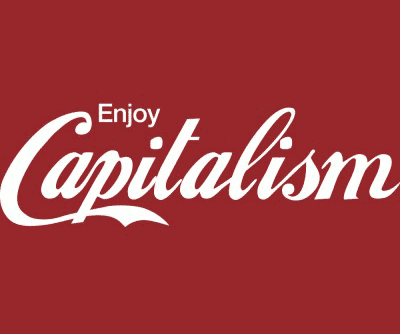
Capitalism Enjoy

What Zizek touches on here is that there is no way around the remainder of capitalism.  If we challenge capitalism at its core as a productive force (the very thing about it that is good) then we cease to have capitalism in its raw form and productivity ad infinitum.  Precisely because it is impossible for capitalism to produce enough is why it continues to produce what is possible: it’s own limits being its own drive and failure.  This is where Zizek says Marx missed it: take away the productive drive and the demon you are attempting to exorcise ceases to exist and so too does any economic will.  The notions of surplus value in things and surplus enjoyment have to go hand in hand via production and consumption because desire always creates abject remainder…and if there is a Lacanian dictum it is thus: Desire is Real.

But the negative consequences of the impossible possibility is refuse and production unabated and continual.  Heaps of garbage that we absolve as antiques or recast into a narrative of continual repurpose wherein all things are recycled and nothing is lost or damaged:  The capitalist dream.

The only question is: as you drive by rising man made mountains along interstates and you see your own closets…as you incarnate the 4.6lbs of trash you produce as a human each day and you realize that there are 8 Billion people on the planet doing the same…you have to ask yourself…can we afford to continue to have this dream or should we start dreaming something else for the sake of posterity?

Because one day we will all be forced to wake up.

When Writing is Impossible

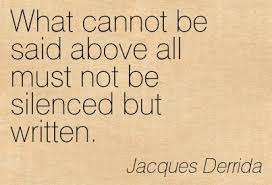
Derrida quote

Words, like statuesque monuments of brick and mortar foreclosed by economic eras past, struggle in vain to rise out of the rubble of their origins…stretching to the surface to breath, like Pauline prayers of souls that can only speak with moans.

Recently, I have found that it is difficult to write, difficult to even produce this sentence or write in ways that synergistically combine my passion and intellect with words that can convey more than themselves.  When it’s difficult to write, maybe writing about why it is difficult to write is the right place to start writing.

So I write why it is impossible to write, hoping I may actually write in my non-writing.

There are moments when the subject and object of our writing makes speaking of itself impossible…when the act of writing simply fails to comprise its subject.  To reference theological discourse, these are moments when we speak of silence and tranquility as we stare into the eternal gaze of the numinous object of our incredible urge to speak.  Our words fall short.  We write to transcend our place, seeking to be carried off by words, but words are simply the substitution for something far more mysterious and real that lies underneath them.

At moments like this, when we realize the disconnect between what we write, and what we write about, and that writing about it is an infinite impossibility that will only produce words that continue to mangle our imaginations even as it gets us close enough to never see it…at moments like this we write, we speak, but we know our writing will never get it right.

We write as a response to the infinite; not in an attempt to encase it.

Yet, this is what makes writing impossible as an act.  Writing feels impossible at moments, at seasons, because it is our attempt to span the chasm of the genesis of our internal echoes into paradigms of symbolic exchange that might somehow bring meaning from the abyss of our deepest subjectivity.  And this is impossible.  It feels impossible because it is.  Nothing can be written only because the only thing we can write is nothing. This is why theological, philosophical, lyrical, and narratival imagination is necessary for the writer.  Without imagination the subject and object of writing is betrayed by prose that falls empty and shoddy, derelict of any contoured image that might make writing worth writing at all.  Writing comprehends itself as the inability to satisfy the imagination with traces of its content, even as it leaves its true meaning behind, lost in the relation of its symbols.  The only way to suppress writings urge to speak nothing is to imaginatively portray the place from where it comes…to look back on itself via a linguistic inversion and see from where it was thrown.

But this conundrum of writing is inherent in the task.  The theory and nature of language is one that refuses its purpose, and thereby, becomes its purpose.

Martin Heidegger in his On The Way To Language delicately describes the balancing act of language and its inability to speak.  He writes, “There is some evidence that the essential nature of language flatly refuses to express itself in words – in the language, that is, in which we make statements about language.  If language everywhere withholds its nature in this sense, then such withholding is in the very nature of language.  Thus, language not only holds back when we speak it in the accustomed ways, but this its holding back is determined by the fact that language holds back its own origin and so denies its being…”

What Heidegger is so accurately portraying and defining is that language itself always holds itself back by its very nature.  It can never contain the whole of its occasion, of its purpose.  Writing occurs at the intersection of origin and community, an originary act to create community and speak within the boundaries of language games yet also knowing that the game is that what we speak will never be spoken because our own medium of speaking, language, is never capable of speaking past its own medium; its very nature does not allow it to say what it means to say.  It is only capable of being a trace of an expression that seeks to be said but as soon as the expression, idea or passion is seen via words or heard via language it loses itself as it enters the symbolic order in which language and words make sense.

To draw illusion to Lacan, one could say that language, writing it, speaking it, is not real; yet language is because the real exists.

And this is not to be nihilistic about language; rather it’s just a simply discussion about the very nature of language itself.

Writing language further confounds the writer because the real of its subject matter, whether it be God, beauty, meaning, truth, passion, story, etc., is always ahead of the medium in which it is communicated.  Just because writing is never occurring as an act of definition that actually says what it means to say, does not mean that what precedes writing is not real or truthful; it doesn’t mean that which gives language and writing occasion doesn’t exist.

But our speaking, our writing, the incessant drive to communicate something that swells within us and claws at our insides peering outside our pores into a world it thinks longs to receive it, always follows what we are saying.  The said is not what is trying to be said but it is all that can be said.  It is always removed from it as said.  Not only does language (& its medium of speaking or writing) itself refuse encapsulation to speak itself, but it is most clearly the incarnation of following language.  The said never catches up to language because language cannot “overtake” what it is attempting to take into itself via its speaking.  To do so would mean to remain in silence because silence would be the only thing that puts us close to saying anything without removing ourselves from it.

So writing doesn’t just seem impossible at times, but it is impossible, the most ludicrous act in which humanity engages.  Our prose fails us.  Our sentences languish.  We rewrite and re-edit.  We try to say it just right knowing that can never happen.  All that can happen is a vacillation around the kernel of the originary moment from which writing comes, a place so deep within the speaking and writing subject that access to its recesses is to plumb depths that are too real to even exist.

The revelation of the revelatory nature of language leaves us hapless.  No wonder speaking is so difficult.  No wonder meaning is so elusive.  No wonder that intense moment inside of us never satisfactorily emerges into a meaningful expression.  The very nature of language, of the things we attempt to speak about, not to mention the hearing and reading part of our language, is to disrupt and betray itself…to exist in wistful repetition hoping that saying it repetitively will take it from there to here.

This reality is what manifests itself when writing is impossible.  This is what happens when one simply can’t write.  This is what is happening when your hands and your mind do not make the agreement that is necessary to produce something worth reading or worth saying.  We are coming up against the very nature of language and we are not able to transgress it and extract our demands from it.

These are the moments when you stare at your screen…screaming in silence words you want to commit to the page, but when you go to write you are trapped in your own ideas of saying nothing because you have everything to say, which means, of course, that nothing is what you have wanted to say all along.  And at the end of the day we will have said nothing as we must say it again and again, hoping that speaking it often enough will affirm its illusory nature.

Writing mocks us because we are bound to language, even as we think we have tamed it with our crafty literary techniques.

This is what is happening when writing becomes impossible.  In dialectical fashion, it is this existential angst rolled up in our inability to write, or speak, which is also a manifestation of writing itself, communication turning in on itself an becoming incommunicable writing that communicates everything it cannot say by saying it.  We stand in the face of our unspeaking, of writing chasing language and language that cannot be harnessed that says more than we can ever say by wishing we could say it.  This negation of language that is language is the speaking of truth even as it must first speak a lie…since lies are all that can be spoken via words that never speak truthfully.

As we stare blankly at screens, our minds racing and anger building at the sights of fingers that cannot move to the rhythm of meaning or hands that cannot write otherwise than themselves, we experience first-hand the impossible possibility of language, of speaking or writing it.  Thus, we should not lose heart when we remain speechless.  The very need to use speech at all will render us all speechless at various intervals.  The Gospel of language is this: Language produces its own speechlessness.

So when is writing impossible?  Always.

It’s not that writing ever becomes impossible; it’s that writing is impossible…always already impossible even in the most lucid prose…and it’s in the moments of profound difficulty wherein that impossibility is simply made more acute.

In the Beginning was the Word.

Be Free in Christ, Ditch the Rules

Joy of living

“One thing, and only one thing, is necessary for Christian life, righteousness, and freedom. That one thing is the most holy Word of God, the gospel of Christ.” –Luther

And Jesus said to the masses, “Come to me all ye who are weary and heavy laden…and be introduced to my list of rules.” (Matthew 11.28)

This is the Gospel in modern day America or at least in the conservative South.

Long have we left behind a love for the Word of God, and its many revelatory moments, and shortly have we embraced a Gospel of “do this” and “do that” if you want to be Christian.

Tragically, we may have never even heard the word of God because we have been too busy hearing our own words as the Word of God.

It’s funny actually…thinking we are reading words that tell us God’s Word and only seeing ourselves.  Silly humans who think they believe in Jesus when they really just believe in themselves.

As a kid I grew up in a very conservative bible believing Church.  I was weaned on sermons of the Premillenial Return of Jesus, a church full of backsliding Christians, and mandatory monthly salvation experiences because the sanctification we failed to fully receive last month didn’t quite stick.

The hermeneutic that was employed was largely a very literal reading of the Bible.

The dictum, “the bible says, I believe it, that settles it” would have fit in well.

Far be it from many of them that the bible only says what it says because they were reading it from a particular historical and ideological bend.  I digress.

Even in this setting, it was never blatantly stated, “Come and receive Jesus into your heart and then receive his rules to make sure he stays in your heart.”

This wasn’t spoken, but this was the assumption.

People were not “saved” to freedom.  They were actually “saved” from the bondage of themselves to the bondage of Christ, which ironically often turned into bondage to themselves.

Far be it from all those preachers that St. Augustine had one day said, “Love God and do what you please.”

The Gospel was a call for bondage disguised in a call for freedom.  Only after accepting this Gospel was one plagued with the burden of performing it.  It was sustained by our actions, as if our actions maintained its legitimacy in our lives.

We were invited to altars to be “saved” and we were invoked to “let Jesus into our heart” and after that prayer was prayed we were then introduced to a Christ whose yoke was not easy, whose burden did not give rest and whose eyes were constantly judging our every move.

Where exactly had the goodnews gone?

Was the goodnews, the Gospel, the eventual hope in heaven?  Cause we all knew the bad news, the bad news that by accepting Christ’s salvation we just accepted his rules and became subject to his chastisement and the chastisement of those who “love” him.

The Gospel could inversely be titled, “Get Saved, Get Rules” or to paraphrase a famous hymn, “All things are ready come to the rules…”  Nevermind the feast that only includes Welch’s grape juice.

At least Jesus has been working on a rule book since the Ascension and is preparing that place for us.

At this point, Slavoj Zizek is right.  When Christ asks us for nothing he is really asking us for our everything…he is not asking us to be free…he is asking us to be a slave without real freedom, not even freedom in Christ.  Freedom in Christ functions as a smoke screen to take away the liberty of salvation.

How in the world has the Gospel been reduced to this…to a simple list of rules and held hostage by a faith more dependent on our faithfulness to a fabricated ethic than the faithfulness of Christ?

Why have we preferred the list of Paul’s rules for his robust theology of justification, love, redemption incarnation and resurrection?   Shouldn’t we attempt to understand these ideas so we might better understand any ethical guidance since theological affirmations preceded ethical guidance?

Why have we looked to reinvigorate Leviticus when Jesus brought the end of this world, it’s norms and it’s structures, to a consummation in his resurrection?

Rather than understanding the message of Leviticus via what it is saying, we have emphasized what it is says and foregone its formative function to make a people…a people that Jesus seemed to think could still be created absent a rigid formal adherence to its mandates.

Why have we preferred a flat boring prescriptional Bible that we can easily manipulate and contain in our actions over a living scripture that seeks to challenge us at every turn and renarrate the world into something that looks like the end of the world known as Jesus lifted up for us?

We have turned the bible into a rule book.  It is now, unofficially, a historical rule book, nothing more nothing less.  It flatly tells us what we have to DO in order to BE Christian and STAY Christian.  Case closed.  This is its job. 

It is just the dictionary to heaven for the uber pious without any analogical, tropological or allegorical application!  (Historical methods of reading scripture in the early church that are not rational/ethical/literal in nature)

Is it little wonder people, young people, aren’t interested in the Gospel?  We have given them a bunch of rules rather than engendered a passion for the story of Jesus.

We have given them a bible that has less nuance than Dr. Seuss and a witness that demonstrates we care more about waging culture wars for Jesus rather than creating the culture of Kingdom.

Who wants such a Bible and such a faith?  To whom does it appeal?

It’s boring.  It’s easy.  It’s about as deep as a 2nd grade education…and after a person is “saved” this 2nd grade knowledge is supposed to pacify us with its lists until we enter the pearly gates at some indefinite period of time in the near future.

Thanks but no thanks.

There’s nothing of any depth here…just listen online, and at work, to all the shallow people that seem to follow Jesus and how they read the Bible.  It will make you sick to see and hear what the Gospel has been turned into.

There is a lot of news close to this premature Gospel but there is no goodnews to be found.

I can hear it now…but ParanormalChrist…Jesus fulfilled the Law, he didn’t abolish it.  We have to have rules!!  How do we know who wins in the end if we don’t have rules?

As if Christianity is a game of Monopoly.

religion-sets-rules-jesus-sets-you-free

Did Jesus come to invalidate the Law?

In Matthew 5 he seems to suggest no, but his no is a yes via his interpretation of the Law.  Jesus only says no so he in fact can reform the law into something more than it is.  This is one of the tricks of Matthews Gospel!

Jesus broke all kinds of Law!

He ate with sinners: tax collectors, women of ill repute and fisherman.  He extended forgiveness under his own authority.  He walked longer than a Sabbaths day walk and plucked wheat on the Sabbath.  He kept women close by.  He walked through cemeteries.  We don’t once see him ceremonially washing himself before ANY act of ministry.  He outright contradicted Moses with his famous, “you have heard is said BUT I say…” statements.  Etc., Etc., I digress.

Jesus’ relationship with the Law is a bit different than we like to think.

How have we let something as awesome and ineffable as the Incarnation of God in Jesus Christ be turned into a dry list of rules?  How have we limited something as limitless as scripture???

Why have we reduced our faith to an ethical norm, one that historically is probably only as old as the Puritans, you know, those folks who occupied New England 400 years ago and made Jesus the Christ culpable in a few historical curiosities?

Why have we not taken Paul serious when he says that in Christ all things are lawful?

In Corinthians, Paul states that when he is with Jews he will not eat meat sacrificed to idols but when he is with Greeks he encourages the divine barbeque.

What’s going on here?  Is Paul being Petra’s “Chameleon” changing with his surroundings?  Is Paul being a New Testament hypocrite, coming under the Book of Revelation’s warning to “luke warm Christians” or is Paul being fully free in Christ and living out his faith as one not bound by the law?

Perhaps Paul believes the Gospel transcends petty ethical norms that have nothing to do with believing Jesus is somehow incarnate God and humanities great hope.

There is no one more qualified than Paul to say that our theology, our faith, our kerygma, is larger than our religious understanding.  Here is a man that lived and breathed the law, by heart, hid it in his heart!  And yet after seeing Jesus Christ…the resurrected Jesus became his agenda, not his obedience to Leviticus, Deuteronomy or any cultural standard grounded in human norms.

Yet we have not taken Paul’s advice.  We have not followed Jesus or read the Gospels careful enough.

We have confused the Gospel with its “rules” and many, many, many of the “rules” we invoke have no firm grounding biblically or theologically.  They are the products of Puritan holdovers and of fundamentalist interpretation of scripture of the past 125 years, making for one deadly combination that seeks to zap the life right out of the Gospel and dematerialize a very material redemption alive in Jesus.

Being Christian now means…follow these rules:

Read this book.  Pray this often.  Don’t do this.  Don’t do that.

If others don’t like it, well, they are going to hell anyway.  I’m going to get fat and happy with my 2nd grade faith and the list of rules given to me by the teacher.

I like Paul’s rules, not his theology.  I didn’t even know he had theology.

I like Jesus’ ministry, but not his take on Moses.

I like the teachings of the church, but only when those teachings take the appearance of actions that momma and them always told me.

And on and on and on.

For those of you who don’t follow Jesus because the Gospel is presented like this.  I don’t blame you.  I wouldn’t either.

It saddens me that we have traded in a robust faith and a deepening understanding of God in Christ as revealed through the powerful pages of the Bible for a faith that has been reduced to Aristotle…a faith that is just a list to do.

The Sermon on the Mount has become The Nichomachean Ethics.

Jesus is no longer the eschatological prophet of God…Jesus and his followers are just supreme ethicists with Gnostic aspirations…but this helps them sleep at night and helps them control their eternal “destiny,” which is why Jesus came in the first place (insert sarcasm here).

Jeremy Bentham and John Stuart Mill would be proud.

Too bad it’s their Gospel we are proclaiming and not that of Jesus.

It’s a shame really.  The world could really use a good word right about now.

Shiny New Humans: A Story & Theology of Personhood

old man window

The walls to the lunchroom were tattered and torn.  It gave the feel of a war zone; it was.  Just not the kind most people imagine.

Floor tiles along the corridor were chipped and worn.  The smell of paint filled the air, as if chemical warfare was present and I would stumble into a trench at any moment.  The lights above us gave off the dull buzz of a light trying to pierce more than its fair share of fog.  Dull plastic covers acting as a shield for the fluorescent sun lined the hall above our heads.

The corridor was empty, but lined along its pathway were holes blown into the walls.  Some people would call these rooms; they resembled caves.

Doors open; you’re invited.  Curtains pulled; please rescind this open invitation.

Lies posted on the back of the taverns: “get well soon” and “thinking of you” and “we miss you.”

Lies. There is only one way to leave this place. 

The lie of optimism extended to someone to pacify our guilt as the cave we have built for them will hide their faces from the light of our day.  Visitors are rare; people don’t like visiting the front lines where death and our life finally stare at one another through the barbed wire of uncertainty.

The sign said “excuse our construction.”  I couldn’t help but wonder if any real construction was present in this facility.  The walls could be repaired, the caves could be covered but those living here found themselves at the end of the earth’s garbage heap, discarded to the demilitarized zone of a world only populated by its prisoners and occasioned by those we pay to clean up the bodies.

I came to a break in the path; it led to the place that is somewhere, but when you arrive you have really arrived nowhere. 

I stared out at the lunch room, loud murmurings and crooked faces decorating the landscape.  A sea of white hair, wrinkled garments and arthritic hands betrayed my senses; I sensed more than I wished.  Disheveled masses of flesh… persons, at least I think they were persons, were being attended to in the wasteland of rectangular boundaries.  There was snow outside, 3 inches on the hand rails of the sidewalks; it was colder inside.

I’ve never been frostbitten until I saw the eyes of these no longer shiny new humans.

Someone was humming; She couldn’t hold her fork as it’s blunt clanking against her bowl rang across the room over, and over, and over, again.  Another was wearing a bib that stretched to his waist as he coughed up the food he was attempting to eat.  Saturated in spit, the fellow of no more than 40 smiled, coughed, gagged.  He was wearing a Stetson but this was no commercial.

Another lady, sitting in her chair with supports to keep her upright, could not perform the simple task of drinking her milk.  She was attended to by a few of our mercenaries who took turns.  The milk would hit her lips, run across the side of her face and then down her chin.  She would utter unintelligible profanities, perhaps cursing her plight, cursing that her mind and her body were no longer harmonious; cursing that she could no better drink milk than she could make her mouth utter what her mind contained.

Then I saw him.  The patriarch of the family.

We tapped his shoulder.  He was turned around by a hired hand.  He stared up at us, piercing us with his crystal blue eyes.  I thought I saw his childhood when his eyes met mine.  I saw life.  Recognition.  It’s that kind of look that says “I know you” but “I have no idea why you are so familiar.”  It is fidelity and betrayal in one glance.

Then there was that grip.  No one has a grip like him.  We stooped low to hug and embrace him, shaking his hand with my right hand and pulling him as close as possible with my left.  He knew the motions.

But his hands could still grip like a man 30 years younger.  He had the kind of hands that swallows yours when you shook it, the kind of grip that lets you know this man is more than the shell of his body.  I looked at his hands as he shook mine, his fingers still firm and resolved, and his veins still protruding with intense rage.  I’d seen these hands my entire life, felt them as a kid who wrestled against them and admired them as they incarnated the mountains they once occupied.

Muscle memory.

His body lay trapped in his godforsaken chair, his legs symbolic stubs of atrophy that have finally immobilized him.  From this chair to his bed and from his bed to this chair: his daily journey.

We sat down next to him, pulling chairs up alongside the table where we would share a meal.

Is eating at the same table the same thing as sharing?  We shared space cause words were not present.

We were brought coffee, I got the “good stuff” as apparently everyone else got the “bad stuff,” you know, coffee without the stimulant that makes it worth drinking.  Grandpa had hot chocolate.  Of course he did.  He’s always had a sweet tooth.  He drank two cups.  We helped him stir his cocoa and watched as he balanced the petite white mug from the table to his lips, his hands shaking the entire time.

The image of his once powerful hands now unable to balance an elevated crevice encapsulated with glass.  A feather had never been so heavy.

He didn’t waste time.  He drank his cocoa quickly and then they brought “food.”  They even brought me some.  I ate it out of courtesy and thankfulness.  Grandpa’s food was mush.  He has no teeth now so all his food must be puréed.  He began eating; we watched. 

He fell asleep.

He woke up. 

We tried speaking with him.  He couldn’t speak more than a few words, single sentences, the utterances of a man suffering from the PTSD of losing your wife, losing your home, losing your bearings and, finally, losing your shininess.

One of us left the lunch table to use the restroom.  Grandpa had been asleep a few minutes.  The bowl of portage that was some form of pureed beef stew, now found itself as a thumb rest for his massive hand.  Here lays a human, one that was once so strong and now whose hands had forgotten their place.  He woke up, I held his hand in mind, wiped it clean.  The man who would once refuse the help of anyone, especially when it comes to personal space, now has no choice.  His hand was held there, lofted above the table, as now the one that had served so many people must now suffer the service of others.

When he awoke one of us had returned.  He was startled.

We hadn’t been there.

He stared blankly surprised by our presence.  It was Groundhog Day only it happened in a matter of minutes.  I asked him if he had received any calls from family members.  I named them.  His reply, “They might have.  I don’t know.”

It was not a confident declaration.  It was the timid, exhausted, voice of a man that had resigned himself to his station, trapped in a body that can no longer do what his mind desired and a mind that no longer remembered the desires of its heart.

Then I felt a presence behind me.  A woman in a wheelchair bumped me.  I turned and looked, she is missing her leg from the kneecap down on her right leg.  She says “I’m just playing.  I’m not doing anything wrong.”  She continued…making her way around me and she said again, “I’m just playing.”

She knew where she was.  She was lost.

I stared at her and as our eyes met I wondered what she saw when she saw me.  I saw her.  I saw them.  I told her “it was fine”…but she was promptly exiled away from me and told to “wait” until lunch was over before going to her cave.  She couldn’t find her way alone.  She wouldn’t know how…she could no longer follow the path of her shinyness.

We tarried a little while longer.  We watched him finish his food.  We watched as those around him struggled to eat, struggled to talk, struggled to exist.  What would take many of us a matter of minutes had stretched into an entire hour of eating.  The finished menu you ask?  2 glasses of cocoa, a muffin that crumbled into a thousand pieces when you peeled it off the paper, and 1 bowl of pureed beef stew.

An hour later it was over.

We said goodbye.  We bent down as when we arrived.  We hugged him.  He kissed our cheeks as he has for years.  It was still grandpa…yet there is something also pulling him away that we can’t stop.  Here is the body of my grandpa…his body is here, it is still him, but inside he is fighting the war no one else can see…it’s a war we know is happening because now he’s at the place where we put all the humans that no longer shine.

Theology of person

As I recount this narrative, the sounds, sights and smells of visiting my grandfather in his extended care facility on New Year’s Day, a care that is necessary due to medical complications and logistical circumstances that are too much to overcome, it occurred to me that such places are where we put the humans we no longer want.  As a society, these places are not even human recycling centers; they are just drop offs.

There is nothing flashy in this insight.

But it struck me anew because at one time all of the people by whom we were surrounded were once shiny new humans.  As I sat and observed these folks that could no longer “function” in society, the people that required care due to some medical condition beyond their control, it struck me that these same lives that are now in the process of being forgotten were at one time the occasion of smiles, swooning admiration and the pride of their parents.  At one time, these people who now defecate on themselves can hardly stay awake during a meal, whose minds are being riddled with dementia and whose limbs are no more of a hindrance than a help…these people were once celebrated.  They were new at one time.  They were shiny and lustrous.

They were shiny new humans.

That’s hard to imagine isn’t it?

It’s hard to imagine that the lives of those that might now trouble a weak stomach by their very appearance, at one time, were the apple of someone’s eye.  At one time they were held up in a church, dedicated, or baptized.  At one time, their mother held them to her breast and kissed their heads; they were the prize after 9 months of laborious carrying and birthing.   At one time they ran on playgrounds, made their parents proud in a spelling bee.  At one time they sat on their fathers lap, heard bed time stories and were nestled in the sheets of a home filled with the warmth and love of parents.  At one time, they were new and shiny.

At one time, they were human; they were desirable.

They are no longer so.

In places like this they reside, proverbial warzones, with all the usual characters waiting to take their lives and harden the siege upon their bodies.

When there is no one left to call our name, our name is lost in its unspokenness.  Or is it?

A simple visit to an extended care facility can become the catalyst for some profound anthropological questions.

What makes us human?  When we have removed the person from the community of which they are apart, either the community that is public, private or ecclesial, from where does their humanity come?  Are we known as human because of some biological trait or does our humanity come from having our name known and spoken?  Is this final act of separation, one that may or may not be justifiable, our attempt to dehumanize these masses of flesh so that eventually, stripped of all personhood, we can rid ourselves of their uselessness?

If our humanity is such only because of others, what becomes of those who have lost all the others?  The question gets even thicker, and more dialectical, in its irony as we consider what it is that constitutes the human being.

Unlike Kant would suggest, our worlds are not given to us via experience alone.  It is our lone ability to apperceive that gives us our personhood and makes us an agent.  It is indeed our apperception that fits into transcendental (above the person) categories through which we can arrange and make sense of the world, but that world is never absent the one that taught us to speak and welcomed us into it.

We are all members of an originary community.

There is no premature material that we arrange to gain our individuality.  Individuality, in the strict Kantian sense of perception that sifts and arranges data, is impossible because such arrangement is the result of our public consciousness via experience with others in the world they gave to us.  As theologian Robert Jenson notes, “The world that I receive and unify in my experience is always already the world interpreted in the discourse of a community, first the community of the trinity, then the human communities I thereupon inhabit.”

Sorry I just showed my theological hand…yet I think a Lacanian hand regarding language is also not too far afield for any agnostic readers.

From a theological perspective the community via which “raw” data is assimilated is a given to us, but only a given via a grace that is God’s triune community in the history of the world, thus making ourselves part of the divine community.  Our first, and foremost, marker as a person is not, therefore, our biology; it is our relationality.  First, as conversation partners with the divine history and secondarily with one another as creatures of grace within that history.

It’s a history we did not choose nor assimilate as individuals, but was given to us.  It’s a history in which our humanity is located as such.

The very people that gave us the world and taught us to speak by holding us in their hands are now being displaced from the world through the very ones that were once recipients of a world they did not create but were given through them.

In a very strict sense, then, the humanity of God is a prerequisite for the humanity of these persons who are now ostracized in the ghettos of the medical community.  As their humanity is found in God, there humanity is also restored and maintained via the life, death and resurrection of the God that became human and restored the dark places where the world attempts to place the dead.  Their humanity is found in this Passion because this Passion is what calls us by name as we stand outside the tomb feeling its emptiness.

While our identity is very much linked to the humans through which we relate, and our negation of life is very much attempted by the world when we reach a certain age wherein we are thanked for our words but dismissed for our bother, our identity is never totally dependent on what us humans cease to pronounce.

To a degree, a proper sense of theological anthropology is predicated on the other, but in another profound way our identity is never lost simply because we are tossed to the margins of the world and put in places wherein our human needs can no longer be a bother for other humans.  This is because our identity is never presumed because we are named by another creature, but because we are named by the one that makes creatures a community!  My identification, the identification of my grandfather, the man that could not eat without coughing up his food or the lady that could not stop her mouth from uttering profanities even while milk seeped over her chin…all of our identities are first found in the human community that is unified in the story of God in Christ, and this story presents us with our identity even when the names and faces of some of God’s human creatures are forgotten.

It is not the case that our identity is primarily spiritual and therefore personnel; it is the case that the identity of our community of humans in the story of God’s relationality with the world (via others) is what first and foremost grants us an identity that can never be taken away even as parts of humanity (who largely have forgotten the triune God) cease to utter our names.

The masses of flesh and bone, of unintelligible words and grotesquely fashioned faces, of people who spit on the floor and others who find their hands covered in beef stew puree…these are all persons whose names are forever spoken in God even as Christ will one day resurrect this miserable life.

Because we are named in God, and God is present in the resurrected presence of Christ via the power of the Holy Spirit, our names are never unspoken and our personhood is found in God and his human community wherever it is incarnated; this universal story that continues to call out our names.  And it is this story that we never leave, even as those around us choose to slowly write us out of the story we gave to them.

So when people forget to call him dad, or grandpa, and his peers have long forgotten French…there is always Christ who calls him son, a son amongst sons and daughters.

In God, our names and identities find rest.

Jesus is NOT the “reason for the season”


Jesus meme

First, there is Christmas…

Then, there is farce…

The subtle denial of a Holy-day that is held delicately in the balance of adoration and consumption, with the latter giving way to our actions while the former  is trapped in our sensibilities.

Our very way of celebrating it dialectically usurping its truest image.

As we push further into the season of Christmastide, the wave of incarnation supposedly still cresting before us, the season has all but ended.  Christmas trees will come down.  Dickinson’s villages will be put up.

Christmas is over.

There is no tide at the end of our Christmas; it has been lost.  There is no lasting effect of Christmas; its consummation occurred by 9am around countless Christmas trees throughout the world on December 25th.  The season that used to begin on Christmas day and extend into the New Year, has now given way to a fully secularized caricature even by those that say “Jesus is the reason for the season.”

Jesus is the reason for a season that lasts one day…a day that covers the eyes of the Christ with swaddling cloths.

Systemically, there is absolutely no theological understanding of what is occurring at Christmastide.  There is no wide spread reflection amongst those that believe the Christ events occurs in Bethlehem or Nazareth and what the meaning of that event is within the history of the world and the history of ideas.  There is no feast that occurs at twilight of the incarnation.  The season has no patterning that would make us assume culturally that our celebration has some particular Christian character.  The only character the season enjoys now is one of capitalist flavor and misplaced affections wherein we tell ourselves Christmas is not about “things” only to spend the majority of our time with “things” and thinking of the “things” we’d have liked to receive.

Say what we may, but Jesus is not the reason for the season.  He’s not even considered that by those that seem to say that quaint phrase the loudest…their actions denying their language.

Christmas is the lie we tell about ourselves to hide ourselves from our true selves cause the thought of us actually not caring about the “real reason for the season” is unbearable upon the selves that deceive themselves into thinking they care or that Jesus as the Christ of God matters in any real material way.

Christmas, as is now celebrated, is usurped in its very celebration.  Our very means of remembrance also containing the deconstruction of the event itself; we think we inaugurate a Savior but in fact we inaugurate his absolute meaninglessness.

A Christ that is good for nothing but to be born.  A Christ and his story that does not shape our lives more than the culture below the Christ into which he is received.

But this is problematic, because “Christ” and our embodiments of “Christmas” are oxymorons.

The very offensive and effacing concept of Christ does not fit alongside the marketplace of ideas in Christianity.  It doesn’t fit with how we talk, think and act upon Christmas.  Even simple things, such as a Christmas eve service, or a Christmas day service, has been deemed as bothersome because it interferes with the real meaning of the season: family and gift giving.  People who are devout in their faith, those that scream conservatism the loudest and proclaim a culture war has been initiated upon Christmas are at the front of the line in relegating Christmas to a secular holiday void of any meaningful theological content, and certainly void of any religious formation other than grandpas prayer over the turkey at dinner.

Christians have lined up in hordes to embrace an empty Christology that is void of any real spiritual formation and caste in the appearance of the secular dismissal of anything more than a current rush to a particular morning that holds no more content than the anemic form of its arrival.

Christmas has become nothing more than farce…but it can be nothing but farce as the paranormal Christ stands beside it.  There is simply no more stark a comparison nor is there a more deep distinction than the theological content of advent, Immanuel, Christ-event, incarnation and the cultural and ecclesial embodiment Christmas suffers at the hands of those that “love Jesus” and those that could really care less.

The object of desire, the Christ, has been lost in a plenitude of objects that fill nothing but create a greater sense of void in society.  What Lacan calls Object a’s…substitutions for the real object of our desire that lead nowhere but to the end of unwrapping presents as children collectively sigh, “is that all?”

We say we desire the Christ, the event, yet our actions say we really desire the object below the Christ that is really the object of nothing.  It is nothing but brown monochromatic semblances coated with shiny illusions.  The trick is we have lied to ourselves about our intent and our desire when our intent and our desire are clearly seen via its own incarnation in the world.

Christ is not an alter event.  Christmas changes nothing.  There is no theological, ecclesiological, or cultural power to be had here…all of these mean nothing to the masses.  Christ has simply become the conduit through which we satiate our desires and participate in the quest for more…and it’s so perfect because we are able to do it all in the name of God.

How fortunate and perfectly ideal that God wants for us what we want for ourselves.

Jesus quote

We like the object of our power to continue to lure us into the imaginary lands of plenty and more and we like for the real Jesus to stay buried so we can turn him into our version of buddy Christ that approves of our blatant sacrilege.  We justify our excess in the face of a Christ that always excessively gave himself while incessantly refusing the excess of power and things.

Even at Christmas time, or moreover especially at Christmas time, we say that we want our kids to “have a good Christmas” and have “good memories,” but what does that mean besides give them a grand display of everything capitalism has to offer?  What makes a Christmas good?  And why must it be made to be so, when the very incredible event of incarnation and its theological content should be enough to keep us preoccupied as we hold hands with loved ones and actually spend time seeing the feast of the incarnation occur in one another?

I wonder what kind of Christians we are making by celebrating Christmastide as we do and not re-narrating the season to be more than the pinnacle of gifts that explode from under a tree.

If such is not the case, when was the last time Christmas was a spiritual experience for you?

When was the last time your faith was actually made stronger because of this special “season”?

Most Americans can’t name one…must be a first world problem.

But this farcical way of celebrating Christmas, or the Mass of Christ, is to be expected in a late capitalist and decaffeinated Christian society.

We do not value mystery.  We do not value a story that is more than characters and details…and we don’t not think deeply about our faith.

The Bible doesn’t require deep thinking because it is plainly obvious what it means…all the while we bore one another with a dead nativity that does nothing more but provide a photo op for our children’s programs.

Scripture is dead.  The nativity just a detail.  The characters just furniture to fill the room of the story.

Scripture only serves the purpose we have for it and the familiar stories of a tired family, a baby born in the still of the night and strange characters gathering around this child are just the details of how; they are not characters that subtly seek to subvert our sense of self and critique our presumed piety…and certainly there is no sense of a proleptic theological point being made by Matthew in this Gospel…because this would of course go against a plain reading of the Bible. (tongue in cheek)

The baby Christ has become “normal”; the nativity has become nothing more than something to defend in the public square…both have become so decaffeinated that there is effectually nothing that happens when we encounter them or think of them.  Rather than being an audacious story that seeks to challenge our worldviews, we have traded in the para-normality of the event and its characters for something we can digest and feel good about a faith that we have given to ourselves since such self given faith never challenges anybody to be different or to seek forgiveness.

And we know this, but to make our idea of Christmas palatable, and our ideas of the details of these infancy accounts infallible, we simply lie aloud about our true intentions so we can justify the appearance of our actions.

But amdist all the deception, misplaced piety and Christians saying Jesus is “the reason for the season” when there is really no season at all and Jesus better not be the reason we indulge ourselves in fantasy…one thing remains: Christmastide.  And it refuses to be decaffeinated…even if our collective Christian experience insists on a faith that changes nothing, not even “believers.”

There are plenty of reasons for the season, but even Jesus knows he’s not one of them, especially a season that is already over.  Perhaps it is a good thing the season is fleeting…we’d hate to desecrate the Christ any further by making Christ a neo-liberal that would clearly celebrate his nativity like we do.


Advent Sermon: God Comes into the Lights of Evil

lantern

Did you see it?  Did you see them?

All around us, in the darkness, there are lanterns.  Lanterns in the darkness that surround us.

We peer into the darkness, squinting our eyes, attempting to make out a shape or hear a sound.  We peer into the darkness trying to see who’s there.  We peer into the darkness trying to see what is there.

We look and look…we seeing nothing, but specks of light in an ocean of darkness.

The walls of our lives are high…there are times we feel totally safe, as if the walls of our lives cannot be taken.  Yet, as we keep watch in the tower that rises above these walls, we can’t help but notice the lights in the distance, those lanterns, flickering outside the walls of our lives.  We are safe in here…yet out there, darkness creeps closer, and pressing against our lives…the darkness merges ever closer attempting to confuse the cities of our lives with the presence of the darkness.

We see the lanterns.  Still flickering.  Still burning.

In the darkness is the reminder that there is something pressing against us that we cannot make out, that we cannot see, that we cannot hear.  Yet, there is it…it’s presence of the ominous light of silence.  The lantern in the darkness letting us know all might not be well.

“Hear the Word of the Lord given to Isaiah the prophet, “Now it came about in the days of Ahaz, the son of Jotham, the son of Uzziah, the son of Judah, that Rezin the King of Aram and Pekah the son of Ramaliah, King of Israel, went up to Jerusalem to wage war against it, but could not conquer it.  When it was reported to the House of David, saying, “The Arameans have camped in Ephraim, his heart and the hearts of his people shook as the trees of the forest shake with the wind.  The Lord said to Isaiah, say to Ahaz, Take care and be calm , have no fear and do not be fainthearted because of these two stubs of smoldering firebrands because they have said let us go against Judah and terrorize it, and make for ourselves a breach in its walls.  Thus says the Lord, “it shall not come to pass.”  Then the Lord spoke again to Ahaz, saying, “ask a sign for yourself from the Lord your God, make it as low as hell and as high as heaven.  But Ahaz answered, “I will not ask, nor will I test the Lord!”  Then he said, “Listen now, of House of David, is it too slight a thing for you to try the patience of men, that will try the patience of God as well?  Therefore, the Lord himself will give you a sign: Behold, a virgin will be with child and bear a son, and she will call His name Immanuel.  For before the boy will know enough to refuse evil and choose good, the land whose two kings you dread will be forsaken.”  Isaiah 7.10-16

We did not come here today care free.  Not one of us came to this place with a perfect life, without problem, without deficiency.  Not one of us came here unaware that there is something, someone, some opposing and broken force, camped outside of our cities that seek to press against us and overcome us.  We’ve seen the light flickering in the darkness and it fills us with fear and anxiety because we know the lights will move closer and those things holding the lights will seek to breach the walls of ourselves and our homes as they seek to terrorize us and destroy us…

Some of us may already see ladders mounted on the walls and we can only imagine what is it at their bottom, attempting to make their way up and occupy our cities.

What is attempting to occupy you?  What is it that is attempting to overcome you?  What do those lanterns in the darkness mean to you as they move closer, and closer…ever closer to our presumed safety?  What is that makes you shake as a tree in the wind when you hear its marching, see its presence moving closer, maybe begin to hear the faint war songs of those things that seek to take away all hope, all future, and all attempts of salvation?  What are those realities in our lives that announce to each of us…let us go up and terrorize them!

Let us breach their walls and overcome them!

The absence of love.

In our families, between husbands and wives who have forgotten how to love, and have instead chosen to co-exist.

Between children and parents, who take one another for granted, ungrateful for the gift that they are to one another.

Relationships that are shipwrecked on selfishness and torn apart by stubbornness.  The absence of love…people who are so lost in each other’s presence that they are not even sure how to have a simple conversation anymore.

The absence of economic certainty.

Funny thing, in times of economic turmoil and strife, we often take our frustrations out on one another, when one another is all we have to make it through.  Do you have enough or is “not enough” threatening your family?  Is not enough the thing that keeps you from being happy?  Do our pursuits for economic certainty get in the way of us finding ourselves, seeing our loved ones, or cast a vision of the world that simply creates another version of, not enough?

The absence of contentment. 

Discontent seeks to overtake all of us.  Discontentment…it eats us alive and pushes us to create another future wherein we can ensure our contentment.  We are not satisfied with who we are, where we are, what we are and the reason we are here is because of everyone else around us…

The presence of temptation. 

What temptation haunts you?  What thing is it that no one else knows about, that is constantly there, whispering your name, whispering for you to enter?  What thing is that you have never been able to overcome and it has paralyzed you physically and spiritually so that you have even begun to question whether God can forgive you or that you can even resist this stranglehold it has one you?  What is it that seeks to press up against you, from out of the darkness…

What carries the lantern and reminds you that it is always there?

“And I will give you a sign, behold, a virgin, a son, Immanuel.”

invading army

As we stand here, in our cities, worried about what is drawing near and camping all around us, seeking to overtake us at any moment and throw our lives into the abyss, we hear a word of the Lord.  And the word of the Lord is…have patience.

Immanuel.

You may see these things lurking outside your walls.  You may be hearing them try to convince you that there is no deliverance…there is no hope…there is no answer to the problems that fill our lives and threaten to break our relationships.

The Good News of Immanuel, of the sign of God, is that these things do not have the final say.  They are not able to overcome you…they will not breach your walls, they will not have victory, they are nothing but smoldering firebrands whose days are numbered…and by the time the Son comes, by the time Immanuel is in our presence, they will be things of the past and would have given way to a future whose motto is no longer, “us all alone”, but “God with us!”

And here is the beautiful thing about Advent:  Advent happens in the midst of occupation; in the midst of a threat to our lives!

Advent is God’s statement that when the world seems bleak, when your life seems to be threatened, when you have more questions than you have answers, when brokenness and loneliness is attempting to fill your home, when temptation is seeking to become a permanent fixture in your daily existence…when it seems like the terror you’ve been living with has no end…just then, at that moment, when you are unsure about even asking God for a sign…God gives us one anyway and his name is Immanuel.

God.  With. Us.

God is coming to dwell with us Church.  When it would be easier for God to leave us alone to the mess we’ve made, our God makes himself known not as one that determines our lives in some far off place, but as a God that knows that only one answer will do: Immanuel.

In reflecting on the Immanuel passage in a sermon Saint Augustine writes:

“You must remember, brothers and sisters, what a tremendous desire possessed the Saints of old to see the Christ.  They knew he was going to come, and all those who were living devout and blameless lives would say, “Oh, if only that birth may find me still here!  Oh, if only I may see with my own eyes what I believe from God’s Scriptures!” The saints knew who from the Holy Scripture that a virgin was going to give birth as you heard when Isaiah was read: “Behold, a virgin shall conceive in the womb and shall bear a son, and his name shall be called Emmanuel.”  What Emmanuel means the Gospel declares to us, saying, “which is interpreted God with us.”  So do not let it surprise you, unbelieving soul, whoever you are, do not let it strike you as impossible that a virgin should give birth and in giving birth remain a virgin.  Realize that it was God who was born, and you will not be surprised at a virgin giving birth.  So then, to prove to you how the saints and just men and women of old longed to see what was granted to this old man Simeon, our Lord Jesus Christ said, when speaking to his disciples , “Many just men and prophets have wished to see what you see and have not seen it; and to hear what you hear and have not heard it.”

I propose the words of Jesus to his disciples are not only to them, but to us also…and the words of Augustine are not merely for his church, but for us in the present…

For indeed, many just men, women and prophets have wished to see what we see and to hear what we have heard…lives spent in anticipation and expectation longing to see what we see and hear what we have heard and experience what we have, and are, going to experience.

The question this advent becomes for us all: when we see, will we believe?  When we hear will we listen? “Therefore, the Lord said to you Church, “Behold, a virgin will be with child and bear a son and she will call his name Emmanuel…which translated means, God with us.”

As the lanterns burn around the camps of our lives: Emmanuel.  God with us.  Amen.

Why You should Love Antiquarian Books

old book image
A prerequisite to loving old books is, of course, an enjoyment for reading. One can appreciate old books, collect old books, and admire the architecture of their spines and ornate cover designs without reading. But this is to love the value of the books or their aesthetic appeal. This is not the same as loving old books. It is not to get caught in the life of the old book itself, to look upon this simple object with words and covers and feel something more than an object of value.

I have discovered that I am book addict. I like books. I buy them. But there is something about an old text, an antique text, that has a whole other appeal to me than the latest modern novel or the latest academic musings.

As I hold an old book I realize a few things.

First, the life of the author rushes through my mind.

I imagine a person that prior to modern distractions poured their shade and energy into this text. Someone who by a dimly lit light, or perhaps even a candle, pen in hand, quarreling with their imaginations how to speak what cannot be spoken. How this pre-post-modern person toiled with their ultimate concern and endowed their characters or their topic with the same passion that occasioned this act of creation at the beginning. Books are pieces of people with dreams, hopes and aspirations. The text is the collision of the author and their context…the latter of which is usually lost on us and the former of which we think to be mechanical.

An example is a recent antique book I bought by Mary Johnston. Her two volume civil war historical fiction, “The Long Roll,” & “Ceasing Fire,” (ca. 1911 & 1912) are fictional attempts to honor and boldly imagine the Confederate struggle from within a Confederate sympathy a generation after the conflict.  Long before the genre of war fiction took hold, Mary Johnston was trailblazing a new way of writing fiction inside history, a bold attempt to give historical figures an additional life.

But what makes Mary so alluring to me as I hold her books is that she was the daughter of Confederate General Joseph Johnston, the last General to make a stand against Sherman in Resaca, Ga, May 1864. Here is the child of a man that made history and was part of the deepest and darkest conflict in our nation. Here is a woman born in the South during Reconstruction, her life animated by the stories her father told her, feelings that have not yet healed from the conflict. Here is a woman that probably still shared the lost dreams, lost hopes, and lost loves of a lost cause. When I hold her book I wonder what was she thinking, why choose this scene, what she felt as she recounted these memories and stories and did she cry as she began to blend history with fiction. Was her book the process of writing her dream and justifying her affections? Were these books exploding inside her or were the words like removing the sword from Kings Arthurs stone?

The thing about old books is that they are written by old people, people now dead but who were once living…people like us. So when I see an old book, I think about the author and I ask, “what was this life that thought writing these words were worth the time, energy and sacrifice?” “What passion is here that I cannot see yet I need to feel?”

Second, I like old books because I don’t imagine we know more than their authors.

One of the most efficient lies of the Enlightenment is that of progress.

The general public thinking they have progressed past the opinions and ideas contained in these old dusty pages. Whole worldviews and animations have been lost because we are so confident that our perspective on history is the correct one. We rarely consult antique books for anything more than mantle decorations when within them one might find that our ideas are not nearly so novel. We think their opinions or stories to be irrelevant on history and we formulate our historical, fictional, scientific, or whatever opinion, absent the people who actually lived and wrote about it as it was happening.

We forget the wise words of Ecclesiastes, “there is nothing new under the sun.”

And this generality extends to fiction as well.

As any great author will tell you, fiction is always contextual, erected from a world of events that make the fiction pertinent. To read fiction as if it is created in a vacuum is to misread it and to think we generate thoughts blindly.

As George Orwell explains in his little monograph Why I Write, “Above all it is your civilization, it is you. However much you hate it or laugh at it, you will never be happy away from it for any length of time…Good or evil, it is yours, you belong to it, and this side of the grave you will never get away from the marks it has given you.”

The context of this passage is the influence of Wells’ Englishness on his work and its interaction with the world. But his point is noted: our writing is always a writing of civilization and generally the really well written fiction is always about imaginatively encountering a non-fictive problem with characters and words that are able to take the heat of criticism and enter places the author would never be able to venture.

Writings is always time-full.

Thus, time would fail us to imagine all the idiots that have commented on Evolution and never actually read Darwin or considered his context!

Time would fail us to recount all the idiot politicians that have never read a stitch of political theory such as Rousseau, Locke or Hobbes, let alone actually read American founding Fathers that read them such as Jefferson and Franklin

Time would fail to note how much anti-southern sentiment has been forged apart from reading any Southern literature from the 1840s-1880’s!

Time would fail to recount all the people that love to invoke Shakespeare because it makes them sound smart yet they have never thought deeply about any play he wrote!

And herein lays the problem: our opinions are often baseless because they are without history, fictive, non-fictive or otherwise. We have our opinions and they are informed by nothing but ourselves…as if our ideas born when they are necessarily implies they are forward progress.

But we should not be relegated to ahistorical opinions because we have old books that allow us to position ourselves historically. Old books contain sentiments against, and within which, we are able to position ourselves and participate with those that have lived and died. We are able to partake of their wisdom, read the words of lives less busy but far more passionate, and imagine a world in which entertainment, education and imagination blend together in indistinguishable ways.

Thirdly, I imagine all the people that have held the book I now I hold.

As I sit among dusty books, many of which as old as my great grandparents x5, I imagine all the hands that have sat on porches or in libraries and held this very book. I imagine why they would bother. What had the hands experienced before or after reading this that would make this book worth their time?

On a daily basis many of us are removed from the dead, they are still and alone in their graves on the outcroppings of hills we have long forgotten. Yet when I hold a book published in 1870 I am instantly in connection with someone that is no longer with us.

My hands are turning the same pages. I am holding the same covers…I am perhaps even placing my fingers in the same places on the same pages as someone who is now deceased but has come to this book for a reason, a reason that might not be dissimilar to mine. I read this old text, write and talk about it with my friends. Perhaps those who owned this book long before me did the same.

Old books are symbols of dead people, writers from which they originated and owners who can no longer hold them because they are no longer physically present.

It is this piece of people and the invisible mark they leave behind that enthralls me, captures me and churns my mind. In an eerie way I feel as if the people I will never know I now instantly know because I have shared history with them…we have shared this book. And long after I am dead someone will share this book with me even if they do not realize it.

Fourth, the smell of old books is the smell of paper that has lived.

There is nothing like walking into a room filled with books, the smell of time bursting through your senses. To stare up at the stacks of time that are lost, yet found, preserved yet forgotten, is as close as we get to an incarnate representation of human creativity. Ancient civilizations have built monuments and stones that are still reminders of their creativity, but these are now giving way to weather and time.

But words…words cannot be destroyed.

They can be torn from their sentences but they cannot be lost. They will always find their way back home no matter how much fire is heaped on the pages that contain them. Roman arches may have fallen and Greek Temples may be decimated, but the words of Parmenides, Anaxagoras, Plato and Marcus Aurelius still live.

Taking an old book into your hands, opening it up and shuffling its pages produces that distinctly old book smell…the smell of time, of aged paper, of ideas inviting you to pause and consider that the smell can take you somewhere.

Old books have lived.

They have been carried through heartbreak. They have been secured in backpacks during wartime. They have been the relief of troubled souls wandering the four corners of the earth. They have been expressions of joy and inspiration for their readers. They have slid around on the floor board of old carriages or sat in the window sills of widows who have lost their loves. They have been hid under old saloon counters waiting to be read by bartenders at the end of the night. They have even been carried by prostitutes and read after a long nights work, feeding the imaginative and intellectual need of a woman or man that had been trapped in this dark industry, the participants of which are now all dead.

Books have lived.

They have been carried by people into countless places, read for a plethora of reasons and now they are still here, speaking to us, as we hold them in the same way as history has always held them since their inception from the press.

So, I confess again, I love old books.

As I hold an old book, I hold poetry that can never be held. I hear dreams that were once only seen. I sympathize with the author and envision them standing beside me. I weep for their loss, share in their joys and continue to toil over the problems their book addresses…and I wonder how many eyes have seen these words in these very pages…stared at them like me…and wonder how much of their soul soaked up these words.

The warmth of hands that held these books long before I was here is still present…and I wonder if hands in the future will feel the warmth of my own imprint on these very books.

Go and Sin…Bravely

sin bravely text

As I prepared for seminary after finishing my bachelor’s degree, a well-respected and articulate professor of mine said, “Go to seminary, study hard, but have fun. Theology is pointless if you’re not having fun.” I’d like to think what I have done since then has been a quest in having fun…and reading Sin Bravely has certainly been an extension, and affirmation, of all the fun being Christian is supposed to be.

It’s not the typical fare I read, or discuss here at ParanormalChrist, but an excursus of theological fun is in order in case you think what I do here usually sucks.

So if you’re not having fun, please stop, put down your Christianity and find the one that is fun.

In a life plagued by interesting the mixture of classic American Liberalism and Puritan anthropological expressions of the Self, this small text goes to the heart of what happens when we turn our faith and our religion inward rather than outward: We become cowardly sinners who think our faith is FOR us and to support OUR worldviews as the INTENTION of God.

Funny how God always thinks like us isn’t it?

The title is catchy, and is in fact why I picked it up, “Sin Bravely,” but the text is not a book that promotes a life that is free from societal obligations nor does it reject personal behavior that is founded in the Gospel of Jesus called the Christ.

The text is, rather, a call to have fun in life, to have fun being a Christian, to have fun engaging our lives as brave sinners…because that is in fact all we are: Sinners saved by grace. Note that Paul does not use a past tense in the Greek there.

To those with holiness tradition sensibilities (i.e., most Wesleyan and American Holiness traditions) this may come as a surprise. At least it did for me, but Ellingsen was a trusty guide through those Augustinian/Lutheran forests.  Historically, Augustine won the debate on defining sin, but in these traditions Pelagius has really taken center stage. Even the late Dr. Bill Greathouse (a renowned theologian and leader in the Church of the Nazarene) quipped after a General Assembly to a colleague, as he was laughing, “we’re all just a bunch of Pelagians,” and this comment after a debate on the floor following how the denomination was to define sin in its articles of faith.

Ellingson is trying to free us from that moral certitude, or overly humanistic perspective, that is touted by folks like Purpose Driven Life author Rick Warren or the similarly related prosperity preacher Joel Osteen (that which is the result of misapplying historical figures such as Jacob Arminius, John Wesley or even the Apostle Paul for that matter).

These authors, along with strong currents of American ideology, promote a “do it yourself” Christianity that seems to equate purpose with a focus upon the self (even though they profess such is not the case). Jesus is to be followed because he enables you to be a better you…though I don’t recall reading this in the Gospels. I digress. Warren, Osteen and their entourage, equate ones success with ones efforts…efforts that can overcome our humanity and align ourselves with God’s “purpose” which somehow also looks like the vision of the world offered via the American Dream.

This is good, and commendable to a degree, but the problem arises when the “steps” are followed and the “purpose” discovered…and we continue to look more American in our materiality and philosophies and less Christian all the while. It’s hard to be prophetic when you’re not really being prophetic…go figure.

In other words, the vision offered in the Purpose Driven model is one that looks like a success story within the American Dream.  The only thing that makes it different is that it is peppered with Jesus…not to mention all this talk of purpose is still talk directed upon ourselves, for ourselves.

The goal becomes the self and its actualization. Christianity and Jesus are just the vehicles by which we actualize ourselves. This doesn’t really sound a whole lot like the words of one who said, “unless you pick up your cross and follow me.”

And this is where “Brave Sinning” takes center stage.

Ellingsen is writing from a Reformed theological perspective, Lutheran to be exact, and he is following Luther’s Augustinian theology of concupiscent desire to discuss sin as not only those things that people do by omission or commission, but all our activities by which our self is the goal, the end, of the action.

And not only are our actions selfish, but even the act of faith and religious expression since being religious (having faith) is something we do for the self…as something that is self-ish…self-centered…so to it is sin. Even reading this review, or stopping to read this review, is an act of self-decision for self-benefit…and hence marred in the sin of selfishness.

This is what Luther and Augustine mean by those bound by sin, Luther’s idea of being simultaneously sinner and justified. It is not an idea hatched in Calvinist Hell as some would observe; it is, rather, the idea that at any point wherein the self is the driving force of the action the action is sinful.

Thus, sin is ever present because our egos always play a role in our decisions. We cannot escape our condition…or as the writer of Ecclesiastes is apt to note, “there is not one righteous, no not one.” Whether it be helping someone pray, writing a sermon, giving to the poor, asking God for forgiveness, mowing our yard, being kind to our spouses, being an awesome teacher to students etc., etc., all these actions have benefits for the self and were the self not benefited in some way than most of us would not do them.

This is what separates us from Christ:  Christ partook in action for the gain of nothing…as humans we do not know how to do that.

Even the act of confession is a sinful act whereby we are confessing our sins to save our “souls” from hell…and in the holiness traditions that speak of sanctification the goal is really a negation of the self in order to find the “real” spiritual self.  Hence even this pious theological idea of purity is still an act of spiritual actualization that is not selfless…in fact it is totally centered on the self.

And that is a profound theological trick: to convince people we are not interested in the self only to really preach a gospel that makes us better selves, feeling better about ourselves and creating a path whereby the self we hate becomes the self we can love.

Thus, Elingsen writes to inform us that once we realize we are all sinners to the core, selfish ego-centric beings, we can then be free to sin bravely.

We can bravely help the poor, preach the Gospel, petition for peace, give to others, bury the dead,  marry the happy,  help a child with their homework., etc., because we know that we do these things as people who are not pure in our intentions but who do them as sinners and do them so that God can turn our actions into something greater than our motives, no matter how pure we think them to be.

sinboldy

In other words, we do them as sinners saved by grace in thought and practice, not as people who do them thinking we are worthy because of our holy intentions. Once we are released from the idea of purity in motive and act, we are then free to sin bravely, courageously, and to embody a Gospel that is authentic and honest…and one that is much more fun than a list of Puritan rules whereby we are the author and sustainer of our faith via our actions that “keep” us “right” with God.

Ellingsen reminds us of the words of Augustine, “love God and do what you will.”

A heart turned toward God will love God through its actions, yet it will do it lost in the space of God’s grace and not beholden to an ideal of purpose and prosperity that remains focused on the self rather than focused on the God wherein the self is to reside. A perpetual quest for self, whether secular or religious, leads to a fragmented society of fragmented people…that take themselves too seriously and get caught up in their own importance as they pursue themselves.

But a life that is committed to brave sinning will face the world in hope and freedom. Hope in the Christ that has made us more than we could ever be and free to be ourselves as those that engage in the playful realities of life that we like to call business, and God just calls playtime.

I leave you with the words of Ellingsen

“So Sin Bravely! But believe and rejoice in Christ even more bravely…as long as we live here in this world we will have to sin, but no sin will separate us from Christ. Have fun, too!”

From The Pew

A Layman's Look At The Gospel

Flora Fiction

Creative Space + Literary Magazine

The Bibliofile

Book Reviews, Books, Bestsellers, Literary Fiction

bookconscious

"Books are humanity in print." Barbara Tuchman

existentialmoonwalking

A few impossible things before breakfast are always on the menu.

Beautiful Life with Cancer

Discovering the Gift

Victoria Elizabeth Ann

Leader. Writer. Employee Development Specialist.

COOL MEDIUM

Media, Space, Technology

Lynette Noni

Embrace The Wonder

Malcolm Guite

Blog for poet and singer-songwriter Malcolm Guite

WHEN THE WHORLS FUSE

REALITY IS MARVELOUS

The Charnel-House

From Bauhaus to Beinhaus

Damyanti Biswas

For lovers of reading, crime writing, crime fiction

Christianity in the 21st Century

The Search for Truth and Meaning as a 21st century Christian

Yard Sale of the Mind

The Price is Right

The Paschal Imagination

Where the Aporia of Faith Meets Phenomena

Where the Aporia of Faith Meets Phenomena