What is “White Privilege?”

privilege

There is a video going viral of a 14 year old boy making an apology tour for “white privilege.”  The video shows a young middle school aged kid reciting a poem at school in which he derides white privilege (thus bringing attention to it) while also refusing to abscond his privilege.

Yes it’s a problem, but no, he’s not voluntarily giving it up. Rather he hopes for the day when no privilege exists.

The video is weird to watch because the kid is 14.  What 14 year old could possibly have been walking around in his own skin self-reflexive enough to understand that his interaction in society is markedly different than people of color?  How has he lived long enough to explore the experiences he recites in his poem?  The parents say they have not “coached” him but it is really hard to imagine all of that came out of his head.

It’s almost like watching a Republican try to speak on behalf of a refugee; it’s just odd and conceptually anachronistic.

After a few minutes of internet trolling this kids poem, it became clear there is a huge disagreement about the topic of the poem: privilege.  Besides all the negative comments about the kid, his parents, and the puppetry that seems to be taking place, privilege is a central issue of disagreement.

Everyone is using the same word but many people are using it differently.

I do not wish to debate the merits of the young man’s poem.  I do, however,  want to look briefly at the concept of privilege because when white people and people of color use this term it is clear we are not sharing in the same Wittgensteinian language game.

First, when people say “white privilege exists” they do not mean that life isn’t hard for white people.  I have heard radio hosts and read many comments wherein this is the interpretation.  This is what has been outraging white people, that the black community, minority communities or the media, seem to be implying that “white privilege” is synonymous with “white ease of life.”

This is simply not the case.

I know many many white people who have hard lives.  I have friends with college degrees who work their butts off and make personal sacrifices to make ends meet for their families and themselves.  I have white friends who are veterans and whom do not have a place of their own to sleep at night. I have family that lives in the Tennessee Appalachia and I see that clearly white privilege doesn’t mean all white people have an easy life, get everything handed to them or that they do not experience discomfort because they are white.

No one is arguing that white people do  life do not suffer.

Life is hard.  It is complex and it can be a tribulation regardless of your skin color.  The term “white privilege” doesn’t negate that your life may be very hard, even if you are white.   All people can have a hard or difficult life; it seems to be an innate part of creation post Adam and Eve.   No one is saying you have an easy life because you are white; you can keep your scars.  No one is taking them from you.

Arriving at that acknowledgment, however, does not now render term “white privilege” meaningless.

Second, the term “white privilege” does not mean you are given first dibs on all the good stuff.  It does not mean that you can skip all societal loops of accomplishment.  It doesn’t mean that you automatically get the best pay, the best job, the best spouse or the best neighborhood.  It doesn’t mean that you automatically get promotions or that you by default are given good grades.

If you have worked hard and accomplished a lot in life…that is great!  You most likely sacrificed time with family/friends for those accomplishments.  I too, am white, and I have spent many hours in study or at work doing what others wouldn’t in order to achieve what others won’t.  I get it.

No one is trying to say you didn’t work hard when they use the term “white privilege.”

President Obama’s comments  “you didn’t build that” made me bristle as much as it did you.   I know what it is like to have employees that want the reward without the work, that want the status without the effort and the notoriety without the sacrifice.  It’s just the country we live in now.  I understand why people of any race react when someone says they have a privileged status yet they have worked hard for everything they have.

I grant you that.  Privilege has not meant you have never had a hard life or that you haven’t worked hard to climb from that life.

These concessions aside, the term “white privilege” is still not meaningless.  It just doesn’t mean what white people think its means.

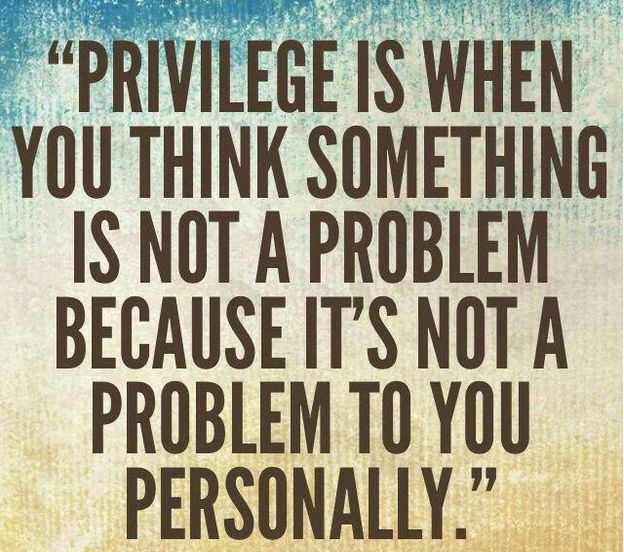
By “white privilege” one usually means that a person who is white is under less suspicion and given the benefit of doubt in many circumstances.  That’s it. 

It means that you have never felt disadvantaged or been looked at with circumspection in routine daily activities because you are white.  Your whiteness, and mine, have given us different life experiences because we have been looked at differently due to the color of our skin.  The worst is never assumed because I am white and driving at midnight; such is most likely not the case for the typical black male.

Simply put, it means there are no societal obstacles to understanding who I am as a white male.  Society allows me the privilege to show who I am by how I act, what I do and the character with which I live my life.  Nothing about me is assumed because I am white. 

I’d be willing to bet that even the poor Appalachian white person would also be given the benefit of the doubt when they are in public.  They may not feel privileged but in that regard they are.  They are poor, but they are white, and in our society that is usually better than being poor and black.  It’s the difference between assuming the white person may have a WIC voucher in their pocket to buy milk while the black person may be watched for theft.

“White privilege” doesn’t mean that black people can’t find work, get equal pay, apply for the same opportunities or even have the same success.   Black people can do everything white people can do in our society and they often do.   It simply means that because of the color of our skin, consciously or unconsciously, the worst is not usually assumed just by looking at us.

“White privilege” also means not having the pressure of being representative of my entire race.   Black men especially don’t have this luxury.

As a white male, if I commit a crime, am rude in public or commit domestic abuse that act stays with me, and me alone.  I bear the responsibility.  My neighbors, fellow church folk and colleagues at work won’t cast my behavior over all white men everywhere.

This simply won’t be said, “Well, Nathan acted like a complete jerk in public and the cops came out to his house to settle a domestic issue…see, just another example of what’s wrong with white people.”

Most people will understand that my actions do not speak for the majority of white males.  Any white male friends of mine will go to work and the grocery store the next day and most likely not experience any suspicion or staring faces because of what I have done. 

 I’m the crazy white dude, not them.

Black men don’t have this luxury.

How many of you have been in class with lots of white people and maybe two black people?  Has there not been a time when the teacher, or a classmate, looks at one of the black people and asks for “the black perspective?”  This happens all the time in campuses across this country.  We all listen intently, many of us gleaning insight into the feelings of someone with a different perspective.  It is an enriching experience, one from which I have benefited.

The problem with this, however, is that it is assumed that the opinion given by one black person is constitutive of ALL black people.  We have a multiplicity of white views but ONE black view.   This is the working assumption.  White people understand that lots of white people think differently, but far too many white people assume all black people (or LGBTQ people for that matter) think the same.  When one black person speaks it is the absolute on the “black experience.”

How can any person be responsible for something so weighty?  I have no idea what it is like to be a black male and know that when I open my mouth people assume I am speaking for, and representing, an entire race of people.  For black men that do this well, kudos, because I cannot imagine how difficult this is socially.

This is what is meant by “white privilege”: it is the privilege to be seen as you are without any assumptions simply based on the color of your skin.  This is it, nothing more, nothing less.

The trouble is white people don’t see this as “white privilege” because they are not aware it is happening (for a fuller expose on whiteness see my other post here).  We just assume all people are looked at the same, treated the same and experience things like us…we don’t know we are privileged in these ways…and honestly, it is hard for white people to even get outside themselves enough to concede this.  Ironically, this is exactly what it means to be privileged.

This does not mean that “white privilege” exists everywhere, all times and with equal proportion but it does mean that as a culture we have presumed ideas that enter our minds when we encounter certain people.  It means that there are nascent assumptions at work in all of us, the production of literally hundreds of years, that silently creep upon us whether we will it or not.

The terminology isn’t about taking anything away from the hard work of white people or their hardships.   Obversely, it doesn’t take away from the fact that just because you are not “privileged” doesn’t mean you can’t work hard and be successful.  Many can and do.

It simply means that when you walk out the door to enter the world, the world will judge you totally and fully by the content of your character and not the color of your skin.  No assumptions.  No stereotypes.  No universals.  You are free to impact the world through your action and the world will only respond to you in kind.

It’s really not a question of whether or not it exists; it’s a question of whether when you sense in yourself this hint at privileging some over others (without any reason or purpose), that you pause and make a choice to change how you will act toward people of difference.  This is the only way the world will change, when people who can act, know to act and then act differently.

It would  be fantastic to limit the labels black, white, etc., to cultural discussions, but until our rhetoric matches our action (and thoughts) we are only deceiving ourselves.  It easy to say you believe “x” until something other than “x” pops in your mind when that different person enters your space, walks near your car, or is seen in your church/neighborhood.

As a Wise man once said, “Do unto others as you would them do to you” (Luke 6.31)
 

Have You Ever Woke Up White?

MLK POST

Have you ever work up and realized you’re white?

I don’t mean have you gotten out of bed in the morning, brushed your teeth and stared at your Caucasian skin, noting blemishes, razor nicks or an unsightly new hair.

I mean, have you ever woken up and REALIZED YOU ARE WHITE?

Well.  I haven’t either…until this week.

Last Wednesday, July 6, I was running late for an appointment.  I was driving, not recklessly, but a little too fast for the speed limit posted.  A police officer clocked me, quickly got behind my vehicle, turned on his lights, and directed me to pull over.  I was doing 55 in a 45.

The officer, who was white, pulled behind my car, parked and delayed approaching my vehicle.  After a few minutes of gathering his thoughts, or perhaps running my tag, he makes his way to my window, stands slightly out of sight and over my left shoulder and asks “How are you doing today sir?”  I could see him from my peripheral vision because he avoided standing directly beside my car, presumably to protect himself not knowing whom he had just pulled over.

My reply was instant and without concern, “Well officer, I was fine until I was pulled over.”

The officer looked at me and replied, “Well, I understand that.  Have a good day and be safe.”

I replied, “Thank you officer, I’ll watch my speed”

This entire encounter took maybe 60 seconds.  It was the fastest interaction I have ever had with an officer.  At the time, I was thankful for its brevity.

Tuesday evening, July 5, news broke about the altercation between police and Alton Sterling, a black man hustling outside a convenient store in Baton Rouge, LA.  The altercation resulted in Mr. Sterling’s death and an unsightly video of interaction went viral.

Later Wednesday evening, the nation would witness another altercation between a black man and police, which resulted in the death of one Philando Castile.  As with the Louisiana shooting, this one in Minnesota went viral with a video and commentary from his girlfriend that sat next to him as he was shot and dying.

Immediately these events started to shake the foundations of America and the quiet undercurrents of prejudice and violence once again erupted before our eyes.  It’s as if a latent existential crisis had now burst onto the national stage front and center, demanding the attention of everyone.  The shock waves of this violence were instantaneously enormous and threatened to swallow the nation in a race war with endless violence as five Dallas police officers were shot by a black man whose motive for killing them was revenge for the brutality he had recently witnessed, as well as the historical witness of police brutality against the black community.

We are not yet out of the woods.  More violence could be on the way, as one alleged plot to kill police officers has already been foiled.

In an attempt to be peacekeepers and healers, Presidents Bush and Obama spoke at a memorial service for the police, each one offering powerful words of hope and admonition for the future. Town hall meetings are taking place to discuss the tensions between policing and minority communities, protestors are clamoring with their city officials and entire communities are mobilizing to peacefully respond to the current injustices.

It’s not just black people that are seeking change, but many white people are busy advocating for their brothers and sisters in the black community as well. 

As all of this unfolded I began to ask myself, “If I were black would the police stop I encountered Wednesday have been different?”  Can I honestly say that if I were a black man (with all the historical baggage and stereotyping I would be carrying) the officer would have released me in a matter of seconds or would this ordeal have involved a bit more questioning and a longer stop?

Of course, this is hypothetical.  I am not black and there is no way of knowing what the officer would have done if I were, but I don’t think it too far afield to assume that if I were black I would have been detained a few minutes longer, I would have been asked a few more questions, and might have even walked away with a ticket rather than an exhortation to “be safe.”

I really hate writing about this.  I don’t want to comment on race.  I want to ignore it and pretend it isn’t an issue.

I don’t want to write about it.  I don’t want to talk about it.  I want to stay out of the fray.

It is safer to be quite and not say anything.

Yet, how can I not speak up when there is clearly a higher level of suspicion against those with black skin than those with white skin, even when it comes to routine traffic stops.

We do have a race problem in this country and the only people saying otherwise are privileged white people who have never experienced a racist sentiment against them in their lives.  Trying to be white and say race doesn’t matter is like telling someone who’s been abused emotionally it doesn’t matter that they are abused because you’ve never been abused emotionally by anyone.  Their abuse is obviously their misperception of what is happening; it’s not the truth of the matter.  The truth of the matter is they have behaved badly and they most likely deserve the emotional abuse.

Who’s going to say that to another person who has EXPERIENCED ABUSE?  My non-experience cannot negate the experience of another.  It’s simply a different witness but it doesn’t nullify someone with a contrary witness.

That logic doesn’t make any clear sense.  Yet this is exactly what white people do to black people.

We discount their experiences because our perceptions of their experiences are not the same, therefore, they must be misguided and if they’d just drop pointing out to everyone that they are black this whole thing would be better…but isn’t this the epitome of bigotry and racism, thinking ourselves better than others?  Thinking our WHITE ideas (since they happen inside our white bodies) are more exact than BLACK ideas or experiences?

If our ideas are only ideas that would occur to WHITE people, and no black person within our sphere of influence would share them, should that not cause us to pause and say “hold up, maybe my idea isn’t as objective as I thought…maybe I have this idea because I am White??”

In other words, it is not that our whiteness or blackness makes the ideas; It is our skin color that allows us the experiences in life that often give formation to the ideas.

This is a distinction that even the most brilliant talking heads fail to make.

The experiences that ingrain skills, dispositions, and habits into us are usually unconscious; it happens to us without our knowing.  In academic terms it becomes what Pierre Bourdieu calls our habitus.  But there is good news; we are not doomed to our habitus forever.

Bourdieu notes, “Habitus is not the fate that some people read into it.  Being a product of history, it is an open system of dispositions that is constantly subjected to experiences, and therefore, constantly affected by them in a way that either reinforces or modifies its structures.  It is durable BUT NOT ETERNAL [my bold].  Having said this, I must immediately add that there is a probability, inscribed in social destiny associated with definite social conditions, that experiences will confirm habitus, because most people are statistically bound to encounter circumstances that tend to agree with those that originally fashioned their habitus.”

To break this down further, one might say we think, act and are disposed in particular ways because of our particular histories.  Our history provides us with normative habits we can live by and use to make sense of the world.  Our habits also usually decided for us in that they are the result of our social/linguistic conditions (religious, economic, political, sexual, etc.) and experiences therein. Further, this means that one is most likely to encounter the world in ways that agree with those already framed dispositions or habits.

In other words, you think like a white person because you are white and all that goes along with that…even if you fail to realize it.

The silver lining to this, however, is that habtius is an OPEN SYSTEM OF DISPOSITIONS that is subject to our experiences.  As that which forms due to our experiences, it can also be re-formed by new ones.  We are not stuck being suspicious of certain groups of people.  We are not stuck with certain opinions or views.  The goodnews of Bourdieu is, while habitus can provide insight into why we do what we do, and who we are, we do have the possibility to change when we encounter new experiences that challenge our current habitus!

Did you hear me, we can change!  We are not doomed!

This week, I sat in a room with black colleagues who shared their experiences. Their experience didn’t attempt to negate dead police officers.  Their experience didn’t attempt to say cops never kill white people.  It was just their stories and how these events impacted them.  It wasn’t an either/or; it was “this whole situation sucks…here is why I am.”

One black mother shared how she has to give her sons the talk about how to behave in a car for fear of being pulled over because they are black young men.  She spoke of the fear of when her 15 year old will get his license and whether she should make him wait a few more years to drive for fear of what can happen to a young black man in a car alone.

A black father spoke of the pain this produced inside him, how this impacted his community and how he was paying for his kids to talk to a counselor to make sense of all this.

An older black woman said, “I know this is a new problem for many of you, but I have been living with this problem for 60 years.  This is not new…and in our community we have known this.  I am glad many of you are now finally getting to see what we live every day.”

These comments were in sharp juxtaposition to comments I was seeing on facebook and twitter, all by white people.

Rather than see their status as white people, as privileged people, who will never have to fear that their young boys will get pulled over or fear of being followed through a grocery store because of their skin color, they commented as if they were sages…pronouncing objective truth from inside their white bodies.

Comments such as “it doesn’t matter if you are white, black or blue, we don’t have a race problem in this country, we have a death culture”…Ah, yes, spoken as only a white guy can who has never experienced racial profiling.

On the radio, hosts scream at the top of their lungs about why the President and others keep talking about white this and white that, black this and black that, ostensibly saying we only have a race problem because you all keep talking about it!  Again, only a white person can say something like this.  It’s not that black or white people want to have race as a central issue; it’s that it is a central issue regardless of what we want…and it seems that the only class or race saying it’s not a problem is the race that has never suffered persecution in this country because of their skin color!  Shouldn’t this cause white folks to pause and ask “Why are we the only ones saying this?”

Another great white response is to deflect attention from this violence and pin it on other issues, such as black single parent statistics and children raised in single parent, poverty stricken homes.  This move simply keeps the white person from actually taking a stand against brutality or racism and says that the real problem isn’t “you all” or “them” getting profiled, it’s the black community having so many dead beat dads.

Again, only a white person can say this.  It lacks any sense of empathy to relate to black people and their history with police.

And finally, here is a laundry list of comments by white people that attempts to deflect issues of race, “I didn’t own slaves, I don’t know what they are so mad about…that was 150 years ago, they should get over it…if black people wouldn’t talk about race than race wouldn’t be an issue…This is not my fault…the cops wouldn’t have shot him if they didn’t have good reason…don’t be in the wrong place and bad things won’t happen…black on black crime is the real problem, not police brutality…why do just black lives matter, don’t all lives matter…why do they have that chip on their shoulder anyhow, it’s just a crutch to keep race an issue…why do they keep complaining, if they would go find jobs and get off government they wouldn’t have these problems”

And these same white people that make these comments say we don’t have a race problem.  Uh huh.  And on and on and on.

I have heard all this and more, in person and online.  And I, admittedly, used to think of some of these same responses…but I did so, not out of attempting to empathize with the black community, but because I was white and I was unable to see the world outside of my white experiences, and therefore, my white habitus.

But this past week, I woke up and I realized I am white.  It had been a long time coming, but I have finally saw myself in a very literal way, as the skin that covers who I am.  Of course I am not just my skin color, but at the least whatever I am does involve my skin color.  I can no more separate my person from my body than my body from my person…and this means my whiteness and my being are linked…but that doesn’t mean I can’t change.

But Nate, you seem like a thoughtful guy, how could you have held even one of those ideas as an opinion???  First, I am sorry that I have not always thought rightly about race.  Since living in Atlanta and Nashville I have actually enjoyed the difference and it is what I miss about large cities.   I have not been prejudiced for a long time, but I have also never seen my whiteness as clear as I do now.  I have never knowingly done a racist thing but I cannot say I have never had a racist or bigoted based thought.  For these unspoken sentiments I ask for forgiveness.

I believe Jesus once said something about seeking forgiveness for thoughts of the heart and not just actions of the hands.

Why would I have ever had those ideas?

Well.  I’m 35 and I am white.  I’m Protestant.  I am old enough to have had grandparents that referred to candy as “n#**#r toes” not as a conscious attempt to be mean, but as a subconscious linguistic association about black people.  I am old enough to have been told when I was younger to not go to certain parts of town, “where the blacks live…in boogeytown.”  I am old enough to have ridden in cars and been told “lock your doors, we are going through a bad neighborhood.”  The only people I saw on the corners were black people.

I am white enough to have not had much interaction with black people except on school sports teams.  My family did not have any black friends growing up.

No, I wasn’t raised to hate black people.  I wasn’t raised to hate anyone, but I was raised with a subtle racism, inculturated within me, so that fear of black people and difference was part of the story as a child.

That fear shaded my adult life where it bred my inability to see my own privilege as a white male.  Now, at 35, I’m still white, but it’s worse, I am white, educated, have a good job, have a position in the church, and I don’t have any close black friends…only acquaintances.  Given all this how would I see otherwise??

The problem, however, is that this fear can breed misunderstanding.  Misunderstanding can breed apathy, or even worse, it can breed hate and bigotry.

Privilege doesn’t mean that society gave me stuff or that I didn’t have to work for what I have.  I did work hard; no one gave me anything.  All my degrees and work based accomplishments were earned.  Privilege simply means I did not face any societal obstacles or experience public disadvantages or scrutiny because of my skin color.  I was, and am, free to move about the country.  From what I understand, this is also what black people want, the ability to work hard and move about freely, providing themselves and their families with a good, secure life.

As a white man (who usually votes libertarian), I am now aware of my privilege.  I couldn’t see it before, but now, with the help of black and white colleagues, I see it.  Yet I do not understand how being aware of that privilege and acknowledging that black people in general do not enjoy that same privilege is a liberal or conservative observation.  Why is this a republican or democratic issue?  Seems to me this is just finally seeing the elephant in the room.

I am not black.  I am now aware that my experience cannot speak for or in place of a black experience.  It is unfair of me to impute my white eyes over a situation and impute that understanding on black people that have a much different experience.  I’m aware that I do not see the world as my black colleagues.  I don’t fear for my three sons growing up that they will be stopped and harassed by police.

I can speak of equality as an ideal because I am white.  I can criticize my black brothers and sisters for making a big deal of this or that police brutality and I can point to the “facts of the case” and justify why officers did what they did, but all that does is tell the black community (who has suffered these recent losses as well as many losses we will never know) that I am blind, deaf and therefore too dumb to speak as an advocate for a community that bears the brunt of police violence at the hands of white silence.

I want to be a partner and neighbor with all people, but at this time especially with my black colleagues.  I want to insure that their children can grow up feeling safe.  I want my fellow black Americans to feel safe when they are stopped by police.  I want police to feel safe around black people and not assume guilt when they make a traffic stop or question kids on the street corner.  I want an equitable world that looks like white people and black people sharing in this nation and helping one another achieve rather than pointing at the others deficiencies.  To quote MLK, I too want to see a world where children and people will not be “judged by the color of their skin but by the content of their character.”

We are not there yet…we are not there yet.

I used to think this country didn’t have a race problem, but as I have watched and listened to stories and media I have come to an epiphany: We do have a race problem and denial by those who have NEVER been marginalized doesn’t solve this problem…it just means they are clueless and it places our collective societal goals at risk in order to assuage a white peace of mind.

Hillary Clinton, Prophet of the Anthropocene

Anthropocene_Era

Today, as I listened to Hillary Clinton on the radio, I heard something profoundly more troubling than rote populist verbiage or party line politics.  I heard her tout this statistic, and I paraphrase, “Our Economy is a 70% consumer economy; therefore, the more expendable income everyone has the better the economy can be for everyone.”

Of course this comment surfaced while she was waxing eloquently about black employment rates, the disproportionate pay of men to women, the lack of good paying jobs post the “great recession,” the role that employee unions play in securing benefits and pay for their members, etc.  It was a speech on the economy she gave while campaigning in North Carolina.

Besides the ideology she seemed to be dousing upon herself , the statistic she shared was abruptly disturbing.  So disturbing, in fact, that I listened to little else she was saying.  The statistic took me back to David Harvey’s text (see my previous analysis) The Enigma of Capital and Richard Heinberg’s text The End of Growth.

To provide a little context to this, earlier today I read about the bleaching of the world’s coral reefs.  It was shared by one of my more intellectual facebook friends who never fails to recommend a thoughtful read.  Thanks for the read Ashton.

I don’t know if you know this, but, we are apparently in one of the largest bleaching events in recorded history.   Bleaching is the means by which coral attempt to save themselves from rising water temperatures or other changes to their environment that threaten them.  To do so, they release the algae that grow on them and provide them with life. If conditions do not change, the algae is released and never returned.  The coral will die.

As best as scientists can tell, the bleaching is a result of rising water temperatures across the globe.  For ecosystems as fragile as coral reefs, even a half a degree rise in water temperatures can make a sizeable negative difference.  Coral reef bleaching is not new.  In fact, it has been around as long as coral have been around, presumably thousands to hundreds of thousands of years.  What is new is the scale we are witnessing and rapidity with which it is being repeated.

The culprit scientists are suggesting?  Carbon.  Our world, functioning as a greenhouse, is causing these temperature fluctuations and in return can also cause fragile ecosystems to become disequilibrialized and in return die.

What generates Carbon? Well, lots of our machines and manmade activity causes carbon.  The issue isn’t carbon per se; the issue is too much carbon.  Nature cannot adequately deal with the amounts we are now producing.   Yes, there have always been cow flatulence and forest fires and other natural phenomena that can cause carbon.  The issue is not that since cows cause carbon we should therefore kill cows or keep them from farting.

The issue is we are producing too much carbon for our existing carbon reducers (aka Forests) to handle and the over abundance is causing the world to heat slightly more than multiple ecosystems can sustain.  I really don’t understand how this is a conservative or a liberal issue but I do see how ideology can blind a person to the common sense of this.

This rise in ocean temperatures is one issue, nevermind the acidification of oceans and pollution that is causing changes we have yet to feel as land sharks.

Bleaching of coral reefs are not the only issue we have in the oceans.  Apparently, garbage can form islands the size of Texas and who really knows how bad or good all that garbage is for the oceans.  Just google “garbage island.”

Back to Hillary’s quote.  We live in a 70% consumer economy.  70%!  Do you realize how large that number is and what it means?

What it means is that the only way our economy can grow and the only way wealth can be grown, redistributed, whatever, is for the human race to make more things, buy more things, waste more things, dispose of more things, and deplete natural resources for more things.

There is no other way.  All matter has mass and takes up space…and the production of things to consume will follow this law as well.

As a consequence of all this “making” we will be producing a lot of carbon.  Machines make things.  Burning forests allows us to make things.  Creating toxic chemicals that cannot be absorbed into the earth is the result of making things.  Making things requires industry, especially if we are talking the scale that is 70% of the US economy and this not to mention what all this making would mean for the economic demands of the rest of the world.

A byproduct of all this making? Carbon.

The United States Gross Domestic Product last year was roughly 17.8 TRILLION dollars.  GDP is how we measure our economy and its health.  It is the measure of everything our country makes and sells, either at home or abroad.

GDP is also built on the assumption that infinite growth of 3% each year is “normal” and “healthy.”   Politicians, particularly those infatuated with Ronald Reagan, love to bandy this 3% around as if it’s as absolute as John 3:16.  Forecasts  for 2016 is a 2% growth rate OVER that 17.9 Trillion, so around 18.4 Trillion.  Astonishingly, the forecast of GDP by 2026 is a whopping 27.6 TRILLION GDP. Just take a look at these CBO projections for yourself. Wow.  Just wow.

There is nothing to scale that can sustain our global economy in a carbon free way and do so at such percentages.  The technology simply isn’t there.  In order for America to continue on this trend we will be making lots of things, running a lot of machines, creating a lot of waste, and in turn, having an even larger impact on the planet then than we do now.  To think we can just recycle everything as some infinite remainder that can be dealt with really means we do not understand what an infinite remainder is.

I know the naysayers: The planet has always changed.  Seasons come and go.  Etc.  Thanks for the anecdotal nursery rhymes Sean Hannity…

This is true, but it’s also equally true that this planet has never had as many people on it as it does today.  There has never been as much global activity as today.  It doesn’t mean we’re special or that we have to buy into some weird notion of manifest destiny.  It’s just a fact.  There is simply nothing analogous about our current global situation to the past…thus all analogies must fail.

They may, however, allow you sleep better at night.

Thus we come full circle with Hillary’s statement and the reality of a world where coral reefs are bleaching and garbage islands appear ex nihilo, both as a product of human activity and a planet changing faster than anyone can comprehend.

Welcome to the Anthropocene everyone. (If you don’t know what the Anthropocene is, this may help)

May we ask a few questions at this point?

What exactly is the consequence of putting all of our marbles in this economic model that requires we CONSUME in order to live?  What have we done to ourselves to place ourselves in such a tragic situation?  A situation that doesn’t seem to have many large scale answers OTHER THAN RUIN!  What happened to a time when people USED things for needs instead of consumed things out of desire?  And is this economic model, as taxing as it is on natural resources and the economic strophes it creates, not somehow also akin to what it means to say the world has fallen from grace?  Could it be that this unbridled desire that has “created wealth” is actually a wolf in sheep’s clothing?  Are we finally seeing the eclipse of Andrew Carnegie?

Yet for some sins, even forgiveness will not be enough.

We most certainly are not in Eden any longer…and in fact, a great irony has occurred.  We long for Eden, yet in order to get back to Eden we are seemingly hell bent on destroying it in the process as we quest for what Eden is supposed to look like.  We are so far removed from a sense of Edenic contentment that all our quests now are simply idols.

70%.

70% consumer economy.

I fear for the world my children and their children will inherit.  Those percentages at compounded rates and those rates compounded by population growth should cause us all to pause and consider our daily routines and contemplate what a 70% CONSUMER economy really means.

May God help us because I fear there is no turning back from this precipice especially if the world continues to lack the global will to change it.


Jokers to the Left of Me, Clowns to the Right: Bernie and Business Rhetoric

BigBusiness

There is one thing in particular that concerns me about the Bern Revolution: the carelessness of thought exhibited by many of its followers.  More exactly, the disregard for understanding the many facets of business that are currently being demonized, particularly with the rhetoric used by Bernie’s campaign.

All of a sudden, folks that have claimed to think with nuance (college students and self proclaimed enlightened folk) have lost all nuances and are drowning in Bernie’s talking points.  They are rehearsing the talking points of intelligent people, but the intelligent people that articulated these ideas never did so at the expense of nuance.  The masses have embraced catch phrases.

Just look at the news or language of protesters…even Facebook posts.  It is mimesis ad nauseum.

Some of the more popular phrases are:

“we are the 1%”

“profits over people”

“wall street and big business”

“Fighting for the middle class”

“common good”

“working wage”

I could go on.

Do the people using these phrases know what they mean or are these just talking points?  Easily rehearsed bible verses if you will?

In case you want to immediately object, or quit reading at this point, I must be like the Apostle Paul and remind you that I have a few liberal credentials, progressive credentials even.  This post is not written by some conservative lackey looking to uphold the status quo though I want to be honest about my own career which is in business and in vocational Christian ministry.  I hope such does not disqualify me from speaking.

By all accounts I am a moderate…in other words a “sell out” to many of you who might read this post.  I will not die on Adam Smith’s sword nor will I hoist Marx into the pantheon of economic Gods.  They are referent points, which at first blush, may seem to be in stark contrast, but in reality are only different teleologically.

In 2012 I attended LEFT Forum, the single largest gathering of Leftists on the planet for their annual conference in NYC.  I was surrounded by real life Leninists, Trotskyists and those who think Rosa Luxemburg is a saint.  These are folks who think Obama is a conservative.  What’s more?  I sat on a panel, presented a paper on a critique of capitalism, and that said paper was published in the Review and Expositor journal, Spring 2013 issue.  My paper’s title, “A Wesleyan Critique of the Leviathan of Capitalism.”  Yes, I used a historically evangelical figure to write a critique of capitalism, private property, liberal republicanism and I was even able to work in the doctrine of sanctification to boot.  What’s more?  For that same issue I wrote a book review on David Harvey’s excellent analysis of capital called The Enigma of Capital, which is a Marxist critique of the function of capital.  I am familiar with, have read, and sympathize with much of these critiques.  I find David Harvey refreshing and honest…though I am not sure he is any closer to the answers of our systemic problem than the next brilliant analyst.

On this very blog I have written on economics.  They aren’t exactly Ayn Rand’s type, though they don’t half-wittedly embrace Marx as the economic savior many claim him to be.  Just check me out HERE if you’d like to see some of my past analysis or search this blog under economics.  Or if you doubt my leftist theoretical credentials, THIS should clear that up (Lacan surfaces elsewhere on my blog as well)

My personal book shelves have more leftist economics and theory than I have books on Saint Paul and his letters, and I’m a minister!   On those shelves one will find Alain Badiou’s The Communist Hypothesis, William Cavanaugh’s Being Consumed, Thomas Piketty’s Capital in the 21st Century, David Graeber’s monumental book Debt, and for some twisted levity Slavoj Zizek’s Living in the End Times to name a few.

To be even more stereo-typical, I have 2 degrees from liberal arts universities (a BA and an MDiv and I’m working on a DMin) so of course I am a Lib.  I have even voted democratic in elections past.

(My own continued research interests intersect around economics, faith and constructive political theology…flavored with Continental Philosophy, particularly phenomenology.  Currently, I am exploring ethongraphy as a tool that can help engage disbelief structures/secularity with the faith.  Not exactly fundie brain food.)

While these credentials do not mean I am a card-carrying Leftist, they do mean I have given thought to a range of ideas outside of the normative ones with which I was raised (conservative, republican, evangelical, religiously fundamentalist, pro-capitalism…the typical WASP).  Being exposed to lots of thought and passionate people on different perspectives has taught me that nuance is important and that a simple reduction of one movement or idea to a villianized phrase is not very helpful.  Likewise, Sean Hannity can get on the radio and use the word “intellectual dishonesty” or “socialist” or “besmirched” and he thinks he’s defining something.  All he’s doing is galvanizing a base.  He is not educating or informing anyone.  He’s just drawing a line in the sand.

For the record, I think Hannity is an idiot.

Back to Bern.

Bern’s supporters are passionate, mobilized, and they want to see change in America.  I have intelligent friends who are supporters of Bernie.  Some of his support is from rigorously thoughtful people that know history and contemporary politics quiet well.   The problem is that the rigor of thought and careful attention does not “trickle down” from the intelligent people to the masses.  The masses key in on these catch phrases the way Sean Hannity does and they end up saying things they do not even understand…just like Sean Hannity (sorry if that stings).

For example, I have seen interview after interview where random reporters ask supporters of Bernie to define democratic socialism.  They have been asked to define the difference between fascism, socialism and communism.  They have been asked to define capitalism.  They have been asked to denote the differences between theoretical taxation under a socialist or capitalist system.

Do you know how many folks have been able to answer with a modicum of intelligence?   Shockingly few.  With stuttering…many have no idea.

(To be fair, I think many conservative people would be equally ignorant of their most “valued” principles if they had to write a few paragraphs as well)

Many of my friends have answers to these questions.  Further, many people I know can articulate actual policy and contrast it with the current policy of Obama or past Republican governments.  Many Bern supporters are thoughtful BUT many many more are clueless as to what they are supporting.  They are supporting sound bites just like dense Republicans who have fallen for Donald Trump’s “Make America Great Again” sound bite.

The problem with sound bite politics is that it generalizes too much.  It tends to lump entire groups of people into the same category, when in fact, it has reduced all plurality of nuance to a oneness of the same.  Not only does it generalize too broadly but it categorizes just as broadly.

For example, when Bernie uses the phrase “Big Business” or “profits over people” he is thinking about BIG Business, like huge hedge funds and banks that literally run the globe via interest rates and pushing policy agendas (and we all know how important these big banks must be if even Washington DC had to go all in and bail them out during the Great Recession).  Bernie is talking about establishments that pay their CEO 200 times what the average hourly worker makes.  He is talking about multimillion dollar corporations who’s havoc spans the spectrum of ecological and financial excess.

Bernie is not talking about a family that might own 4 hardware stores.  But the masses do not know the difference.  Do the masses not hear the words “big business” and lump all business into this category, castigating business owners as if they are the vampires of the economy?  I am sure some don’t but far too many do.

This current climate has given way to a demonization of business and capital endeavors.  (for my Leftist friends, lets not forget even Lenin harnassed capitalism to pull Russia out of depression via the New Economic Policy in the 20’s…and he took flak from his own party for doing so).

While we should all be angry at the large banks that placed the entire economy at risk a few years ago, and the politicians that continue to empower them, and the FED who’s fiscal policies are in the business of creating bubble after bubble and fair trade deals that have made the West drunk on cheap Chinese imports…the American public has directed their hatred and political angst on the one thing they all deal with daily: a business.

Ironically, business is both the problem, and the solution, since all the funding for any utopia would start with business or the “rich” people who own the businesses.

Bernie is not an idiot.  He knows the economy needs business.  If anything, it needs business to pay for his programs and utopia.  He would not be so stupid as to confuse big business with ALL business, but many of his followers don’t know the difference.

The average person sees a Wal-Mart, a CitiBank, an ACE Hardware, a McDonalds, a Starbucks, a local tire company, or a mom and pop outdoor outfitter that sells experiences on the Ocoee River as one and the same.  These are businesses floating in cash, with lots of top heavy administration who are pillaging the labor of others to get rich.  These businesses can, should and need to do more for the average citizen (if you need a list of what businesses already pay for and their tax rates hit me up and I’ll gladly bore you) and if they don’t do it out of their own volition then the government will pass laws to confiscate it (see, that’s my anarcho-libertarianism coming through).

At least these are the assumptions that negate the particularities of the climates and markets in which a business operates.

Allow  me to offer this illustration as a means of delineating small and large businesses and why placing every business under a generic business category is misleading.

Wal-mart has huge buying power because of their size.  They can singlehandedly negotiate a price with Coca-Cola for its products.  If Coke wants exposure to Wal-Mart customers, then Wal-Mart can pretty much set that table.  So go into Walmart and you can buy a 2 liter Pepsi for $1.25.  Not bad.  However, go into a pizza joint and try to purchase a 2 Liter.  You’ll find the cost could be as high as a dollar or $1.50 more.  Why?

Well, of course, the pizza joint guy wants to rip you off!

Wrong.

Coke doesn’t sell its products at the same price to the smaller buyer as the larger buyer because the smaller buyer doesn’t have as much leverage to drive down the cost of the good.  Leverage meaning customer exposure and sales.  So the small retailer pays MORE than Wal-Mart even though Wal-Mart can actually afford to pay more for the product!  Thus the small guy has to sell it for more to make money and STAY in business.  Even more, its highly likely Wal-Mart can sell for less and make more profit than the guy that sells it for more at a smaller business.

Some people think that you pay more at a pizza place for a soda because of the “convenience” factor, but that’s wrong too.  Why would a pizza place not want to sell you three 2 liters products for $1.25 if it could make a profit?  It  would be dumb to jack a price up just to jack a price up and it wouldn’t be an optimal way to make use of customer traffic if a business could make more money selling 3 cokes rather than 1.

Does the average voter even understand or pause to think about these pricing idiosyncrasies or is everything reduced to “business is bad and wants to rip me off?”

Does the average voter understand that when Bernie says “profits over people” he isn’t discussing the owner of this singular pizza shop…or the family that operates 1 restaurant…but instead he refers to the large corporations that stand behind these franchises or even the large banks that make this small business family dream possible?  Perhaps we should get a list of the good and bad businesses so we can at least arbitrate those morally suspicious too large businesses from the small ones and the small ones from the medium size ones…that way the citizens of America know who to hate and who to encourage.

We need a list of the corporate and independent businesses, the small, medium and large that exist within these facets and we need to pass a law that requires all businesses to post, like a health department score, their type of business so that consumers can know who they are giving their money too and who to hate on Facebook.

We all like David, but Goliath be damned.

Or how about the types and sizes of business?  Are these considered when lighting the passions of the masses with the catch phrases “profits over people” and “big business?”

When Bernie says “business” which one is he talking about and is he being clear to his audience?

Perhaps you didn’t know but there are differences between BIG business, franchised businesses and small independent businesses (not to mention monopolies, trusts or corporations in general).

Franchised businesses can be BIG business but they need not be.

An owner of 1 McDonalds can be an owner of only 1 or an owner of 20.  And there is a difference.  Similarly, a McDonalds may not have an independent owner, it may be owned by the corporation.  Likewise, an owner of a Smoothie King can be an owner of 1 or 20, but you better believe the operating income of a single Smooth King is not in the same ballpark as the operating income of a single McDonalds.  Yet when the government or folks who “feel the Bern” want to enact legislation that businesses pay for…or the National Board of Labor Relations makes rules on salary pay…they do not consider the differences of these vastly different business models , revenue differentiations, their particular markets, or capital flow.

Laws are passed with sweeping generalities.

Votes are won with sweeping generalites.

In addition, franchised businesses, so long as they operate within their franchise agreements, are typically free to set their own operating particulars.  They can set benefit and pay structure, holiday and sick leave ( I know my progressive friends would like this mandated but to do so would require government support either via staffing or subsidization since not all businesses have excess labor from which to draw while folks take months off of work), as well as the way they organize their administrative tasks.

Thus, one franchise can offer lots of cool perks and another, even the same franchise just a different owner, can offer much less.  A franchise is part of a large business, but it isn’t; it’s typically run by a group of people or person who pays a fee to the Brand in order to operate under the Brands business model.   It has a connection to a large business but may not see any financial contributions, by way of profits, from the Brand itself.

Large Businesses, however, often dictate their markets.  They call the shots.  They ARE awash in cash and because of all the cash they can drive the business agenda and MAKE markets move.  (note to readers, all BIG or large business was once a small independent business).  These businesses usually employ hundreds to thousands of employees.  They have lots of capital to spread around if they have made good business decisions (good is a relative definition here since some might call this good a “bad” if it has been exploitative).  These are the big banks and international corporations that you hear about in the media.  The Occupy Movement was about protesting this category of business.  The “average Joe” cannot join this business as an owner.  There is no way to buy into them except via the stock market or if you’re a famous person for whom Starbucks will make an exception.  These businesses offer lots of perks to employees and have such a large work force they can afford the PTO and benefits lots of people earn from them.

Then, there are small independent businesses.  These are “start up” businesses without attachment to a corporate structure.  These businesses begin with an idea and attempt to bring it to the market.  It can be something small like Apple that began in a garage and becomes something much larger or it can be a beauty boutique opened by someone who wants to be their own boss, market the uniqueness of their salon and is willing to take the investment risk that operating a business would incur.

Some small business cost more than others.

In my hometown, I have witnessed multiple restaurants open up with original menus and marketing plans.  These businesses had to find inventory suppliers, determine wages, determine proper inventory usage, configure their books to meet state and federal regulations, develop a marketing plan, etc., all on their own.  There was no corporate entity to help them.  And they had to invest in equipment in order to bring their product to a customer’s table.  Obviously, this costs more than a beauty boutique, but they are both small independent business.

These three types of business are all different.  Each one requires unique particularities to sustain their business model.  Each one has different cash flow, capital costs, employee costs.

The take away is this: NOT ALL business is big business.  NOT ALL business has the same cash.  NOT ALL business owners are millionaires.  Many business owners make enough to pay their bills and provide a better life for their family than they would otherwise…yet they are still well below Obama’s tax increase on couples making $250,000 or more.  Yes, its a real life version of Ripley’s Believe It or Not!

Business as a category of understanding is much more diverse than this political season has insinuated.  So when Bernie invokes “business” and crowds chant mantras of hate against “business” are all of these even being considered?

Businesses know their market and operating strategies better than government and better than any politician or keyboard warrior.  When foreign elements attempt to lump all business together or create a large paradigm by which every TYPE of business must operate it  creates fissures in the system that may have unintended consequences.

Unfortunately, these consequences cannot be seen until they start to take effect.

When all business is reduced to the same by politicians without any qualification it galvanizes a misplaced hatred toward business in general and creates unrealistic expectations on just how much and in what way businesses can pay for utopian dreams and visions.

Unless, of course, the dream is to have a full confiscation of business at the government level…this may not be too far from the truth.  Not being a conspiracy theorist here…just saying.

This would also be another fantastic way to have a large ruling elitist political class while shrinking the middle class.

These are just a few examples of the things that typify the wide-spread misunderstanding among the masses. These nuances and contextualities extend much further than the price of a Coke or whether a business is independent or corporate, small, medium or large.

They extend to inventory, labor and government regulation.  It extends to intricacies within small, medium and large businesses.  All businesses are different because they inhabit different markets, operate with different philosophies and are at different levels of success or failure.

When politicians fail to teach their adherents the nuances across business climate (or at least tacitly acknowledge these nuances in speeches) they are creating false generalities in order to prop up a false perception that can include every business everywhere.   Further, when politicians tap into the willful ignorance of the masses their crime of misrepresenting business in general, and their exploitation of ignorant voters, is no less egregious than the business that exploits its workers for profit. 

Both are committing sin and both will profit from it…but only one can get voted into office.

This is the production of class warfare at the expense of the truth and its only solution is to change our culture from one of distraction to one of interaction.

So please, do the world a favor.  Turn off FOX NEWS, quit reading Politico as your only news source, don’t drink Chomsky’s kool-aid unless you know why its flavored and don’t believe capitalist fairy tales of infinite production.   And please, when you talk about business or anything else…know what you are talking about.

An uneducated opinion is like an ass…and we all know what comes from those.


Value Voting is Nonsense

value voters

Recently, the Atlantic published a column describing the transition of part of the American voting segment from value voters to voters of nostalgia.  Christians who used to vote based on a candidates position on abortion, gay rights, euthanasia, pro-family, etc., have forgotten those values and are now voting for their identity as Americans.

We have transitioned from being voters of values to voters of identity, voters who want someone to restore order to the chaos we see surrounding us.

America has lost it way!  Prayer is no longer in schools, apple pie is no longer piping fresh from the oven when dad gets home from work, and gasp, football has surpassed baseball as the nations favorite sport!

We need the good ole days when FDR created the New Deal, Ike gave us the interstate system and grew government spending to do so,  JFK nearly began a nuclear holocaust and Lyndon Johnson was creating the Great Society…not to mention air conditioning was a boon in the middle of the 20th century.

We long for the days when women had much lower social standing, fewer people were educated, gay rights was an oxymoron and your kid could get beat up on the play ground without consequence.

Yes!  Let’s make America Great again!

As large groups of people have coalesced around a bombastic candidate in Donald Trump, they have not found unity in his morality or social views.  In fact, they ignore them.  Instead, people have found unity in the awesomeness of days gone by.  The slogan, “Make America Great” indicates both the opinion that right now isn’t great and that in the distant past such greatness can provide a model for future greatness.

This is just as well.  It’s about time we vote what we really believe: voting for values is nonsense.

The Reagan Coalition had historically long legs.  But its step has finally reached its pinnacle and is now on the descent.

For nearly 30 years the Republican Party convinced voters that if they would vote Republican they would be casting their lot with a party that stands up for American Values, for Christian values.

Republicans vowed to protect unborn babies, pursue amendments to Constitutions preserving “traditional marriage,” and keep the war on drugs at a fever pitch.  Republicans would conserve the America of our grandparents and parents, and in turn, would preserve an America that we would recognize as we hand it off to our children.

All of this was nonsense.

It was religious populism garnering votes as the Republican and Democratic party made indistinguishable decisions.

Both parties spent a lot of money.  Both parties started wars and continued conflicts.  Both parties traded in public interest for their electoral interests.  Both parties spoke like Patriots while acting like bastards.

As the value voting mantra swept through our country and continued to foment political action in our churches, it continued to mean nothing while those who voted based on values felt as if they were really doing something.  In fact, they did nothing but cast their lot with people who would no more change a single “value” law then undo the results of the Civil War.

Libertarian voices tried to speak out and be heard.  Large constituencies of younger people, or disillusioned boomers, who tried to draw attention to economic policy or public policy were silenced because libertarian positions were too liberal.

How can you legalize marijuana?

What…you believe people should be able to do with their body parts what they want so long as it doesn’t infringe on your rights?

You don’t want prayer in schools…are you a pagan!?  Of course wanting prayer in schools is the Christian thing to want!

You don’t want to outlaw abortion?!  How can you even sleep at night?

These questions and more were, and are, frequently asked by values voters.

While many of us look around and have seen for decades that agreeing with George W. Bush on abortion had absolutely nothing to do with the way he governed the country, still a stubborn voting segment has thought voting by values would change something.

In similar fashion, even liberals who thought that agreeing with Bill Clinton on social policy would usher in an American utopia were sorely disappointed…and if you ask far left liberals about President Obama, they would say he, like Clinton, has pandered to the political class and not gone far enough to the Left to institute the sweeping change our country needs.

Obama ran on change and a new set of values, yet other than a token gay marriage decision by the Supreme Court, he has continued the policy of war, taxation, free trade, expansive oil discovery and government growth of his predecessor.

As with Republicans, so with Democrats: votes cast for similar values are just that, votes.  Sharing a value with a candidate does not mean they will administer the country as they should.

Republicans did not outlaw euthanasia.  They did not make abortion illegal.  They could not stop gay marriage from becoming law.  They cannot get prayer back in schools.

Sharing a professed value can make them your friend but it shouldn’t make them your candidate.

Democrats have not made good on their single payer intentions.  It took President Obama two terms to finally come around and support gay marriage.  The black community continues to have high crime and incarceration rates, while black youths are the single highest unemployed segment of our society, all under the first black president.

Democrats haven’t come good on their values either…why?

Because values DO NOT MATTER in politics.

This was recently illustrated when I watched John Kasich during a CNN town hall.  Someone asked about his approach to appointing a Supreme Court Justice.  His reply?  He did not want an activist judge but neither would he let his personal opinion about gay marriage influence his decision to appoint a judge who was pro gay marriage.  He said, “it’s the law of the land so we move on.”

In other words, he has his personal conviction, but in a secular politic it’s not a deal breaker because it is not the job of the state to uphold religious norms.  Political life and religious life don’t have to be mutually exclusive.

As for commerce, Kasich said, “I don’t understand why we can’t trade with someone who thinks differently than us.  Like the instance of the bakery and gay couple…In my opinion, its trade, sell them a cup cake and move on.  If you disagree then say a prayer for them, but in my opinion it shouldn’t prevent us from the political activity of commerce.” (my rough paraphrase)

Politics and values at the operative level do not go hand in hand, which is why, the value you need to share with a candidate is not their stance on gay marriage or gay cupcakes.

The value you need to share is their principle of governance.

What animates a person’s political philosophy?  How would they legislate and why?

Values come and go with time, but political principles remain.

This is why our Founding Fathers could have diverse opinions on religion, yet they were bound by a pursuit of liberty and freedom.  This is why Benjamin Franklin could be an agnostic and still unite in brotherhood with George Whitfield, even giving money to his ministry.  This is why Thomas Jefferson could be a Deist who did not believe any New Testament mythology, yet he shared a passion for liberty with Baptists and united with them in pursuing an American nation that would embody liberty (albeit one with its contextual limitations).

Christian values did not unite the Founders of our country.  Social values did not unite our Founders either.  Just ask South Carolina if they shared the same values as New York 200 years ago.

What united the country was a love for liberty, a principle.  This principle does not change even as social moors and interpretations of scripture do.  Either you believe in liberal republicanism or you don’t.  Either you agree with John Locke or you don’t, but such is not predicated on a “value” grounded in any “moral” concern.

Thus, I am glad The Donald has entered the world of politics because he has finally disclosed what so many of us have believed for so long: value voting is nonsense.

When you cast your vote today, consider not voting for someone who shares your morality, but perhaps, someone who shares your political vision for the country.


Death on Ash Wednesday: In Memoriam

ash wednesday

James Napier was a man of stark truth.  A man of black and white.

His affability was matched by his billowing voice, a voice that was as inviting as it was stern and filled with rigid conviction.

“When this old body takes its last breath…I’ll be at the right hand of the father…”

He died on Ash Wednesday, a fitting time to die if a time could ever fit.

Having a conversation with him a couple days before he passed…was difficult.  At that moment, when I wanted to be optimistic and he wanted to be realistic without becoming morbid, anything that one could talk about becomes irrelevant.

When death is literally seen approaching the door, about to let itself in, what does one say at that moment?  What does one think in anticipation of that meeting?

At that moment, things aren’t complicated.  Life is easy.  Death is easy.  Speaking is difficult…but speaking is all we have.

This was the last of words I would speak to him.  I have spoken many words to him throughout the years.  Anyone that knew Uncle Jim would doubtless agree; they too had spoken many words to him.  Jim was that warm summer evening that invites a person onto the front porch, asks them to have a seat, take a sip of a tall glass of sweet tea, smell the honey sickle and enjoy his company.

When Jim was around a few things were going to happen.

One, you were going to get called “son” or “honey.”  It was his way of claiming you with his words.

Two, you were going to get an embrace, accompanied by a smile that took up the entire real estate of his face.

And three, you were going to get genuine conversation.  Jim was capable of talking about the mundane and the sacred, both with unmitigated vigor.

“Honey” he said, “I’m not worried about a thing.  Imma doing alright, but the doc told me, he said, Mr. Napier, you may not make it out of here.”

This.  This is real life.  The stark truth staring him, and our conversation, in the eye.  I asked about his visitors and those who had called him.  He replied that “there were plenty of folks who had called and seen him” and “he had plenty of family and friends who loved him.”  Indeed he did.

That’s why I called.

I wasn’t particularly close to any of my extended great uncles or aunts.  I did not know anyone from my grandmother Napier’s side of the family.  I knew all of my grandpa Napier’s brothers and sisters, but Jim held a special place for many of us simply because he was present.  I don’t say this to suggest that others weren’t.  My perspective is only mine and I allow that it may be fallible.  But what I do know is Jim held a special place in my grandpas heart, and as such, he held a special place in mine.

As I sat on the front pew of my grandpa’s church, at his funeral, listening to my aunts and uncles speak about their father as he lay before us, Jim sat beside me.  He sat upright, stately, a man that had gotten older but still carried his dignity and manhood with care.  He sat beside me, one hand on his cane, the other on my knee, an expression of comfort toward one who would somehow speak to folks who had lost a parent, grandparent, brother and friend.  Just moments earlier I watched as he walked up to the coffin in which my grandpa lay, his eyes becoming misty, as he beheld his brother and friend lifeless.  I don’t understand the loss of losing a brother, and at this time, Jim had just lost his first.  You could tell the pain was deep.  The loss was real.

Jim sat beside me.  He encouraged me as I sat before my family, and my grandpa’s church, about to eulogize my grandfathers nearly 90 years of life.  Once it was my turn to speak, Jim was my familiar face to look at.  It was hard to look at my parents, or aunts or uncles.  Many of them had tears.  I didn’t want to cry…so when I looked at people, I looked at Jim.  He would just nod his head in agreement with my words, a tall order for a man that didn’t agree unless he meant it.

Afterward, Jim embraced me and said, “your grandpa would have been proud of you…you did a fine job son.”  How can I, a grandson of just 33 years old, speak anything meaningful to a man who lived with my grandpa far longer than I?  If Jim was being kind, at that moment, it was much appreciated.

I would say if my grandpa had a brother that was a best friend it would be Jim.  Now, as with any sibling relationship, it wasn’t always peachy.  They would disagree.  They would trust one another.  They would take advantage of one another.  On and on.  They were family and it had all the warts one would expect.  BUT…it also had affection and brotherly love.

During my grandpas final months, when I was able to speak to him, of the things he would talk about when talking mattered, he’d tell me we need to go four wheeling again and he’d also mention “ginsenging” with Jim.  Ironically, in the last conversation I had with Jim he said, “the last time I went four-wheeling was with your grandpa.”

Maybe they weren’t the kind of men to hug one another and say “I love you,” but they did in fact love one another.

The very last time Jim went fourwheeling was with my grandpa.  They used to go often.  Just imagine the movie, “Grumpy Old Men,” only with a West Virginia hills backdrop and probably a little more laughter than you’d hear complaining.

I can hear them now…my grandpa would reply to Jim ”Why son you’re crazy…” to which Jim would reply, “Son, I’m not.  I tell you the truth.”  This would be followed by laughter…only my grandpa didn’t laugh when Jim laughed, unless, of course, it was the rehearsal of a childhood memory in which both men shared.

Those of you who knew my grandpa, French Napier, know that he wasn’t the easiest person to convince of something.  If my grandpa had an idea, that idea wasn’t gonna be shaken easily.  If he had a plan, that plan wouldn’t be shaken easily either.

Well, on our final four-wheeling trip, about a decade ago when Jim would have been 70 and my grandpa 78/79 years old (Jack Lalane had nothing on what these men were capable of in their old age), my grandpa had the bright idea of going up this steep bank with his four wheeler.  He said it was the “best way through” this spot.  Jim disagreed.  Jim, a little less reckless than my grandpa, wanted to drive around it.  I can hear him as clear as if it was this morning, Jim saying, “Now son, you’re too old to be trying stuff like that.  That just ain’t a gonna work.”

(Now this may sound crazy to you readers, but these fellas were used to making their own trails where there weren’t any trails…a slight grade of a hill wasn’t much of a deterrent.  We once drove off the hill from Justice cemetery down to Brush Creek.  You may be thinking, “well there’s aren’t any trails down that steep hill to Brush Creek!”  You are correct…there are not.  That is the point…they just made them.  When you went four-wheeling with Jim and French you followed or got out of the way.)

These words would be followed by Jim’s notorious chuckle.

My grandpa, French, would look at him, wave Jim’s concern off with his hand and he’d go headlong into his plan.

Well, this time, Jim was right and Grandpa was wrong.  Grandpa flipped the four-wheeler and if not for his uncanny ability to get out of tight situations that machine would have landed on him.  I didn’t know a 79 year old could move so quickly, but when grapnda had to…he could tap into that extra step.  Jim knew what it was like fourwheeling with grandpa, so on the back of his four-wheeler one could find a giant gray storage box with an array of tools to get them out of any situation.  He asked if my grandpa needed the wench, to which he got a negative reply…because of course he did.  We all got off our rides and flipped the machine back on its wheels…just another adventure when you were in the woods with Jim and French.

The very last time I went four wheeling with my grandpa and Jim was one of the best moments of my life, literally.  I had wanted to go again, afterward, but life got too busy and I didn’t make time for what mattered…cause everything else mattered over fourwheeling in the woods.

I loved being in the woods with my grandpa.  He would take us back into Brush Creek, point to a pile of bushes and tell us what used to be there.  He’d take us into hollers and ravines that were special to him, places where he grew up, where his dad grew up, where my grandma was raised, where my deceased Uncle Paul was born, to the place where the old school was, to the old tree his dad planted, to the site of the old church house and even to the hole he’d carved into a rock in order to take a nice cool sip of a West Virginia mountain stream.  He’d take us to the old cemeteries, many being slowly forgotten, and walk amongst the graves and tell us about these people…whom history was slowly swallowing.

My grandpa and Jim were walking dictionaries…something akin to what is today the “urban dictionary,” only they were the source of knowledge everything not urban.  If grandpa forgot a detail, to which he would never admit, Jim would promptly fill that space with content.

I loved spending time with these men.  They offered balance to one another.  They poked fun at one another.  They joked.  They derided.  They corrected.  They remembered…together…and for those of us who had the pleasure of being with them we were able to experience the priceless story of their world, as seen through their eyes, and listen to voices that would slowly be silenced but still desperately had things to be say.

They would re-member together, and in so doing, help us re-member too.

I knew I wanted to speak with Jim a final time.  I knew the news wasn’t good.  I called his room.  His wife, Willa Jean, answered the phone.  I asked if Jim was able to speak.  She gave him the phone.

He immediately said, “Hey son, how are you doing?” To which I replied, “Shouldn’t I be asking you that question?”

We spoke for a few moments.  I listened as Jim, with a steely resolve and confident demeanor, recapped how he’d ended up in the hospital and reaffirmed that regardless of what happened he wasn’t “worried.”

He said “Son, I’m not worried about me.  I just wish I could gather all of the family around me here and tell them how much I love them, how important they are, and how much they need to love one another.”  He said, “You tell all those boys, your dad and the rest of em, you tell em I love em and I’m thankful for em.”

That was his final request…when he was staring out his screened in front door and saw death coming for him…his final request was for family to love one another.  This was the same request as my grandpa

That was my moment…that’s why I called.

At that time when there is nothing to say because nothing matters when you are faced with what really matters, I told Jim that I appreciated him.  I thanked him for his support at both of my grandparents funerals.  I thanked him for his conversations and wisdom.  I thanked him for four-wheeler trips.  I told him he was loved and appreciated and that I would hold my memories of him and my grandpa dear to me.

And in his usual, affable manner, he said “Son, well I appreciate you telling me that…and you hold onto those memories as stories from two old men.”

I could tell he was getting tired in just the few minutes we spoke…his coughing getting the best of him despite what he willed.  I told him I was praying for him and that I was optimistic.

He didn’t correct me…but he knew my optimism was misplaced

He said, “well, son, thanks for calling me.  I’ll talk to you later…”  I replied, “Yes sir uncle Jim, we will.  I love you”…and He said, “I love you too honey. Bye Bye”

Saying goodbye is never easy.  Saying goodbye to people that are tangible connections to our past, to those who give us a sense of who we are…saying goodbye to them is even harder.

I got word of Uncle Jim’s passing from my Uncle Greg at 6:30pm, Ash Wednesday.  I was driving to church, where, ironically, I was about to receive the ashes of my own mortality on my head, a reminder that from ashes we have come, to ashes we shall return.

Uncle Jim had just made that return.

I can still hear his words echoing in my ears, “When this old body breathes its last…I’ll be at the right hand of the father…”

I’m not sure God is going to be able to handle the kind of conversations my granpda and Jim must be having right about now…

I Don’t Believe in Jesus

Magellan

This is the newest rage…and by people far less intelligent than Magellan.  (FTR, I support Magellan, Galileo and Copernicus)

Just go onto any social media outlet and you’ll find people clanging the cymbals of disbelief.  And not just disbelief in general (for which there may be justifiable cause) but disbelief in Jesus, his actual historical existence.  Magellan disagreed for sound reason.  Today, people disagree because they don’t WANT to agree…baseless disagreement and decisions abound.

Pseudo-intellectuals that want to sound smart and flex their post-modernism resound uniformly, “I Don’t believe in Jesus.”

Like this is the new popular belief that all the cool kid’s hold…cool kids who are not experts in history, Jesus or modes of belief…hell, people who hardly read a book or if they do its Richard Dawkins lite.

This very phrase was actually used in a recent conversation I had with someone that should know better.

After I spoke about my very historical trip to the Middle East and some of the reasons for going, out of nowhere this phrase comes flying in, as if from a resident twitter atheist, “I Don’t Believe in Jesus.”

I mean, what does that even mean?  What are you expressing when you say that?  Cause when I hear that, without any kind of qualification, I immediately ask myself, “which part of Jesus do you not believe in?”

And then things become drowned in the absurd.  The illogical leap is made from the presumed, “I don’t believe in the Divinity of Jesus,” (which I understand and am willing to discuss) and quickly devolve into the “I don’t believe he EVEN EXISTED?”

Seriously?

In our collective attempt to sound enlightened or flex our autonomy from the strictures of the Bible belt, let’s not look stupid.  We can be critical thinkers without being idiots.

Let’s be clear: those that deny that Jesus even existed are on shakier ground than those that believe all the dogma about Jesus ever contrived.  There is simply no warrant for disbelief in the historical personage of Jesus other than the ideological preference for his non-existence (and thus not having to deal with his historicity…I digress).

Like anything else, if we hear others say it, and we tell it to ourselves, we can eventually believe the most ridiculous things…things like saying Jesus wasn’t even born.  That he never walked the earth.  And that all the people who heard stories and read stories of this figment of our imagination were equally duped into retelling them.

Now, we can debate the nature OF his birth.  We can debate the PURPOSE of his life.  We can discuss his ROLE in the historical plane of the 1st century.  We can even debate his HUMANITY and its relation to God, but we cannot debate that he was born, had a purpose (we all do), had a role and he was a human that made sense of his life within the drama of God (if you don’t think about your life like that fine, but most 1st century Jews did…this part is called history for those of you wanting to make historical statements about Jesus not ever setting foot in history).

So how do we know?  What are our sources?

First, there is the Bible.  I know I know.  The Bible.  It’s a book ridden with fairy tales, myths and absurdities.  I agree.  It is.  But so is your life and mine.  Deal with it.

We cannot discount the Bible based on the logic that all literature therein is of a singular type.  The Bible is NOT A BOOK.  It is a compilation of many books.  Think of it as an anthology.  As such, it is comprised of many TYPES and KINDS of literature.  Some of this literature is poetic.  Some is mythological.  Some is historical.  Some is hyperbolic.  Some is biographical.  Some is personal, like letters.  Some is apocalyptic, etc.  Therefore, we cannot reduce the content of one type of writing in one part of the anthology because writing in other parts includes things like talking asses and floating ax heads, stories shaded as much by theological intent as by the event itself.   This means that the literary character of  Genesis 1-11 or parts of the loosely historical books can logically discount the content of the Gospels.

The Gospels are our primary source for information about Jesus especially that he existed.  The literary type that is the Gospels was basically brand new in the 1st century but its closest of literary ken was Greco-Roman Biographies.  These biographies included three elements usually: a birth narrative, a life with work and pivotal moments of significance and a narrative of death.  Greek biographies were not synonymous with “lies” or “myths.”  They addressed real historical people and attempted (with some literary freedom) to interpret that life for their audience.  T

This literary genre was in no way synonymous with what we today know as fiction.  Thus, the nature of the Gospels as writings indicate that the kernel with which they deal is real and historical and this not even mentioning the striking historical accuracy of geography and Jewish custom found in the Gospels.  In addition, there is diversity of witness about Jesus in the Gospels, yet in this diversity is a singularity of a historical personality: Jesus of Nazareth.

Further, there is an entire field of research that deals with issues pertaining to the “historical Jesus” and scholars that participate in that endeavor range from fervent believers in his divinity to fervent detractors of anything about Jesus that has to do with “saving” the world.

Yet, what they all agree on is that Jesus did EXIST and the Gospels offer us clues to the more or less accurate details of the life of Jesus.  The literature here is too dense to describe here in detail, but if you are so inclined a quick googleing of “historical Jesus” will bring up enough sources to remain occupied for a lifetime.  There you will find the criteria for why parts of the gospels may be more or less historical, how that criteria is judged, and the implications of this research.  I recommend, for a juxtaposed study, to begin with Dominic Cross and John Meier.  They disagree on everything, but they both believe as historians that Jesus existed.  One believes Jesus was resurrected; the other thinks he bodied decayed like all bodies but he lives on metaphorically in Christians…so you get the drift.

Secondly, we have the Apostle Paul.  I know I know.  He wrote the “Bible” so that makes his letters a bunch of lies and myths.  Humor me for a minute.  He didn’t write the Bible.  He wrote letters that came to comprise large portions of the New Testament.

In Paul’s letter to the Corinthians we have the earliest extant Christian reference to the last supper.  Paul writes,

“ For I received from the Lord that which I also delivered to you, that the Lord Jesus in the night in which He was betrayed took bread;  and when He had given thanks, He broke it and said, “This is My body, which is for you; do this in remembrance of Me.”  In the same way He took the cup also after supper, saying, “This cup is the new covenant in My blood; do this, as often as you drink it, in remembrance of Me.”  For as often as you eat this bread and drink the cup, you proclaim the Lord’s death until He comes.”

This is important because Paul is writing about an event that presumably took place, historically, and the events of that night were passed on through oral tradition.  The Gospels have not been written yet when Paul writes this.  Paul says this in a letter.  Paul’s Letters, while theological, were not fictitious rehearsals of history.  We can debate Paul, his theology and anything else you want, but what cannot be debated is that Paul in a very personal letter to a real historical church mentions an event that was remembered to have happened with Jesus and his disciples even before that event was recorded in any Gospel.  Oral history does not equal fiction.  While this passage obviously carries some Christian dogma, the kernel of the event remains tucked inside.

This passage alone, and its authentically Pauline character, gives reason for most scholars to say that the Last Supper, along with Jesus’ Baptism and death, are THE three most historical moments in the life of Jesus that can be explored by the unbiased critical historian.

Secondly, we have extra-biblical sources that testify to his existence.

The most notable source is Josephus, a Jewish historian during the time of Jesus’ life that kept history for the Romans, traveled with their armies, and who never believed on Jesus or his teachings.  Josephus writes this,

“About this time arose Jesus, a wise man. He drew to himself many; and when Pilate, on the indictment of the principal men among us, had condemned him to the cross, those who had loved him at the first did not cease to do so, and even to this day the race of Christians, who are named from him, has not died out.” (Antiquities 18.63-64)

This is a reconstructed passage that takes out agreed upon Christian interpolations of Josephus’ writings.  In fact, there has been a lot of ink and keyboards spilled on scholarly opinion regarding Josephus’ statement about Jesus but the central idea that Jesus lived, was killed and had followers, is virtually agreed upon by all scholars as authentically Josephus.

Josephus has no reason to play into the make believe fantasies of Christians.  He has no reason to reinforce the idea that Jesus lived.  While his writings are not free of historical error, he is widely held as an authoritative voice in Roman history and his work, especially writings free of ideological content as the above.  Josephus, at this point in his work, simply mentions “Jesus” as one who was also killed by the Roman empire at this time and that people who followed him are still called Christians.

That is history.  That is an event of some kind.  That is a real historical person whether you like it or not.

Josephus, however, is not the only extra-biblical source that confirms that Jesus existed.  Roman historian and Senator, Tacitus, also mentions Jesus aka “Christ” in his writing.

He notes

“Consequently, to get rid of the report, Nero fastened the guilt and inflicted the most exquisite tortures on a class hated for their abominations, called Christians by the populace. Christus, from whom the name had its origin, suffered the extreme penalty during the reign of Tiberius at the hands of one of our procurators, Pontius Pilatus, and a most mischievous superstition, thus checked for the moment, again broke out not only in Judaea, the first source of the evil, but even in Rome, where all things hideous and shameful from every part of the world find their centre and become popular.”  (Annals Book 15).

Tacitus was not alive during the time of Jesus (Born in 55AD) but he was also not known for perpetuating falsehoods.  As a Roman historian and Senator he would have taken his work seriously and would have only recorded what he knew was of definitive importance and accurate.  Tacitus’ mention of Jesus, or his posthumous personage “Christ”, demonstrates the existence of one Jesus and his followers.

I could continue to offer other Roman authorities or very early Christian sources that would also continue to provide these historical centralities: that Jesus was born, lived, was killed by the Roman Empire and continues to have followers.  Time would fail me and this blog would bore you more than it has already.

We can say many things about Jesus.  We can debate a lot about him.  We can disagree on his nature or if Christianity is a total waste of time.  But what cannot be debated is that Jesus was a real person.  He lived.  He existed.  He taught people.  And he was executed.  Just because you don’t want to follow him doesn’t mean you should make yourself look foolish by denying his existence.  The former can be a respectable choice; the latter, a childish outburst to deal with your daddy issues.

You don’t have to believe what the church says about him but church dogma and historical existence are two different things.

So when you say, “I don’t believe in Jesus, “ at least think about which Jesus you don’t believe in because the historical Jesus is one that you disbelieve at your own discretion and at the display of your own ignorance.

The Beauty of Love: Learning from Thomas Jay Oord

FullSizeRender

As the events at Northwest Nazarene University continue to unravel in the coming weeks, I wanted to offer some positive words about my good friend Tom Oord, and perhaps introduce him to those who know the man of the books, but could also benefit from knowing the man behind them.

It was the year 2003 and I was a senior Religion major at Trevecca Nazarene University. I had worked hard, emerged from the cocoon of my theological raising, and spent the last 4 years of my life preparing for ministry. For my efforts, the Religion  Dept at TNU granted me the Systematic Theology Award for my graduating class. We had lots of smart folks in my class that year, folks whom I highly respect, so getting this award was a surprise even as it was an affirmation of how hard I had worked, how much I had read and the newly assimilated theology I was beginning to develop.

The award didn’t grant a person much, just bragging rights and a piece of paper with my theology professor’s signature (Dr. Henry Spaulding, now president of Mount Vernon Nazarene University). It also included a 25$ gift card to Cokesbury bookstore in downtown Nashville. My four years at TNU taught me to love books…making this 25$ almost as awesome as the award itself.

I’ll never forget the book I bought.

I perused the shelves and looked at all the textual options until I came across a book edited by a fellow Nazarene, a scholar with whom I had only began to become acquainted in my studies at TNU. The book was Tom Oord’s dual editorial with Bryan P. Stone, Thy Name and Nature is Love: Wesleyan and Process Theologies in Dialogue. This book absolutely peeked my interest. I had begun to really appreciate process theology at the time (at least as much as an undergrad religion major could) and was definitely interested in seeing how my Wesleyan roots might connect with this more progressive theological movement that placed a heavy emphasis on God’s relationship with creation, rather than God’s relationship above or in juxtaposition to it.

Tom’s article “A Process Wesleyan Theodicy: Freedom, Embodiment, and The Almighty God,” radically shaped the way I thought about Theodicy, a theme that was very important in his earlier work and continues to echo in his more direct explorations of Love. One could argue that this early essay is an issue that continues to motivate Tom as he continues to think about things like sin, death, evil, salvation and freedom in light of God’s name and nature of holy love.

As a young theology student I was really struggling with ideas central to the idea of God and our doctrine of such. One thing I came out of TNU clearly convinced of: classical theism and Greek Metaphysical theologies couched in the Bible didn’t make a lot of sense to me. I needed something more and I needed it to be more biblical and more Wesleyan.

Tom gave that to me.

He talked about how we as creatures are free and that God does not over-ride our freedom even to perform God’s will. He discussed the nature of evil and how God wishes to deal with evil through the almighty persuasion of human bodies to shape history and proclaim God’s goodness. The concept of “indirect bodily impact,” that God chooses to shape the world through us, not in spite of us, made a lot of sense methodologically and it was consistent with the ideas that God is holy, God is love, and we as creatures are free.

Most indicting in this essay is when Tom is busy being a great teacher and delineating differences of various theodicy’s employed in the church. Once he outlined multiple ways of talking about God’s absolute power in relation to conditional evil in the world, he gets to the crux of the matter. We can’t talk about God as being all-powerful in the traditional way of understanding that statement without God in some way being culpable for evil that God could otherwise prevent. If God is a God of perfect love, and that love is in some way intelligible, we must be able to speak in some way positively about that perfect love. He says it like this, “Because the God of accidental free-will theism fails to override or withdraw the freedom of such perpetrators, attributing perfect love to this God seems implausible.”

In other words, to have the power to prevent evil, and then not prevent it, makes one culpable for the action…and its hard to ascribe that sort of willful declension as loving.

He goes on to argue that God is not culpable for evil because God allows the world to be free and such freedom cannot be over-ridden by God. Thus God’s power must be understood in ways that are more relational and not coercive. This is where divine persuasion and love comes into the mix and Tom speaks of how scripture demonstrates to us God’s loving insistence to persuade humans to act, rather than coerce them to do. (a take that is also empirically verified in our daily lives)

This theodicy has proven indispensible to me as a Wesleyan thinker and pastor because it takes serious our Wesleyan insistence that God is love and God is relational…and that holiness is located in a relational holiness between God, world and others. Tom is simply trying to make theological and philosophical sense of how that might best work in a way that is methodologically responsible and also avoid creating a bastard theological hybrid between Wesleyanism and Calvinism, a marriage that never did make pretty babies.

In 2004, at the Wesleyan Theological Society’ meeting in Seattle, I met Tom Oord for the first time. I asked him some questions about this essay. He didn’t know me from Adam, but I remember the hospitality with which he engaged me and took me seriously. I followed that meeting up with emails and Tom always gave me thorough responses. He treated me as if I was one of his students, not the alum of a sister institution for which he had no time.

Since this first essay and meeting with Tom, I have learned that Tom is second to none in his support of young scholars in our tradition.

In 2009, I gave a paper at WTS in the science and theology section. Tom Oord was the head of that section and accepted my paper for presentation. Later in 2009, over some science and freedom discussions, Tom sent me a complimentary copy of his book Creation Made Free. The only caveat was he asked I write a review and get it published. I did so and that review appeared in the Review and Expositor: A Baptist Consortium Journal that same year. In 2011, I attended the Bible Tells Me So conference in Nampa, ID. After the conference, I noticed the intended publication from that conference did not include a particular essay that I found profoundly important on the relationship between the Academy and the Church. I wrote Tom. I don’t know what happened behind the scenes, but the essay was included in the final text. Later in 2011, I told Tom a fellow pastor and myself were going to read his text Defining Love. He sent me two copies, both signed, and even asked how the study went. In 2012, I asked Tom about proposing a paper on Arminius and Inter-religious Dialogue at the upcoming WTS in Nashville. I also wanted to get it published in the WTJ. After inquiring with Tom, he encouraged me to propose the paper, that it had a good chance of publication. In 2013, my first WTJ article appeared in the Spring 2013 Issue. And lastly, when I was applying to do Phd at Emory, Tom spent 45 minutes with me on the phone discussing a career in the academy.

Had it not been for Tom Oord, there is much I would not have learned from his multiple books, but there are also many chances I would not have been given in our tradition. Without his help, the doors of Wesleyan academia would probably have remained shut to me.

My seminary degree was done at a Bapstist institution. I have had multiple chances to publish in print and online, give papers and be a part of projects through my Baptist connections. I have had zero opportunity in my own tradition, except what has been granted by the hospitality of Tom Oord, the gifts he saw in me and the gift of his friendship. I never had him as a professor, but he has worked with me as if I was one of his students.

Our tradition needs teachers like Tom Oord.

We need scholars that provide us with a broad theological landscape and challenge us to think through our ideas not just with our existing ideas. We need scholars that will drop the proverbial Barthian Bomb on our theological playground and equip us with the tools to engage the world with responsible and mature reflection. We need teachers with whom we may not always agree, because in disagreeing, we may be given a stronger intellect if it leads to a more thorough discovery of the weaknesses of our position. We need folks like Tom Oord that aren’t content to just give us buzz words and pledge allegiance to the old guard, but really believe our theology of holy love is worth doing…but it must be done right and without trite. And lastly, we need scholars like Tom who will stand beside young scholars, encourage, equip and give them the opportunities they need to be the future teachers of the church…teachers who aren’t worried about the good ole boy Wesleyan or Nazarene club but sincerely want to shape the future through influencing young scholars.

I am thankful for the decade long history I have with Tom Oord. He has shaped me in ways he’ll never know…but I do know I am simply one among many to have been changed by his life and work.

I am thankful for the ministry and academics of Tom Oord. I am thankful for his friendship. And I am thankful for what is happening on NNU’s campus as some of the steps of recent days are being reconsidered. The truth is, despite everyone being worried about Tom’s future, the real future we should be worried about is ours. Administrations may think they are doing Tom a favor if they let him keep his post, but the reality is, We, our tradition, need Tom…perhaps even more than he needs us.

So Tom, thank you for who you are, what you stand for and all you do. Your efforts have not returned void.

In Memoriam: Posthumous Lessons from my Boston Terrier, Jax

My little boy kept going over to the blind, opening it, and peering outside, to see if it had really happened.  His mother would come behind him and close the blind again, trying to put a salve on the curious wound that had now been opened.   He would not be deterred.  Again and again, this happened, for several hours, until the night swallowed up the day and the empty pavement was no longer a distraction.

A few hours earlier, Jax, my Boston Terrier, had been hit by a car.  This 11 month old puppy, with whom I had not even shared a birthday, his or mine, was dead, his lifeless body lying at the head of our driveway, motionless.  There are three little boys to whom this dog belonged.  One had been told to bring him inside only moments earlier.  Moments earlier, Jax, was being himself.  He was on the porch wrestling with his favorite play thing, the cat.  All was normal.  Jax was being himself and the cat was on the receiving end.  They let him remain on the porch in his usual style with his usual best animal friend.

A minute later, another one of the kids was asked to bring Jax off the porch.  He goes over to the door, looks out the window panes on either side, and Jax is missing.  He was just there, now, he’s gone.  The boy goes outside, looks around, and suddenly rushes back in the door and exclaims, “Something is Wrong!”  All the children run outside with their mother only to find that death had snuffed life from the place where it once resided.  What was offered as a few minutes more of playtime had turned into a tragic tale of a dogs love for life proving his demise.

We are not sure what happened.  No one saw it.  It happened too quickly.  We surmise he was on the porch with the cat, whom was not faring so well, and the cat took off running across the road.  Jax, for whom caution was no obstacle, most likely dashed toward him, while an unforeseen vehicle driving much too fast on the road in front of our house, was dashing toward him.

There was no sound, no screech of wheels.  There was no remorseful driver that made their way to our front door, dog in hand, apologies falling from lips.  There was just our small puppy who had brought himself up the driveway going to the only place that he knew could help him. 

I hold many powers, but resurrection is not one of them.

About this time, I get a text, “Jax was hit by a car.  He’s dead.  I’m so sorry.” 

My reply “No. No.”

How could this little guy who had just played hide and seek with me only hours earlier be gone?  This little dog who kind of sorta smelled like Fritos and would wait for his turn to lick out the remaining contents of my morning yogurt container, gone? 

This news hit me like a punch to the gut, instant pressure and breathlessness moved over my chest as the suddenness began to overtake my senses.  This was a little guy that I took selfies with, and if you follow me anywhere on social media, you know I don’t take selfies…but now, I’m glad I did.

My favorite memory of him was the neurotic way he obsessed over my hands.  My hands were his favorite play thing because they contained the magic of the man/dog wolf pack of two that we had created together.  He liked to play rough and he liked being pushed and shoved and tapped on the nose with lightening speed.  He’d growl and nibble at my hands, and he would sound ferocious, but he’d never bite me and if I stopped playing rough, and went full silly voice, his ears would go back and he’d lick me until I needed another bath.  He was so obsessed with this way of playing I would often come home, sit on the couch, hands in my pocket, and he would come over to me, begin to nudge my pockets and attempt to dig my hands from their lair.  He would not be deterred.  I possessed the greatest toys around.

My wife moved him into the garage, wrapped him a towel and placed him in his bed.  She turned out the lights.

A few moments later she noticed one of our kids going to the garage door, looking through it and turning on the lights, the same child who was earlier opening the blinds.  She asked him what he was doing and he replied, “Jax doesn’t need to be in the dark.”  He loved his dog and he wanted to make sure that he was ok, that he wasn’t left all alone; he was hoping Jax would get back up…he was hoping for a miracle. 

When everything feels dark, it’s only natural to turn on the lights.

Two of my boys are huddled on the couch crying together, wrapped in a blanket, and the other sits with his mother and says, “I sure wish magic was real so I could bring Jax back.”

All three kids are crying, not able to concentrate on homework, not able to play or be kids because Jax is in the garage, dead. 

I step into the house and the absence is palpable.  I get home and find them all in their room, attempting to do the impossible: sleep.  This just doesn’t feel right.  I, for one, am speechless.  Not that I don’t have words; I just want to keep them inside.  I don’t have much time.  Jax needs to find his final resting place tonight, but I want to the kids to have one more opportunity to say goodbye.  We ask them if they would like to do that before I go and take care of Jax.  They all say yes, climb out of the bed in their pajamas, make their way into the garage, and stand around Jax still not sure what is happening but knowing that whatever this hurt is, it is real.

I was at work all day.  The last time I saw him I put him in his cage, told him he was a good boy and left the house, fully expecting him to be excited to see me hours later.  Instead, what I found was a poor little puppy, wrapped in a blanket, rigor mortis set in, his eyes open peering into mine, as he lay in his dog bed.  Animals this small begin the death process quickly after they breath their last.  I really hoped I’d find a softer puppy I could pick up, look at and hold, but he was too stiff and his body was cold.

He had died around 3:50pm.  I did not get home until 9:15pm.

I find a box that is suitable for him.  Put on my hat, gloves and goose down coat, and carry him in his box into the yard, the cold biting my face but my face not even flinching.  I have parked my car at a slant facing the part of the yard where I will bury him and I turn on the headlights so I can see.  I choose a spot right next to Bailey, his predecessor, and our family dog of 11 years.

What made burying Jax so difficult tonight was the fact that we had just buried Bailey last April.  Bailey was our Westie we had gotten the week of college graduation, Spring 2003.  He had been the dog that was home through our first milestones: babies being born, 3 different apartments, 2 different houses, moving out of state, and sat by my feet as I wrote many papers for seminary.  Jax was brought into our home 3 months later.  He was supposed to be the dog for the next 10-15 years, the dog the kids would leave with mom and dad when they went to college, that their High School girlfriends would pet, the dog they would really remember as their own.  And now, in an untimely fashion, I was burying him feet away from Bailey.  Losing him seemed like losing Bailey all over again, only now with a year of memories to boot.

I understand that having a pet will mean dealing with loss and I am totally “ok” with that loss happening once every decade.  I can deal with a gaping hole that is more loyal than most humans happening to me once every 10 years…but twice in less than a year just sucks.  I promised myself that all the things I didn’t do with Bailey, or the ways I would sometimes think of my dog as an inconvenience, I would not do with Jax.  Jax was my redemption, my next attempt at being the owner that Bailey deserved when I felt like there were times when I had not loved him as much as he had loved me…and that’s why losing Jax hurts…because I was a good owner and I loved him the best I could and he loved me…and now he’s gone, so I have lost the dog that knew my voice for the past 11 years and now I lost his successor much too quickly.

I picked up the shovel and began carving out a 1 ½ x 3 size square into the ground.  After 35 minutes of digging in the dark, taking brief pauses for emotional moments, I opened the box and looked at him one last time.  I cried.  Actually, I wept.  I touched his face.  I apologized to him.  I told him I loved him.  And I thanked him for being a great dog.  I closed the lid.  Placed him in the ground and covered up my newest best friend.  With what remaining strength I had left at the end of the day, I padded down the dirt, leaving a mound for the ground to settle…walking away, I looked back, still not sure of what I had just done.

Funny thing is I used to not be a dog person, until I was.  Bailey and Jax did that to me.  They made me love them because they loved me.  Even when I didn’t realize it, they were working their magic on me and I only realized how successful they were when they were gone.

It seems ridiculous to be hurt and tore up over losing an animal.  I used to think so myself, until I felt the hole that is left when something you love so deeply is gone.  No, they are not human…but when they live in the house with you they become one of your creatures, part of you, and something you consider when making decisions.

The reason it hurts when we lose humans close to us is because they were close to us, not because they were human.  Humans die every day and none of us care.  Humans in our families die, humans that we didn’t see or talk to much, like our “moms dads cousin” and many of us have been to their funerals, offered condolences, but it hasn’t kept us up at night.  But humans that live with us, humans we share life with, humans that are human with us, those humans matter and when we lose them we are inconsolable.  And truth be told, we never really get over that loss.  The loss remains and we know it.  We just learn to incorporate the loss into our lives and learn to live a life of loss under the charade of healing.   But we all learn that part of living is living with losing.

Jax’s absence is already salient because he lived with me.  He slept in my bed.  He followed me around the house.  He rode in my car.  He would greet me every day when I got home from work.  He would bring me his toys and he would lick me to death if I’d let him.  He was the creature that would get my copyrighted stupid voice every day because only he would be entertained by it.

What makes us value those creatures, human and animal alike, is our interaction with them, and for many of us who are pet owners, we can literally have thousands of interactions over the course of a lifetime with our animals.  The interaction we share with God’s creatures will often times dwarf what we share with most other humans, even the ones in our family, so it makes sense that we value these relationships and it makes sense that it hurts when they are stolen from us.

Our connection with our animals also indicates that we are created to be in harmony with both the human, and non-human, creation.  We want relationship with people and creatures…it taps into something that tells us we are not so different even though we tell ourselves we are.  This is why we are able to become attached so quickly.  Within a matter of days of bringing a dog home, he is already part of the family.  Once this belonging has been established, removing him from the family can in no way be undone without causing trauma, even if it is only a slight wandering of our mind toward “what if?”

The loss of our animals hurts because they are a gift to us; very literally, they become a grace to us, giving us forgiveness, acceptance and affection when we do not deserve it.   Grace is an unmerited favor bestowed upon someone without cause or purpose; grace is typically preceded by an unconditional love.  Jax, and all our animals, teach us many things, but perhaps the most important is that love can be given without condition.  Our animals love us regardless of how we treat them, what we buy them or how often we even give them attention.  Dogs, and I’ll go on a limb her, are perhaps one of the best examples of incarnational love in the animal kingdom because they truly, in essence, embody the love of the Christ toward us…a love offered by God, without stipulation, toward us, in order to save us from ourselves and our own damnation.  And they do it without thought for personal gain. They just want to love the world one lick at a time. I don’t know about you, but on more than one occasion Jax saved me from my own pity and loved me even when him licking my face was the last thing I wanted at the moment.

So I write these words and these thoughts in memoriam to my good buddy Jax.  I am thankful that he reminded me my heart is not rocky soil and I am thankful for the grace that he was in my life.  I sure am gonna miss him.  If God is ever going to be in the business of renewing creation like scripture says, Jax better be there or me and Jesus are going to have words.

Jax Napier.  In Memoriam: March 2014 – February 2015

IMG_0360

IMG_0361

It’s What YOU See

its-not-what-you-look-at-that-matters-its-what-you-see

Have you ever ran across one of those quotes, or sayings, that no matter how hard you rack your brain the simplicity of the statement gets lost on you?

Usually, I get lost when reading Hegel, Whitehead, or some other abstractly concrete thinker begging me to silence all the glowing screens and focus on the ENTIRE argument. I take no shame in admitting that on more than one occasion, I not only read, but I re-read, and do so loudly, to follow the argument and make damn sure I have understood every word, every sentence, every nuance that might be hidden beneath and on top of the words.

But sometimes, when I travail against my own inclination to cohort with academic prose and I succumb to the allure of imagination, I read fiction.

Fiction teaches me to see. It teaches me to create.

It’s not an argument; its an invitation to see something that no one else sees yet is seen by everyone. It invites us into a picture shrouded with ideas, worlds and ends that are somehow conjoined together by the illusory fiction that fiction is based on seeing what the words give us, rather than seeing what the words create in us…hence recasting our angle of vision into something not even the author could have foretold.

So I read and I am shaped. I see.

I am shaped by those fictive words and those non-fictive ones, in anticipation of something I know not what but inevitably lead me to seeing as I never have before, or will, thereafter.

The beauty in such seeing is that some passages, particularly ones that don’t require a ton of exegetical context literarily, fly off the pages at us and slap us with their simplicity. They teach us to see when we forget we had forgotten.

We grew up. We put aside child play. We lost our sight.

One such passage that now sits ornamentally on the desk I pretend to write at is by American literary icon and transcendentalist, Henry David Thoreau.

I’m not quite sure how it happened, but somehow I have managed to live my life without much Thoreau. This isn’t surprising. I have managed to live without much of a few things that I now find indispensable. I was 33 before I read a single word of him and this to my shame.

I am 33 now.

To the point, Thoreau is deserving of all the accolades that adorn his name, his books, his story. In his journals, he writes of seeing as only a transcendentalist can.

To risk the cliché I mention it here, the simple words that slapped me in the face, “It’s not what you look at that matters, it what YOU see.” [emphasis mine].

Thoreau’s work is full of this idea of sight, of seeing what others miss even though they are staring at the same damn thing. His work is full of a oneness of thought and rugged intellectualism that unities nature and nurture. His writing taps into that human originary desire to peel back the complexity of life and just…you know, be human in the world.

At first blush, a philosophical treatise made more sense to me than this quote. What does it mean? What romantic ideal is he describing and why does it matter?

I am always suspicious of these bleeding heart Utopian dreamers, like Thoreau, that push me to the edge and dare me to jump.

Yet, I need them.

Their logic is impervious to a logic that sees in this sentence what I see in prose, even poetic prose.

When I first read Thoreau, this quote, I think, “Of course it’s not what we look at that matters! It’s what we have been sociologically conditioned to see! We see only what our lenses allow us to see!”

Allow a simple American sports analogy.

It is common parlance for someone to say, as if to commend their sight, “I call it like I see it.” This once simple sports confession by umpires has now become common vernacular for “it is what it is” or “It is what I see” so to speak.

In other words, this trite saying presumes the one seeing is seeing correctly. In reality, who cares “if you call it like you see it,” especially if you’re an idiot and you saw it wrong! The fact that you’re relying on your own weak empirical vantage point doesn’t make your sight impeccable.

So when I, one trained in the humanities, read Thoreau and I see this, I think, “well, duh, of course it’s all about what you see…it’s never been about what you’re looking at.” From Plato’s cave to an Atlanta Braves baseball game, life is never about objectivity, it’s always about perception.

Then, something made its way into my life.

This quote now not only sits in the Journals of Henry David Thoreau, but it sets on my desk, encompassing a circular pewter encased magnifying glass. To remind me, “hey stupid, look here, remember this lesson.”

This small object careened into my life and it yelled at me.

Those words, “it’s not what you look at that matters, it’s what YOU see,” punched me in the stupid head that is supposedly filled with things that make me smart.

It careened not only into my life but was born during a moment in which it appeared that everything I have been working toward for nearly 15 years was finally coming to fruition. Yes, you did the math correctly. This would be a journey that started when I was 18.

Ubiquitously, this meteor of awakening fell into my lap only recently, a year past what has become a loss, and not a victory. I stared at this object, with these words, Walden rolling around in my brain, and my nihilist self thought, “what the hell does this even mean? What the hell is HDT even talking about?”

You see…I was dense. I admit it. It’s one of only 3 hamartias in my life. Being dense is prob 3rd on the rung.

So, I asked someone wiser than me. I was the Ethiopian Eunuch and I needed a Philip.

I asked, “what does this mean? How does this make sense? How I see obviously got me no where!”

And I have to admit. I am not prone to emotion. But the next few words that hit my ear were equivalent to the Blitzkrieg emotionally, precisely because I am dense, “it never mattered if you got in, what always matters is the way you see things because the way you see things is unlike anyone else.”

Ho.Ly. Shit.

Srs?!

I thought what I achieved mattered! I thought that my great ideas mattered! I thought the prestige of this next journey mattered! Nope. None of it. I was wrong.

None of that ever mattered…and as I stared at where I wanted to be a year ago, I finally learned (though I have hardly incarnated), it’s not what I was looking at that mattered. What mattered is what I saw when I opened my eyes, light flooded my body and I inhaled creativity each day…because no one did that, or does that, quite like me.

What always mattered was just…my seeing. What my sight beheld never mattered; it was always what I saw through my sight that mattered. That was the gift, even though I often berate the smallness of the gift, of my own human potentiality or possibility.

Of course, I have been taught how to see. I see because of many factors, most of which I did not choose. My Apologies to Arminius.

No one has quite had the same experiences I have had. No one has read the bizarre combination of texts and integrated that with the many people that have walked through life with me. No one is the unique mess that is my life. And my life is comprised of a ceiling that covers my world and shapes what I see when I stare at what is through the glass ceiling that hangs above us all.

And this is the lesson: The world is never what we look at…what we look at is only what we see in front of us. The real world is what we see in the world that we look at, and that position, is unique to us all, even when in our darkest moments we feel like the eternal night of the soul will never end.

Quit looking for the gift…the gift was already given and it’s what happens when you see the world and you give the gift of sight to others.

From The Pew

A Layman's Look At The Gospel

Flora Fiction

Creative Space + Literary Magazine

The Bibliofile

Book Reviews, Books, Bestsellers, Literary Fiction

bookconscious

"Books are humanity in print." Barbara Tuchman

existentialmoonwalking

A few impossible things before breakfast are always on the menu.

Beautiful Life with Cancer

Discovering the Gift

Victoria Elizabeth Ann

Leader. Writer. Employee Development Specialist.

COOL MEDIUM

Media, Space, Technology

Lynette Noni

Embrace The Wonder

Malcolm Guite

Blog for poet and singer-songwriter Malcolm Guite

WHEN THE WHORLS FUSE

REALITY IS MARVELOUS

The Charnel-House

From Bauhaus to Beinhaus

Damyanti Biswas

For lovers of reading, crime writing, crime fiction

Christianity in the 21st Century

The Search for Truth and Meaning as a 21st century Christian

Yard Sale of the Mind

The Price is Right

The Paschal Imagination

Where the Aporia of Faith Meets Phenomena

Where the Aporia of Faith Meets Phenomena